
Why does makeup break me out?
Makeup can trigger breakouts when texture, residue, friction, or a pore-clogging formula sits on acne-prone skin. Here is how to test it calmly.
On this page
When I had acne and oily skin, I understood the urge to hide the skin before leaving the house.
My own version was not a full makeup routine. It was strategic lighting, avoidance, and hoping nobody looked too closely. Very sophisticated. But after helping more than 100,000 people with problem skin, I have heard the makeup version of the same feeling again and again: "I want to cover the bumps, but I think the covering is making more bumps."
That is a frustrating little loop. The goal is not to shame makeup. The goal is to find out whether one formula, one texture, or one removal habit is keeping acne-prone skin irritated and clogged.
The short answer
Yes, makeup can break some people out.
Acne itself begins in the pilosebaceous unit - the follicle and oil gland - with sebum, altered keratinisation, inflammation, and Cutibacterium acnes involved[1]. Makeup does not create that biology from nothing. But a heavy, irritating, poorly removed, or pore-clogging product can make acne-prone skin more likely to form small bumps where the product sits.
The most suspicious pattern is:
- many tiny bumps
- closed comedones or whiteheads
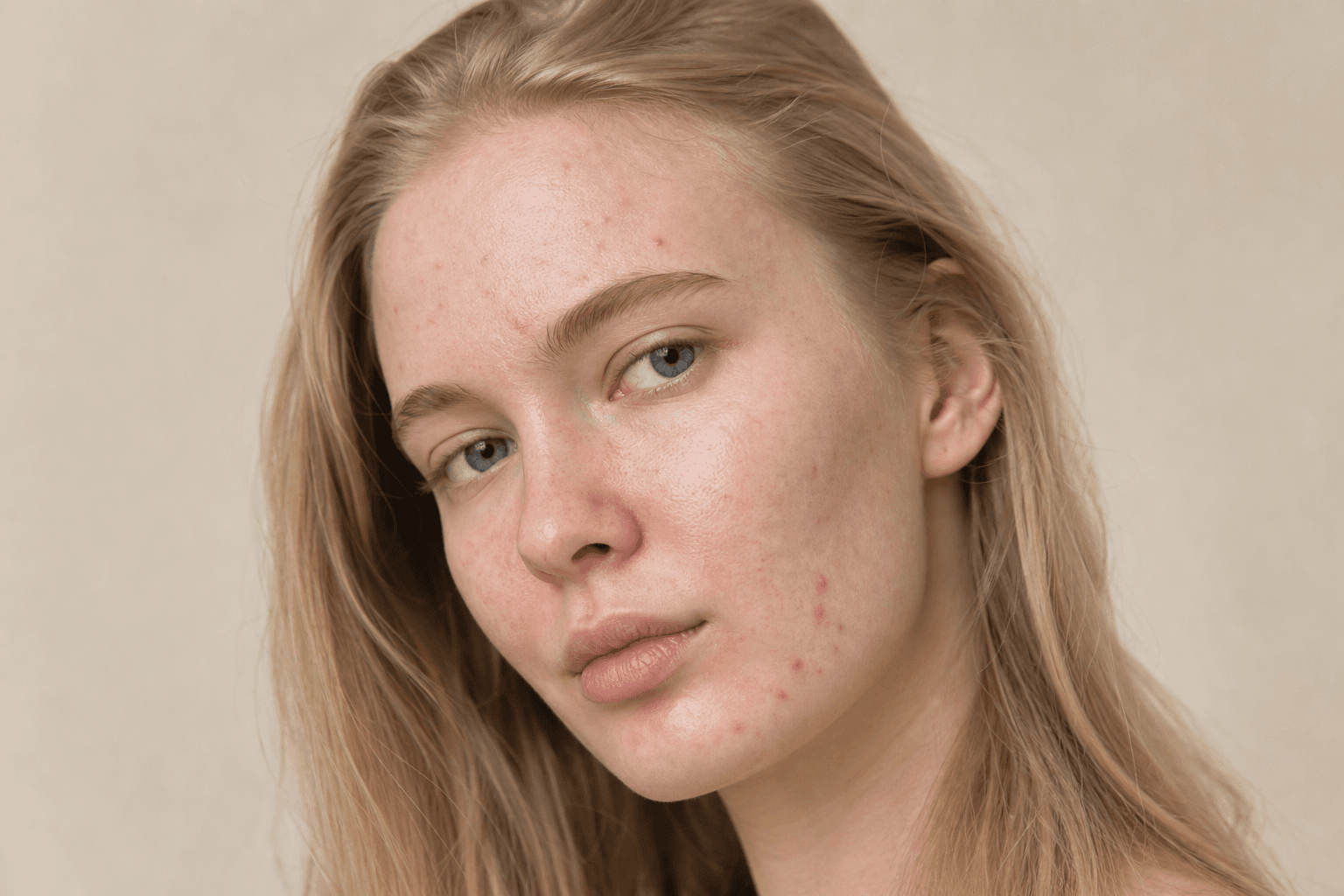
- bumps on cheeks, chin, forehead, or around the lips
- breakouts exactly where foundation, concealer, blush, primer, or lip balm sits
- skin that improves when you stop one product, then flares when it returns
If your acne is deep, painful, cystic, scarring, or linked to your cycle, makeup may still annoy it - but it is probably not the whole story.
Acne cosmetica is the calm name for this
Kligman and Mills described acne cosmetica in 1972[2] as acne linked to cosmetic exposure.
That does not mean "makeup is bad."
It means acne-prone skin can react when certain products repeatedly sit on areas where follicles clog easily. Foundation, concealer, blush, primer, lip balm, sunscreen, hair products, and rich skincare can all be part of the same residue story.
The useful question is not "Is makeup allowed?"
The useful question is: "Does this specific product leave my specific skin more clogged?"
Makeup is not guilty until proven annoying
This part matters.
A 2013 case-control study[3] of post-adolescent acne found that overall cosmetic use was negatively associated with acne, while some individual cosmetics had odds ratios above 1. In plain English: makeup as a category was not the villain. Some products were more suspicious than others.
That fits real life.
One foundation may be fine. Another may give you cheek bumps. A lip balm may clog around the mouth. A primer may turn your T-zone into a small texture project by Thursday. The product matters. The amount matters. Removal matters. Your skin matters.
The pattern usually gives it away
Makeup-related breakouts often appear where the product lives:
- Foundation or concealer: cheeks, chin, forehead, jaw
- Primer: oily T-zone, nose, inner cheeks
- Blush or bronzer: cheekbones and temples
- Lip balm or lipstick: around the mouth
- Eye makeup or remover: eyelids or under-eye irritation, not classic acne
- Makeup plus hair products: hairline and temples
If the bumps are mostly at the hairline, read the guide on hair products and breakouts. If they appear after SPF days, the sunscreen breakout guide is a better next read. If the pattern keeps landing on the cheeks, the guide to cheek pimples separates makeup from pillowcases, phones, hair products, and friction.
Your 4-week makeup audit
Do this like a test, not a punishment.
Step 1: Keep the rest of your routine stable
Do not change cleanser, moisturiser, SPF, exfoliation, pillowcase, diet, laundry detergent, shampoo, and foundation in the same week.
If everything changes, your skin cannot tell you which change mattered.
Keep your acne baseline boring:
- gentle cleanse
- one tolerated acne active, such as salicylic acid, if you already use it
- light moisturiser
- daily SPF
Step 2: Remove the most suspicious products
For 4 weeks, pause the makeup that sits on the breakout area:
- heavy foundation
- full-coverage concealer
- rich primer
- cream blush or bronzer if bumps sit on the cheeks
- waxy lip balm if bumps sit around the mouth
You do not need to throw anything away yet. Put it in skincare jail. Temporary custody.
Step 3: Choose lighter label language
The American Academy of Dermatology advises acne-prone makeup users to look for products labelled oil-free, won't clog pores, or non-comedogenic[4].
These labels are not perfect guarantees. They are filters.
For acne-prone skin, I would start with:
- oil-free or non-comedogenic base products
- thinner layers
- fewer complexion products on active breakout areas
- fragrance-free if your skin is also sensitive
- no shared makeup brushes or sponges
If you want the label nuance, the non-comedogenic dictionary entry explains why the finished formula matters more than one word on the tube. The new oil-free definition explains why oil-free and non-comedogenic are related but not identical.
The guide to cleaning makeup brushes covers washing the bristles, drying them flat and setting a regular cleaning reminder.
Step 4: Remove makeup before bed, gently
Sleeping in makeup is not a moral failure. It is a residue problem.
The AAD recommends removing makeup before bed and cleansing gently rather than scrubbing[4]. I like that wording because it keeps the fix practical: remove the film, do not sand the face.
Try:
- Remove makeup with a gentle, acne-friendly remover.
- Cleanse with lukewarm water and fingertips.
- Pat dry.
- Apply your usual simple moisturiser.
If you need double cleansing, keep both steps mild. The skin should feel clean, not disciplined.
When you can reintroduce makeup
If the breakout pattern improves, reintroduce one product at a time.
Give each product 1 to 2 weeks if your skin tolerates it. Start with the item you miss most. Use it on the smallest useful area. If bumps return in the same place, you have useful information.
This is slow. It is also much better than buying seven new "acne-safe" products and creating a new mystery.
When makeup is probably not the main cause
Makeup is less likely to be the main driver if:
- breakouts are deep, painful, or cystic
- acne appears on the chest, back, and face at the same time without makeup contact
- flares clearly follow menstrual cycles
- the skin has burning, rash, swelling, or itching
- breakouts continue despite a careful 4-week makeup audit
- you are getting scars or dark marks quickly
In those cases, see a qualified dermatologist. Makeup can still be adjusted, but medical acne care may matter more.
My final advice
You do not have to earn clear skin by giving up makeup forever.
Start calmer. Test one thing. Remove makeup properly. Choose labels that lower the odds of clogging, then let your actual skin be the judge. In my experience, the best routine is the one that helps you feel comfortable enough to live your life while still giving the skin fewer daily reasons to complain.
People also ask
Can makeup really cause acne?
Yes, some makeup can contribute to acne cosmetica in acne-prone skin. The usual clue is many small clogged bumps where the product sits, not one random pimple.
How long does makeup acne take to clear?
If the product is the main trigger, the pattern often improves over several weeks after you stop using it. AAD guidance notes that acne cosmetica can be delayed, so the test needs patience.
Should I stop wearing makeup if I have acne?
Not automatically. Choose lighter, non-comedogenic or oil-free products, remove them before bed, and keep acne treatment consistent.
Is mineral makeup better for acne-prone skin?
Sometimes, if the formula is lighter and less irritating for your skin. Mineral is not a guarantee. The finished product and your skin's response matter most.
Keep reading
- Ingredient · salicylic acid
- Ingredient · niacinamide
- Ingredient · dimethicone
- Ingredient · silica
- Ingredient · decyl glucoside
- Condition · acne and blemishes
- Condition · blackheads
- Condition · oily skin
- Condition · sensitive skin
- Read · are hair products breaking you out
- Read · why do i break out after sunscreen
- Read · why do i get pimples on my cheeks
- Read · best skincare routine for clogged pores
- Read · how to get rid of pimples
- Read · what are blackheads
Citations
- Williams HC, Dellavalle RP, Garner S. Acne vulgaris. Lancet. 2012;379(9813):361-372.PMID 21880356
- Kligman AM, Mills OH Jr. Acne cosmetica. Arch Dermatol. 1972;106(6):843-850.PMID 4264346
- Singh S, Mann BK, Tiwary NK. Acne cosmetica revisited: a case-control study shows a dose-dependent inverse association between overall cosmetic use and post-adolescent acne. Dermatology. 2013;226(4):337-341.PMID 23859829
- American Academy of Dermatology. I have acne! Is it okay to wear makeup?AAD