
Why does salicylic acid make my skin dry?
Salicylic acid can make skin dry because it loosens built-up cells inside pores and on the surface. Useful for clogged pores, annoying when the barrier is already tired.
On this page
I learned the hard way that oily, acne-prone skin can still get dry.
When I had acne, salicylic acid felt like the clever ingredient. It went into pores. It helped blackheads. It sounded more precise than simply hoping my face would behave. So when my skin started feeling tight, I assumed I had found proof that it was working.
Not my finest logic.
After helping more than 100,000 people with problem skin, I see the same pattern again and again: people use a good acne ingredient too often, the barrier gets irritated, and then the skin looks both clogged and dry. Very unfair. Also very common.
The short answer
Salicylic acid can make your skin dry because it loosens the bonds between built-up surface cells and helps clear clogged pores.
A review of salicylic acid as a peeling agent describes it as a desmolytic ingredient - meaning it disrupts the connections between cells in the stratum corneum - and notes its comedolytic usefulness for acne-prone skin[1]. In normal bathroom language: it helps loosen the stuff that makes pores look congested.
That same useful action can become irritating when:
- you use it too often
- your cleanser already leaves skin tight
- you combine it with retinoids, scrubs, benzoyl peroxide, or other acids
- you skip moisturiser because the skin is oily
- your barrier was already stressed before the BHA arrived
Salicylic acid is not bad because it dries your skin. Dryness is a dosing message.
Why a pore ingredient can dry the surface
Salicylic acid is loved because it is oil-soluble and useful around clogged pores, blackheads, and mild acne patterns. Acne guidelines describe acne as a follicle disease involving clogged follicles, sebum, Cutibacterium acnes, and inflammation[2]. That is why a pore-focused ingredient can make sense.
But your pores do not live in a separate apartment from your barrier.
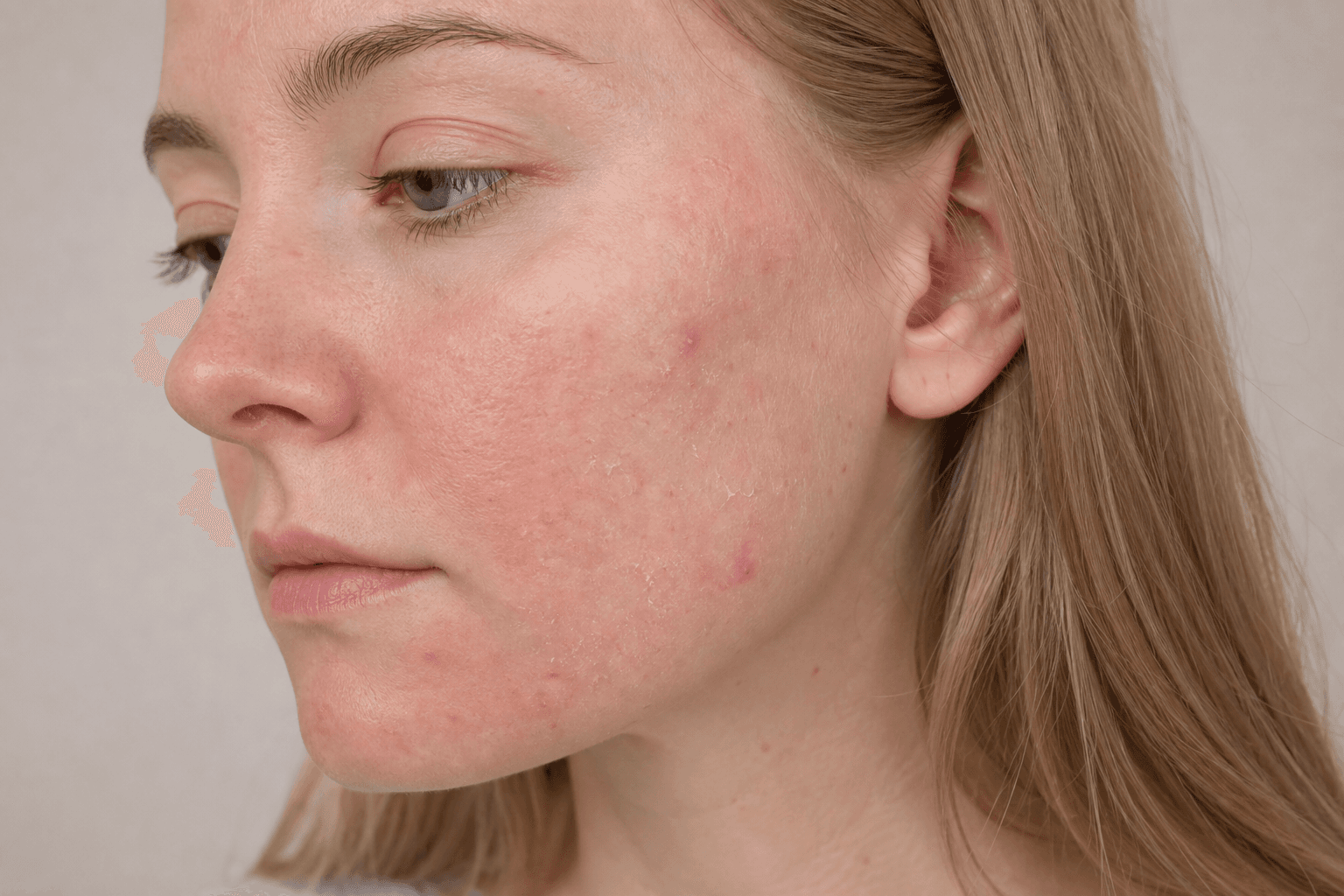
The same face that needs help with blackheads may also need hydration, lipids, and fewer experiments. If salicylic acid keeps loosening surface cells while the routine gives the barrier no support, the skin starts to feel:
- tight after washing
- flaky around the nose, mouth, or chin
- shiny but uncomfortable
- stingy when moisturiser goes on
- redder after cleansing
That is the point where "more treatment" usually becomes the problem.
Normal dryness or a stop sign?
Use this split:
| What you notice | What it often means | What to do |
|---|---|---|
| Light dryness for a few days | Skin adjusting to a new exfoliant | Reduce frequency and moisturise |
| Flaking around active areas | Too much exfoliation for your current barrier | Use fewer BHA nights |
| Burning or sharp stinging | Irritation, not useful progress | Pause salicylic acid |
| Moisturiser suddenly stings | Barrier is stressed | Focus on barrier repair |
| Redness that builds each use | Formula, frequency, or routine is too strong | Stop and simplify |
A 2023 barrier review[3] explains moisturisation through barrier structure, water-binding ingredients, lipids, and reduced water loss. That is why the fix for salicylic-acid dryness is rarely another stronger acne step. The fix is often boring: fewer active nights and better moisturising.
Boring gets a bad reputation in skincare. Boring is often where the face exhales.
Can you use salicylic acid on dry or sensitive skin?
Yes, sometimes. Dry skin can still have blackheads or clogged pores, and salicylic acid may help when you use it selectively rather than treating every centimetre of your face.
Start once weekly on the congested area, moisturise, and judge the next morning. If your skin stays comfortable, you can slowly increase. If it burns, reddens, or keeps peeling, stop and let the barrier recover. “Dry skin” is not an automatic ban on BHA; it is a reason to use a smaller dose and a calmer schedule.
The pH and cleanser problem
Salicylic acid dryness is not always caused by salicylic acid alone.
Healthy skin surface pH is part of normal barrier function. Proksch's 2018 review[4] explains that skin pH influences barrier enzymes, shedding, and microbial balance. If your cleanser already leaves the skin squeaky and tight, a leave-on acid can feel harsher than it would in a calmer routine.
This is why I always ask the unglamorous questions:
- Does your face feel tight after cleansing?
- Are you using salicylic acid every day because the bottle allows it?
- Are you also using retinol, vitamin C, scrubs, or peeling masks?
- Do you moisturise after BHA, or do you avoid moisturiser because you are scared of shine?
- Is the skin dry everywhere, or only where you apply the acid?
If your skin burns when you apply normal cream, read the guide on why moisturiser stings. At that stage, the problem is bigger than BHA technique.
How often to use salicylic acid when skin gets dry
Start lower than your impatience wants.
For many people, a better rhythm is:
- Use salicylic acid one to three nights per week.
- Apply it to breakout-prone or clogged areas, not automatically the whole face.
- Moisturise after it has settled.
- Keep other strong actives on separate nights at first.
- Increase only if the skin stays comfortable.
If your skin is oily in the T-zone and dry on the cheeks, apply salicylic acid only where the clogs live. Your cheeks do not need to attend every meeting.
The guide on oily and dry skin at the same time goes deeper on that split routine.
What to pair with salicylic acid
Think support, not a product pile.
Good partners are:
- Niacinamide for barrier and sebum-supportive routines.
- Glycerin for simple water-binding comfort.
- Panthenol when the skin feels easily annoyed.
- A plain moisturiser you can use every day without stinging.
- SPF in the morning, especially if acne marks or redness are part of the problem.
You do not need a separate serum for every bullet. A well-built cleanser, treatment, moisturiser, and SPF routine is enough for most people.
When to pause salicylic acid completely
Pause BHA for now if:
- your skin is peeling in sheets
- moisturiser burns
- the face feels hot, raw, or tight all day
- redness is getting worse
- you recently over-exfoliated
- you are starting a retinoid and your skin is already irritated
Use the barrier repair guide if your skin feels overworked. Then come back to salicylic acid later at a calmer rhythm.
No ingredient becomes more effective because you endured it while your skin was irritated.
The practical takeaway
Salicylic acid is useful when the problem is clogged pores, blackheads, and acne-prone congestion. It becomes annoying when the routine turns it into a daily dare.
Use less. Moisturise more consistently. Keep the cleanser gentle. Let the skin tell you whether the rhythm is working.
Clearer pores are nice. Calm skin is the reason you can keep going long enough to see them.
People also ask
Is dryness from salicylic acid normal?
Mild dryness can happen when you start salicylic acid. Strong tightness, burning, peeling, or redness means you should reduce frequency or pause while the barrier calms.
Should I moisturise after salicylic acid?
Yes. A simple moisturiser helps keep the barrier comfortable while salicylic acid works on clogged pores. Drying the skin out is not the goal.
How often should I use salicylic acid if my skin gets dry?
Start with one to three nights per week, then adjust by comfort. If normal moisturiser stings or the skin flakes, pause salicylic acid until the skin feels calm again.
Can salicylic acid damage my skin barrier?
Overuse can irritate the barrier, especially when combined with strong cleansers, retinoids, scrubs, or other acids. Used at a tolerable rhythm, it can still be useful for clogged pores.
Is salicylic acid good for dry or sensitive skin?
It can be useful when dry or sensitive skin also has blackheads or clogged pores, but use a low frequency, apply only where needed, and moisturise. Burning, persistent redness, or peeling means pause rather than push through.
Keep reading
- Ingredient · salicylic acid
- Ingredient · niacinamide
- Ingredient · glycerin
- Ingredient · panthenol
- Ingredient · beta glucan
- Ingredient · urea
- Condition · sensitive skin
- Condition · acne and blemishes
- Condition · blackheads
- Condition · oily skin
- Read · how to repair skin barrier after over exfoliating
- Read · why does my skin burn when i apply moisturizer
- Read · why is my skin oily and dry at the same time
- Read · what are blackheads
- Read · blackheads removal
- Read · how to get rid of oily skin
Citations
- Arif T. Salicylic acid as a peeling agent: a comprehensive review. Clin Cosmet Investig Dermatol. 2015;8:455-461.PMID 26347269
- Zaenglein AL, et al. Guidelines of care for the management of acne vulgaris. J Am Acad Dermatol. 2016;74(5):945-973.e33.PMID 26897386
- The Skin Barrier and Moisturization: Function, Disruption, and Mechanisms of Repair. Skin Pharmacol Physiol. 2023.PMID 37717558
- Proksch E. pH in nature, humans and skin. J Dermatol. 2018;45(9):1044-1052.PMID 29863755