Why does my face get red after exercise?
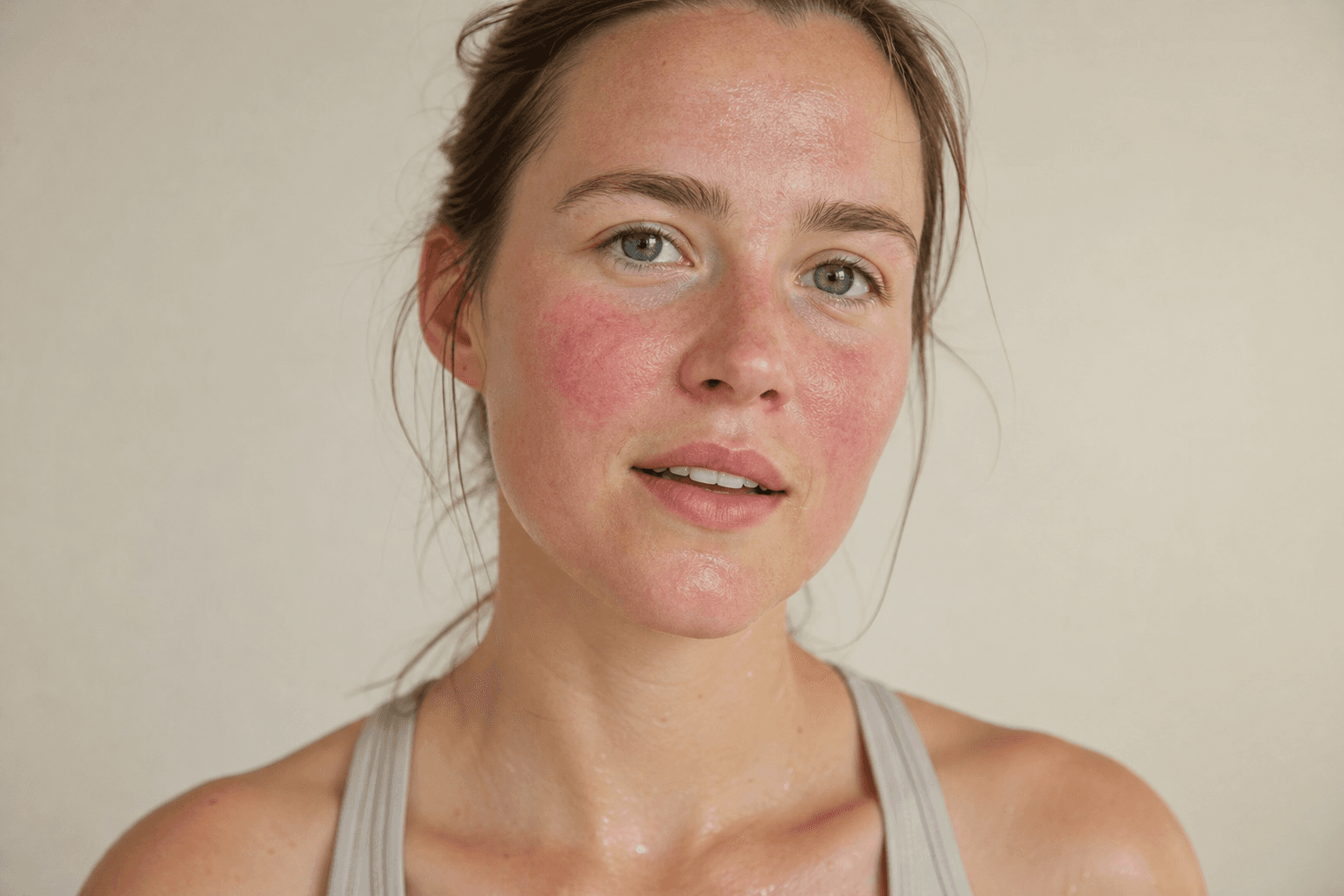
A red face after exercise is usually normal heat regulation. If the redness burns, lingers, or behaves like a rosacea flare, the goal is to cool the routine down - not stop moving.
On this page
When my skin was acne-prone and irritated, exercise gave me two very different feelings.
My head felt better. My face sometimes looked like it had joined a tomato appreciation club.
That does not mean exercise is bad for your skin. It means the skin on your face is very good at showing heat, friction, sweat, and irritation. After helping more than 100,000 people with problem skin, I have seen this pattern often: people quit good habits because their skin reacts loudly, when the calmer move is usually to adjust the habit.
The short answer
Your face gets red after exercise because exercise raises body temperature and increases blood flow to the skin.
That is normal cooling biology. The face is also full of visible small blood vessels, so flushing can show up quickly - especially on fair, sensitive, or rosacea-prone skin.
In rosacea, the same redness can be more reactive. A rosacea review describes increased facial blood flow, vasodilation, and neurovascular dysregulation as part of why flares can look so red[1]. In bathroom language: the blood vessels are not always subtle.
Normal exercise flush or rosacea flare?
Use this split:
| What happens | What it often means | What to do |
|---|---|---|
| Redness appears during exercise and fades within 30-60 minutes | Normal heat flushing | Cool down gently |
| Redness burns, stings, or feels hot long after training | Sensitive or rosacea-prone reactivity | Lower heat and intensity next time |
| Redness appears with bumps or rough irritation | Sweat, friction, sunscreen, or rosacea overlap | Simplify the post-workout routine |
| Redness mainly follows hot showers after training | Heat trigger | Read the red face after shower guide |
| Redness is new, severe, one-sided, or comes with feeling unwell | Not a routine problem | Speak with a clinician |
The key question is not "Did my face turn red?" It is "How long did it last, and did it feel angry?"
Why exercise can be a rosacea trigger
Exercise can trigger redness because it stacks several flush triggers at once:
- body heat rises
- heart rate rises
- sweat sits on the skin
- outdoor workouts add UV and wind
- helmets, hats, masks, or collars add friction
- sunscreen or makeup may mix with sweat
A 2015 study in people with rosacea found stronger sympathetic nerve activity during physical stress and faster sweating and cutaneous vasodilation during heat stress compared with controls[2]. That helps explain why one person gets a healthy glow, while another gets a red face that feels hot for hours.
Annoying? Yes. A moral failure? Absolutely not.
How to exercise with less facial redness
You do not need to become an indoor plant.
Try these first:
- Train cooler. Use a fan, air conditioning, shade, or early morning outdoor sessions.
- Lower the peak intensity. A slightly easier workout you repeat beats one heroic session that makes your skin flare for two days.
- Split the workout. Two shorter sessions can be kinder than one long heat build-up.
- Cool the neck. A cold damp towel on the neck often helps more than attacking the face.
- Drink cold water. Simple, boring, useful.
- Skip hot showers right after. Let the face cool before warm water enters the chat.
The American Academy of Dermatology gives similar rosacea advice: avoid overheating, exercise where it is cool, lower the intensity when needed, and use cooling supplies like cold water or a cool towel[3].
What to do with your skin after a workout
Wait until the face has cooled a little. Then keep it plain:
- Rinse or cleanse gently if you are sweaty or wearing sunscreen.
- Use lukewarm water, not hot water.
- Pat dry. No scrubbing towel performance.
- Apply a simple moisturiser if the skin feels tight.
- Use sunscreen again if you are going back outside.
If your main issue after training is clogged pores or body breakouts, read how to prevent workout breakouts. That is more about sweat, friction, and acne mechanics. Exercise redness is more about heat and blood flow, though the two can overlap.
What not to do to a hot red face
Please do not punish the skin because it flushed.
Avoid:
- strong acid toners immediately after exercise
- scrubs
- cleansing brushes
- ice directly on the skin
- fragranced "cooling" products that sting
- re-washing the face several times
- assuming every flush means you need a new active ingredient
A skin-barrier review explains that moisturisation depends on barrier structure, water-binding ingredients, lipids, and reducing water loss[4]. A flushed, sweaty, hot face usually needs less drama: cool, cleanse gently if needed, moisturise, stop.
When sunscreen matters
Outdoor exercise adds another layer: UV exposure.
If you have rosacea, pigmentation, or post-acne marks, sunscreen is part of keeping redness and marks from lingering. If SPF seems to irritate or break you out, do not quit sun protection immediately. Start with the guide on why sunscreen breaks you out and adjust texture, cleansing, and timing.
For rosacea-prone skin, the sunscreen for rosacea guide goes deeper on choosing an SPF that does not make the face feel like it is arguing back.
The practical takeaway
A red face after exercise is usually your cooling system doing its job.
If the redness is intense, painful, or slow to fade, treat it like a heat-management problem before treating it like a skincare-product problem. Cooler workouts. Shorter peaks. Gentler cleansing. Less bathroom panic.
You are allowed to move your body and protect your skin at the same time. The routine should make that easier, not turn exercise into another thing to fear.
People also ask
Is a red face after exercise normal?
Often, yes. Exercise raises body temperature, and the face can flush as blood flow helps release heat. It is more concerning if the redness burns, stings, lasts for hours, or comes with rosacea symptoms.
How do I stop my face from getting so red when I work out?
Reduce overheating: train in a cooler place, lower the intensity, split workouts into shorter blocks, use a fan, drink cold water, and cool the neck and face gently afterward.
Does exercise make rosacea worse?
For many people with rosacea, heat and strenuous exercise can trigger flushing. That does not mean you should avoid exercise; it means the workout may need better cooling and pacing.
Should I wash my face immediately after exercise redness?
If there is sweat, sunscreen, or makeup, cleanse gently once the skin has cooled a little. Avoid hot water, scrubs, and strong acids on a flushed face.
Keep reading
- Ingredient · niacinamide
- Ingredient · panthenol
- Ingredient · glycerin
- Ingredient · zinc oxide
- Ingredient · allantoin
- Condition · rosacea
- Condition · sensitive skin
- Condition · acne and blemishes
- Read · redness after shower
- Read · rosacea triggers
- Read · rosacea skincare routine
- Read · how to prevent workout breakouts
- Read · best sunscreen for rosacea
Citations
- Del Rosso JQ. Advances in Understanding and Managing Rosacea: Part 1. J Clin Aesthet Dermatol. 2012;5(3):16-25.PMID 22468176
- Metzler-Wilson K, et al. Augmented supraorbital skin sympathetic nerve activity responses to symptom trigger events in rosacea patients. J Neurophysiol. 2015;114(3):1530-1537.PMID 26133800
- American Academy of Dermatology Association. How to prevent rosacea flare-ups.AAD
- The Skin Barrier and Moisturization: Function, Disruption, and Mechanisms of Repair. Skin Pharmacol Physiol. 2023.PMID 37717558