
Keratosis pilaris on the face: how to calm rough cheek bumps
Facial keratosis pilaris can look like acne, redness, or stubborn dry texture. Learn the clues, a gentle cheek routine, and when a dermatologist should check it.
On this page
Rough cheeks can make stronger cleansing seem like the obvious next step. Before adding a scrub or leaving a cleanser on longer, look at the kind of bumps you have. Small, uniform bumps on dry cheeks call for a different assessment from blackheads or painful spots.
More cleansing cannot establish the diagnosis. The pattern, symptoms and presence of similar bumps elsewhere are more useful clues.
Facial keratosis pilaris creates the same trap. The cheeks feel rough, the dots look red or brown, and the obvious response seems to be scrubbing them smooth. That response usually adds irritation without changing the follicle plug underneath.
The short answer
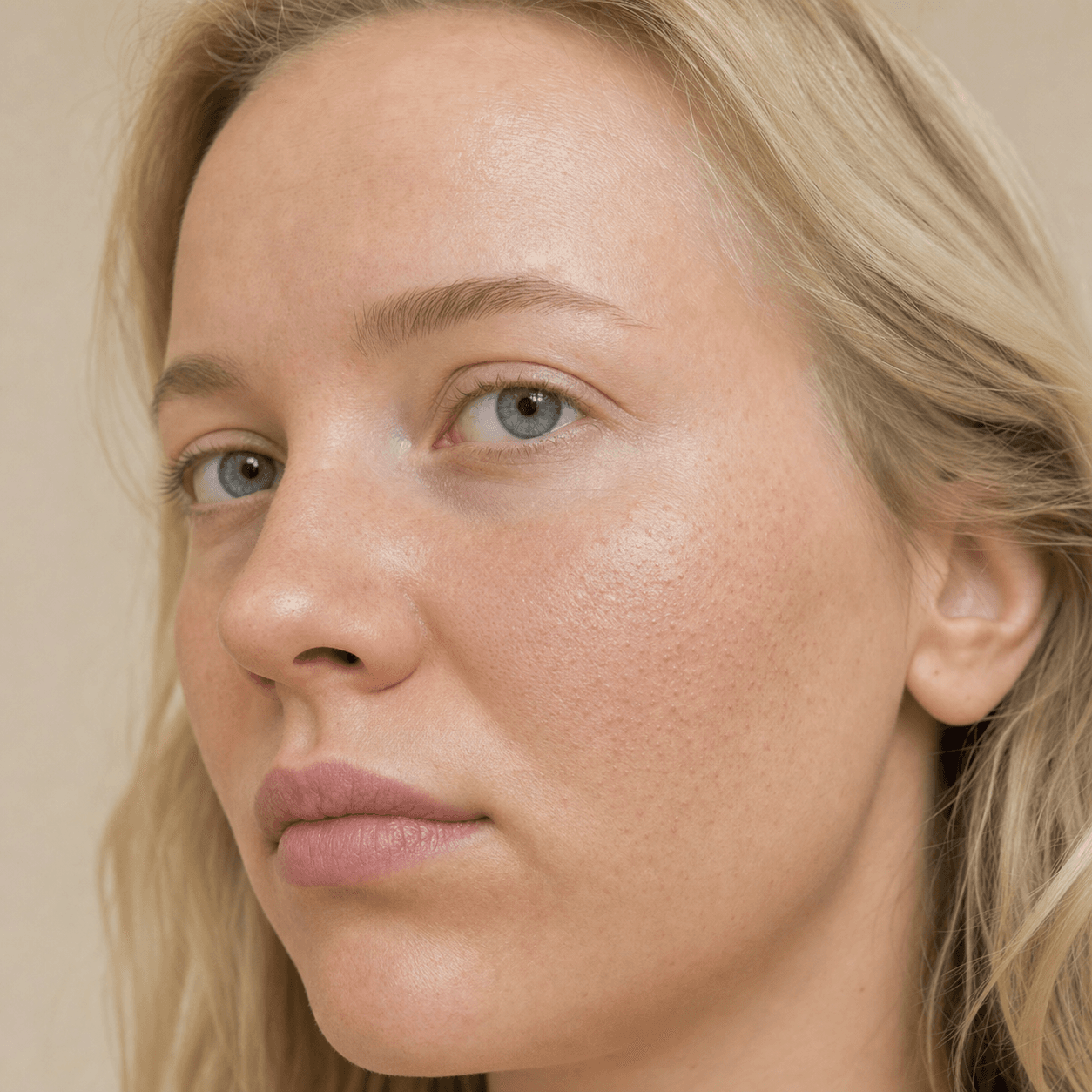
Keratosis pilaris can appear on the face, most often as many tiny, uniform, rough bumps on the cheeks.
The bumps form around hair follicles and may be skin-coloured, red, reddish-brown, or darker than the surrounding skin. A 2023 clinical update describes KP as a follicular hyperkeratotic condition with variable redness around each follicle[1]. In ordinary language, keratin builds a small plug where a fine hair exits.
Facial KP is harmless in its common form. It is not contagious, and it does not mean the face is dirty. A gentle routine can soften the texture, but the tendency may return when treatment stops.
How facial KP differs from acne
Both conditions involve follicles, so the mirror can be unhelpfully vague.
Facial KP usually has:
- lots of small bumps with similar size and shape
- a dry or sandpapery feel
- a concentration on the outer cheeks
- little or no pus
- matching KP on the upper arms or thighs
Acne more often brings:
- blackheads and whiteheads
- oily congestion
- bumps at several stages
- tender papules, pustules, or deeper spots
- a pattern across the forehead, jaw, chest, or back
You can have both. You can also have rosacea, eczema, folliculitis, or another condition that looks bumpy. If the skin burns, flushes, forms pustules, or changes quickly, guessing with acids is a poor diagnostic system. A qualified dermatologist can examine the pattern properly.
Why cheeks need a gentler plan than arms
The logic behind facial and body KP is similar: hydrate the surrounding skin and loosen stubborn keratin gradually. The dose and frequency should change.
Cheek skin is exposed to cleansing, weather, makeup, shaving, and whatever active product seemed persuasive last Tuesday. It also sits near the eyes and lips. A strong body lotion that works well on upper arms can sting badly on the face.
The 2022 systematic review of KP treatments found support for several topical and device-based approaches, but studies used different methods and outcomes[2]. There is no single universally best product. Tolerability and maintenance matter.
A simple facial KP routine
Morning
Cleanse only if you need to. Use lukewarm water and fingertips, not a brush or textured cloth.
Apply a moisturiser that leaves the cheeks comfortable rather than greasy or tight. If the face will be exposed outdoors, finish with sunscreen. Sun protection is not a KP treatment, but it helps prevent irritated or picked bumps from leaving more noticeable colour.
Evening
Remove makeup or sunscreen with low friction. Moisturise, then decide whether the skin is calm enough for one smoothing ingredient.
Useful options include:
- Urea, which hydrates and softens keratin depending on concentration.
- Lactic acid or ammonium lactate, which combine hydration with gradual surface smoothing.
- Salicylic acid, useful when clogged pores overlap with the rough texture.
- Retinol, which can influence cell turnover but needs a slow introduction.
Choose one. Start two evenings per week. If the cheeks become persistently sore, shiny-tight, flaky, or suddenly reactive to plain moisturiser, pause the active and return to the baseline routine.
The general keratosis pilaris routine explains body treatment in more detail. Do not copy body strength and frequency directly onto your face.
What to stop doing
Scrubs, cleansing brushes, picking, and repeated acid layering make the surface feel busy without guaranteeing a better result.
Heavy creams are not automatically a cause either. If one product repeatedly seems to make cheek bumps worse, test a lighter formula for a few weeks. Do not turn that observation into a permanent ban on every oil, balm, or occlusive ingredient. Finished formulas behave differently.
Try not to chase redness and texture with separate aggressive treatments at the same time. A smoother cheek that now burns is not a win.
When it may be more than ordinary facial KP
Common facial KP should not cause scarring or hair loss.
A rare condition called keratosis pilaris atrophicans faciei can involve inflamed follicular bumps around the cheeks, forehead, chin, and eyebrows, followed by thinning at the outer eyebrows. A 2021 observational study describes that pattern and its early onset[3]. This is not a reason to panic over ordinary cheek texture. It is a reason to get professional care if eyebrow hair is disappearing, pits or scars are developing, or the pattern began unusually early and is progressing.
See a dermatologist as well when bumps are painful, pus-filled, crusted, intensely itchy, spreading fast, or unchanged after 8 to 12 weeks of a gentle routine. Diagnosis matters more than finding a stronger exfoliant.
The realistic goal
Facial KP can soften. Redness may settle. Makeup may sit more comfortably. The skin may still keep a little texture, because human cheeks are not laminate flooring.
Aim for calmer follicles and a routine you can repeat. Over the last 15 years, helping more than 100,000 people with problem skin has taught me that the plan people tolerate usually beats the plan that looks most impressive on paper.
Start small, watch the response, and let a dermatologist take over when the pattern stops looking like ordinary KP.
People also ask
Can keratosis pilaris appear on the face?
Yes. Facial KP often appears as many small, rough follicle bumps on the cheeks, sometimes with surrounding redness or brown discoloration. It is especially common in children and younger people.
Is facial keratosis pilaris acne?
No. KP is a keratin-plugging condition, while acne more often includes blackheads, whiteheads, inflamed pimples, and oily congestion. The two can coexist, so persistent uncertainty deserves a professional diagnosis.
What should I use on keratosis pilaris on my cheeks?
Start with gentle cleansing and moisturiser. Add one low-frequency keratolytic such as urea, lactic acid, salicylic acid, or a retinoid only if the skin stays comfortable.
When should facial bumps be checked by a dermatologist?
Get help for pain, pus, crusting, rapid spread, scarring, loss of eyebrow hair, severe itch, eye symptoms, or bumps that do not match the usual uniform KP pattern.
A calmer routine for rough cheek bumps
Facial KP rarely benefits from a crowded shelf. I built the Danish Skin Care Kit around a few repeatable steps, so you can support moisture and test one smoothing active without turning every evening into an experiment.

A simple facial baseline with gentle cleansing, salicylic acid, moisturiser, retinol, and daytime protection. Introduce the active steps slowly when cheek skin is reactive.
Full transparency: Danish Skin Care is my own company — I formulated these products and earn from every sale. That's exactly why I only recommend them where they genuinely fit the guide you just read.
Keep reading
- Ingredient · ammonium lactate
- Ingredient · urea
- Ingredient · lactic acid
- Ingredient · salicylic acid
- Ingredient · retinol
- Condition · keratosis pilaris
- Condition · sensitive skin
- Condition · dry skin
- Condition · rosacea
- Condition · acne and blemishes
- Read · how to get rid of keratosis pilaris
- Read · keratosis pilaris on arms
- Read · keratosis pilaris on legs
- Read · how to repair skin barrier after over exfoliating
- Read · rosacea acne
Citations
- Kodali N, Patel VM, Schwartz RA. Keratosis pilaris: an update and approach to management. Ital J Dermatol Venerol. 2023;158(3):217-223. doi:10.23736/S2784-8671.23.07594-1.PMID 37166753
- Maghfour J, Ly S, Haidari W, Taylor SL, Feldman SR. Treatment of keratosis pilaris and its variants: a systematic review. J Dermatolog Treat. 2022;33(3):1231-1242.PMID 32886029
- Fekete GL, Fekete L, Neagu N, Bacârea V, Drăgănescu M, Brihan I. Keratosis pilaris atrophicans faciei: An observational, descriptive, retrospective clinical study. Exp Ther Med. 2021;22(5):1331. doi:10.3892/etm.2021.10766.PMID 34630685