
Keratosis pilaris on arms: how to smooth bumpy upper arms
Bumpy upper arms are one of the classic keratosis pilaris patterns. Here is how to soften arm KP without harsh scrubs, picking, or a routine you abandon after four days.
On this page
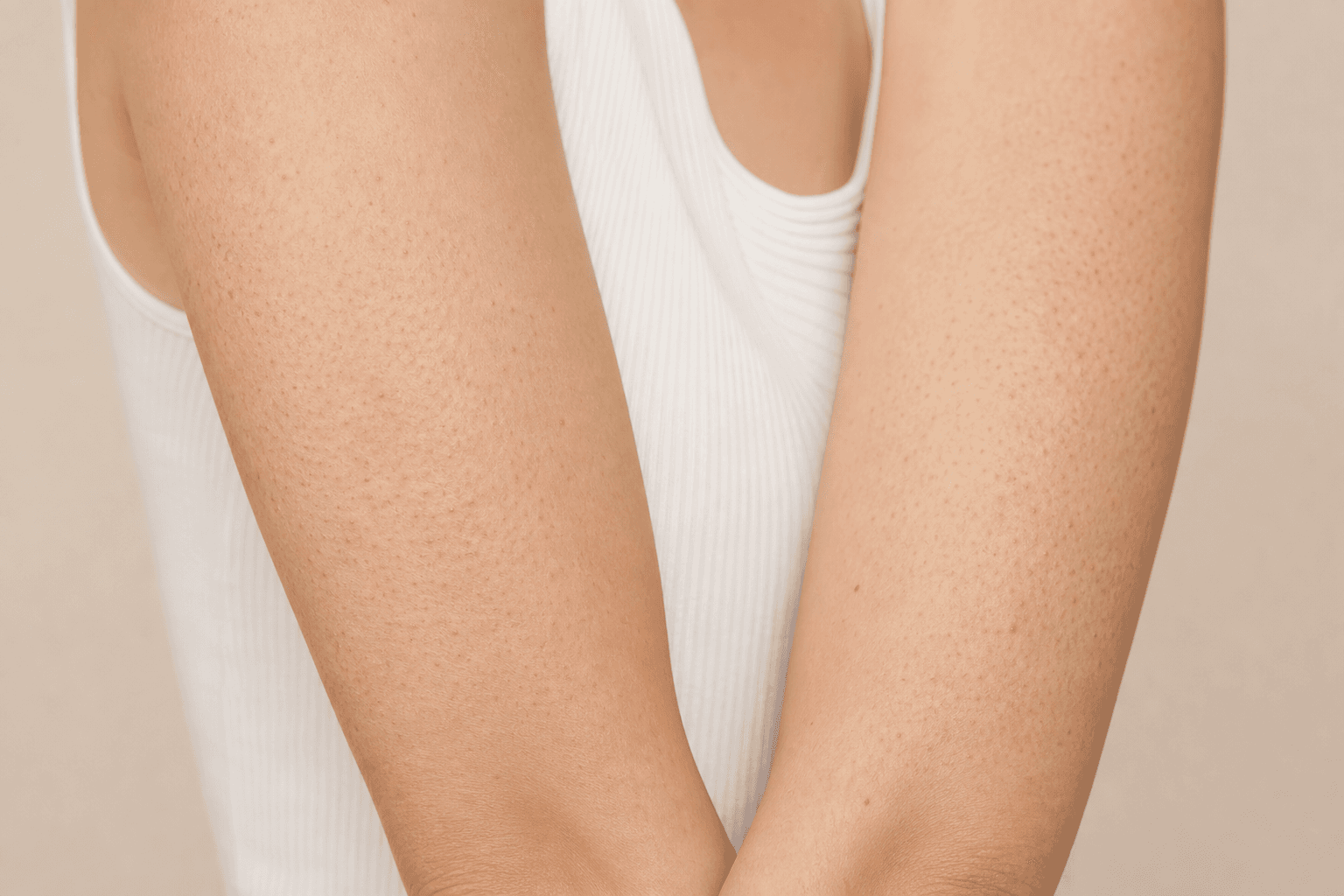
Keratosis pilaris on arms is one of those skin things people notice in tiny, ordinary moments.
You put on a T-shirt. You cross your arms. Someone rests their hand on your shoulder. Then suddenly your brain says, "Hello, we are now thinking about upper-arm texture."
I know that kind of skin awareness from acne. The problem is not always pain. Often it is the background noise. The feeling that your skin is quietly taking up more mental space than it deserves.
With arm KP, the good news is simple: the bumps are usually harmless. The annoying news is also simple: they are stubborn, and they do not respond well to force.
The short answer
Keratosis pilaris on arms is usually caused by tiny keratin plugs inside hair follicles on the backs or outer sides of the upper arms.
A 2008 clinical overview[1] describes KP as a common inherited follicular hyperkeratosis, most often on the upper arms, upper legs, and buttocks. In normal-person language: the follicle gets plugged with keratin, and the skin feels like permanent goosebumps.
To smooth bumpy arms:
- Stop scrubbing.
- Moisturise the upper arms every day, especially after showering.
- Add a keratolytic such as urea, lactic acid, salicylic acid, or glycolic acid a few nights per week.
- Reduce tight sleeve friction.
- Use SPF when arms are exposed.
- Judge progress after 8 to 12 weeks, not 8 to 12 minutes.
That last point is where most routines fail. KP is slow. The bathroom mirror is impatient.
Why the upper arms get KP so often
The backs of the upper arms are classic KP territory because the area has many hair follicles and often runs dry.
Dryness matters because rough, dehydrated surrounding skin makes each follicle plug feel sharper. The bump may be tiny, but dry skin gives it a better stage.
Arm KP can look like:
- Tiny skin-coloured bumps.
- Red or pink dots around follicles.
- Brown or darker follicular marks on deeper skin tones.
- Rough patches that feel sandpapery.
- Small bumps that look like acne but do not behave like acne.
It is common to have both KP and acne-prone skin in different places. But KP on arms is not the same as body acne. Acne usually includes oilier clogged pores, inflamed pimples, whiteheads, blackheads, or deeper spots. KP is more uniform and rough.
If every bump looks identical, feels rough rather than tender, and sits mostly on the backs of the upper arms, KP is a strong possibility.
The mistake: treating arms like they need sanding
I understand why people scrub arm KP. The bumps feel physical. A physical problem seems to demand a physical solution.
But the plug is inside the follicle, not sitting politely on top of the skin waiting for a loofah.
Rough mitts, gritty scrubs, dry brushing, and aggressive towels can:
- Increase redness around each bump.
- Dry out the surrounding skin.
- Trigger itching.
- Create tiny scratches.
- Make post-inflammatory marks linger longer.
Your arms may feel smoother for half a day because the surface is freshly buffed. Then the dryness catches up and the follicle plugs remain.
That is a bad trade.
The arm KP routine
Step 1: Shower less dramatically
Hot water makes rough arm texture worse for many people because it strips surface lipids and dries the skin.
Keep showers lukewarm. Wash the arms gently. Skip rough body tools. If your cleanser leaves the skin tight, squeaky, or itchy, it is probably too aggressive for a KP routine.
Squeaky clean is not a skincare goal. It is a sound effect.
Step 2: Moisturise while the arms are damp
This step does more than people expect.
After showering, pat the arms so they are not dripping, then apply moisturiser while the skin is still slightly damp. Look for ingredients that hydrate and soften rough texture:
- Urea, especially useful when roughness is the main issue.
- Glycerin and sodium hyaluronate for hydration.
- Squalane or other emollients for softness.
- Panthenol and allantoin for comfort support.
If you do nothing else for two weeks, do this. You want the arm skin less dry before you add active exfoliation.
Step 3: Add one active slowly
Once the arms are comfortable, add a keratolytic 2 or 3 nights per week.
A 2015 KP study[2] found that both 10% lactic acid and 5% salicylic acid creams improved KP over 12 weeks. That does not mean every arm needs those exact strengths, twice daily, forever. It means chemical softening can help when the skin tolerates it.
Good options:
- Lactic acid if the arms are dry and rough.
- Urea if you want hydration plus texture support.
- Salicylic acid if the bumps feel more clogged or follicular.
- Glycolic acid if your arm skin is resilient and not easily irritated.
Pick one. Use it consistently. Do not layer three exfoliants because you are in a short-sleeve emergency.
Step 4: Protect exposed arms
If your upper arms see daylight, use SPF.
This matters more when you use acids or retinoid-adjacent products, but it also matters for marks. Red, brown, or purple-looking spots after inflammation can linger longer with UV exposure.
You do not need to become afraid of the sun. You need the boring habit: sunscreen on exposed skin, especially during summer.
How often should you treat arm KP?
Most arm routines do best with a rhythm like this:
- Daily: moisturise after showering.
- 2 nights per week: active treatment at first.
- 3 to 4 nights per week: only if skin stays calm.
- Daily active use: only if the formula is gentle and your arms clearly tolerate it.
If the skin stings, burns, flakes, or looks shinier and angrier, reduce frequency. More treatment is not better when the barrier is annoyed.
What if the bumps are red?
Red arm KP often means there is inflammation around the follicle, irritation from friction, dryness, picking, or a subtype with more visible redness.
A 2022 systematic review[3] found that topical treatments can improve KP appearance, but outcomes vary. That is important when redness is the main issue. Texture may improve before colour fully calms.
For red arm KP:
- Avoid scrubs completely.
- Choose fragrance-free body products.
- Keep active nights modest.
- Moisturise daily.
- Reduce tight sleeve friction.
- Use SPF on exposed arms.
If redness is intense, painful, hot, or spreading, do not assume it is normal KP. Get it checked.
Arm KP or something else?
KP is common, but not every upper-arm bump is KP.
It may be:
- Body acne, if there are inflamed pimples, whiteheads, blackheads, or tender spots.
- Folliculitis, if bumps are itchy, pustular, very uniform, or worsen after sweating.
- Eczema, if patches are itchy, scaly, cracked, or weeping.
- Contact irritation, if the pattern matches a product, detergent, perfume, or fabric.
If the routine for KP makes things worse, pause. The skin may be telling you the label is wrong.
The 12-week upper-arm plan
Weeks 1 to 2
Stop scrubs, dry brushing, and hot water.
Moisturise damp arms daily. Wear softer, looser sleeves when possible. Do not pick. If the skin already looks red or itchy, keep the routine this simple for the full two weeks.
Weeks 3 to 6
Add one keratolytic 2 nights per week.
Use a thin layer on the bumpy area. Moisturise on the other nights. If the arms tolerate it, increase to 3 nights per week.
Weeks 7 to 12
Keep the routine stable.
Look for softer texture, fewer sharp-feeling bumps, and less angry redness. Do not judge by one close-up mirror inspection. Arm KP improves gradually, and the skin will have good and bad texture days.
The bottom line
Keratosis pilaris on arms is common, harmless, and frustrating because it sits exactly where short sleeves make it visible.
The best plan is not a harder scrub. It is daily moisture, gentle chemical softening, less friction, SPF when exposed, and enough time.
Your arms do not need punishment. They need repetition.
People also ask
Why do I have keratosis pilaris on my arms?
Arm KP happens when keratin plugs build up inside hair follicles, most often on the backs or outer sides of the upper arms. It is common, often genetic, and usually worse when the skin is dry.
Can I scrub keratosis pilaris off my arms?
No. Scrubs may make the arms feel smoother for a few hours, but they often increase redness and irritation. Moisturising plus gentle chemical smoothing is usually a better long-term plan.
How long does arm KP take to improve?
Many people notice softer arm texture within 4 to 8 weeks, but clearer improvement often takes 8 to 12 weeks. KP usually needs maintenance because the tendency to plug follicles remains.
Does sun help keratosis pilaris on arms?
Some people think KP looks calmer in summer because skin is less dry, but sun is not a treatment. Use sunscreen on exposed arms, especially when acids or retinoids are part of the routine.
A simple routine for bumpy upper arms
Upper-arm KP is tempting to attack because you can see and feel it easily. I prefer the calmer route: daily moisture, a few careful treatment nights, and less friction. The Danish Skin Care Kit follows that same philosophy for face skin, and the same patience applies to arms.

A simple routine for KP-prone people who also get facial bumps, clogged pores, dryness, or irritation. Use the same calm logic on the arms: moisturise, treat gently, repeat.
Full transparency: Danish Skin Care is my own company — I formulated these products and earn from every sale. That's exactly why I only recommend them where they genuinely fit the guide you just read.
Real results from simple routines
A few real before-and-after cases from people using Danish Skin Care for skin concerns related to this guide. No filters, no miracle promise. Consistent skincare over time.
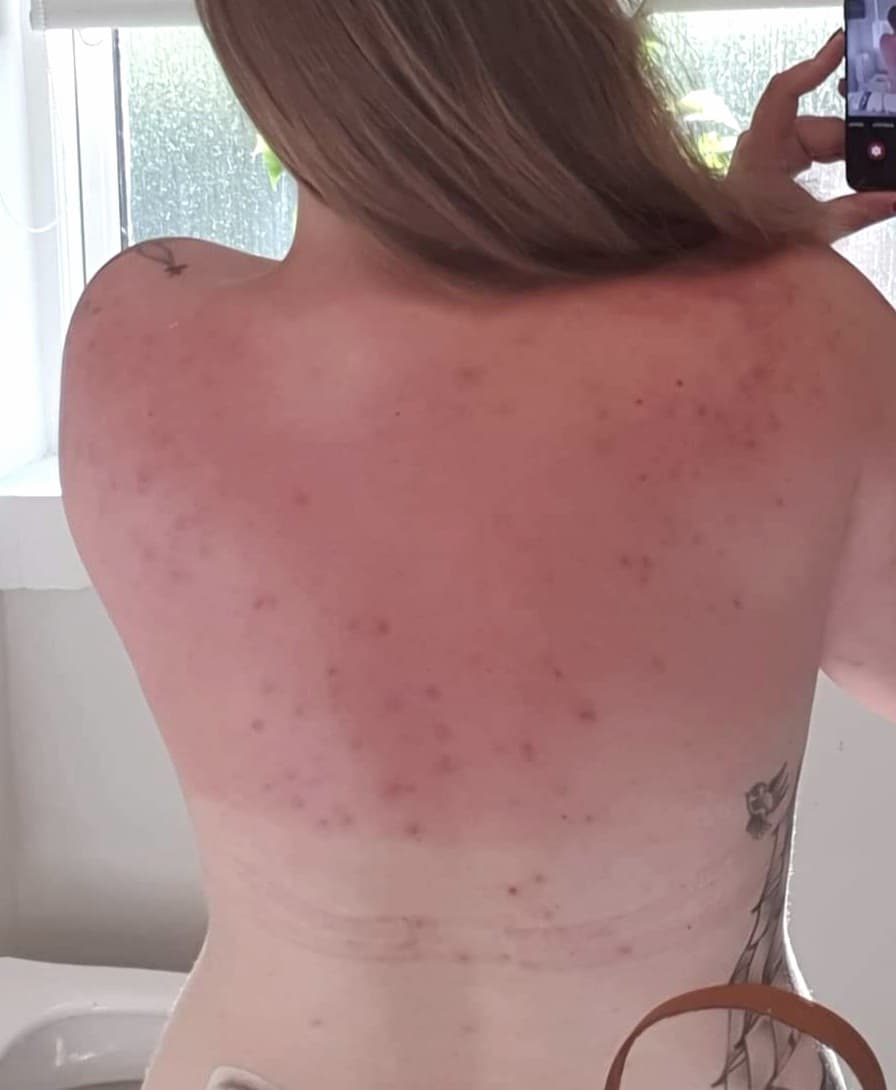 Before
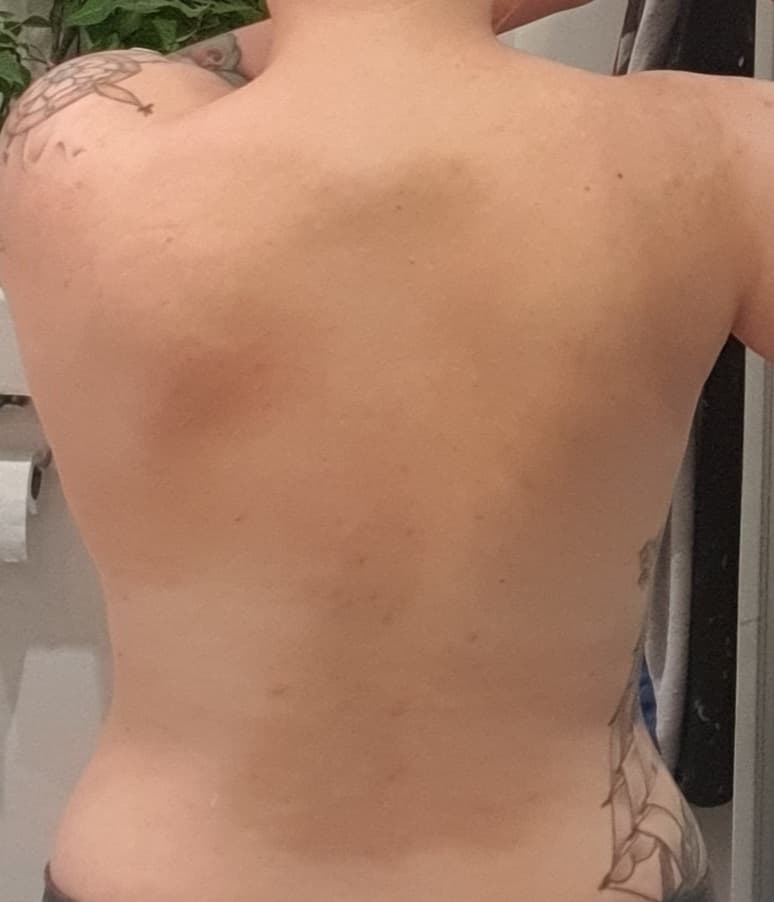 After
AfterKeep reading
- Ingredient · urea
- Ingredient · salicylic acid
- Ingredient · lactic acid
- Ingredient · glycolic acid
- Ingredient · sodium hyaluronate
- Condition · keratosis pilaris
- Condition · dry skin
- Condition · sensitive skin
- Read · how to get rid of keratosis pilaris
- Read · keratosis pilaris on legs
- Read · how to get rid of back acne
- Read · types of acne
Citations
- Hwang S, Schwartz RA. Keratosis pilaris: a common follicular hyperkeratosis. Cutis. 2008;82(3):177-180.PMID 18856156
- Kootiratrakarn T, Kampirapap K, Chunhasewee C. Epidermal permeability barrier in the treatment of keratosis pilaris. Dermatol Res Pract. 2015;2015:205012.PMID 25802513
- Maghfour J, Ly S, Haidari W, Taylor SL, Feldman SR. Treatment of keratosis pilaris and its variants: a systematic review. J Dermatolog Treat. 2022;33(3):1231-1242.PMID 32886029