
How to get rid of chin acne without declaring war on your face
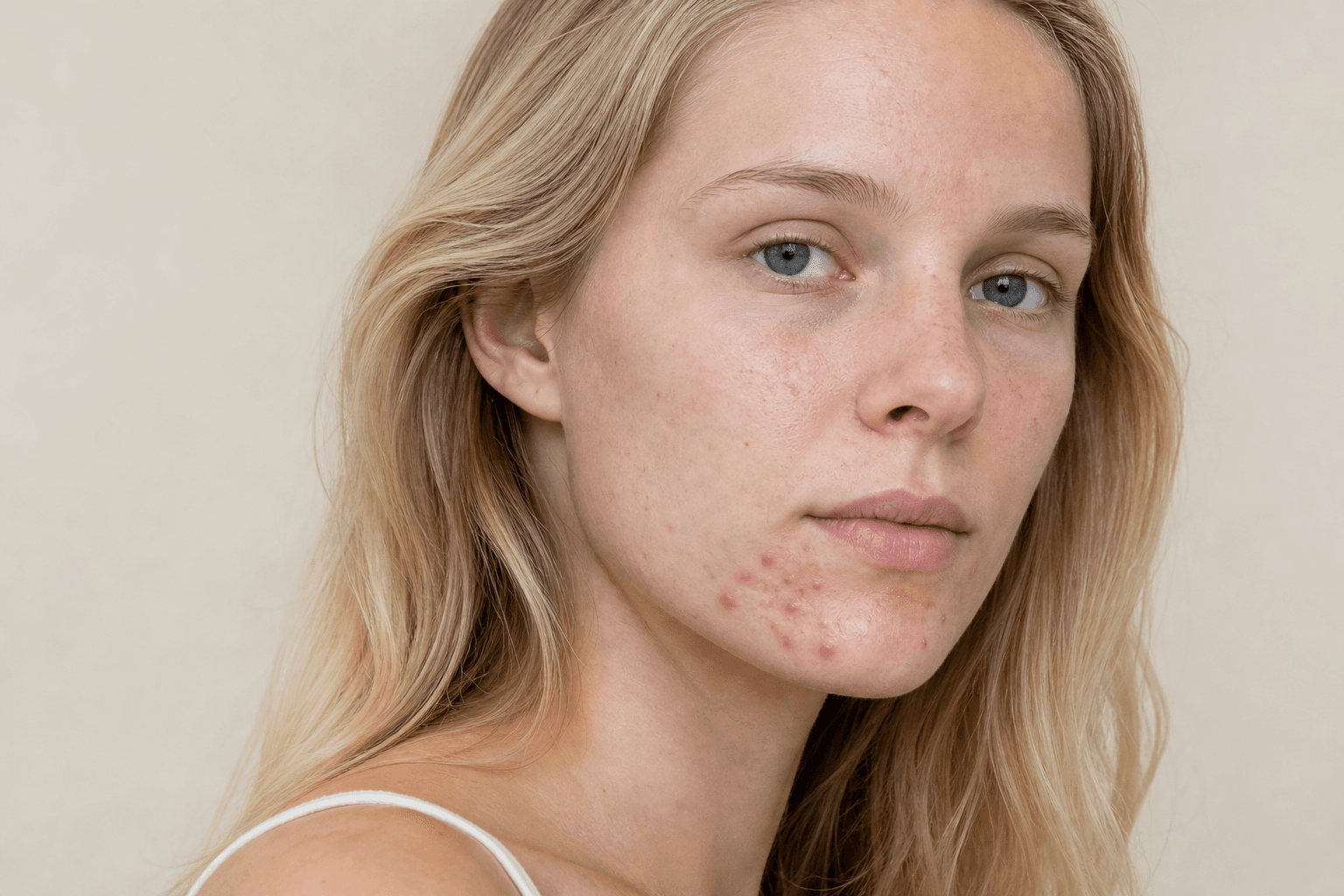
Chin acne is usually oil, follicle clogging, inflammation, and often hormones. Here's the calm routine that clears it without turning your chin into sandpaper.
On this page
I know how tempting it is to treat chin acne like one small area that needs more force.
When I struggled with acne, the chin and lower face were exactly the kind of places that made me impatient. You can feel every bump when you talk, smile, shave, or rest your hand on your face. So you start negotiating with the mirror, and suddenly a simple routine has become a late-night investigation with bad lighting and worse decisions.
Chin acne is one of the patterns people ask me about most. After helping more than 100,000 people with problem skin, I have learned not to assume it is always the same thing. Sometimes it is hormonal. Sometimes it is clogged pores, irritation, picking, heavy products, or perioral dermatitis pretending to be acne.
The first win is not buying the strongest treatment.
It is understanding what kind of chin breakout you are dealing with, then treating it calmly enough that your skin can actually recover.
The short answer
To get rid of chin acne, stop treating your chin like a crime scene.
Most chin breakouts are the same basic acne process happening in a very annoying location: oil, sticky dead skin cells, a clogged follicle, Cutibacterium acnes, then inflammation. Adult-acne evidence adds one extra detail that explains why the chin gets so much drama: in adults, acne often clusters around the lower face, chin, jawline, and neck, especially when hormones are part of the pattern.
So the routine is not complicated:
- Cleanse gently.
- Use salicylic acid a few nights per week.
- Support the barrier with niacinamide and moisturiser.
- Wear SPF so the dark marks do not become a second hobby.
- If the bumps are deep, painful, cyclical, or scarring, see a dermatologist.
That last line is not me being dramatic. It is me trying to save you six months of attacking hormonal acne with a walnut scrub and a prayer.
Why chin acne happens
Acne is not dirt. Please let that sentence retire somewhere warm.
A 2012 Lancet study[1] summarises acne as a disorder of the pilosebaceous unit, which is the tiny hair follicle plus oil gland. Four things usually stack together:
- Sebum increases. Androgens turn up oil production in susceptible follicles.
- Dead skin cells get sticky. They do not shed cleanly, so the follicle narrows.
- C. acnes gets involved. This bacterium is normal on skin, but in a blocked follicle it can contribute to inflammation.
- Your immune system responds. That is the redness, tenderness, swelling, and general "why is my face doing admin without me" feeling.
The chin is not magically different skin. It is a common place for this pattern to show up in adults, especially when breakouts flare before a period, during stress, after a contraceptive change, or alongside jawline bumps.
Is chin acne hormonal?
Sometimes. Not always.
A 2023 adult-acne study[2] notes that adult acne commonly affects the lower face, including the chin and mandibular area, and that many people report premenstrual flares. That does not mean every chin spot is a hormone emergency. It means the pattern is worth noticing. If your biggest clue is monthly timing, read the focused guide to pimples before your period.
Think "hormonal pattern" if your chin acne is:
- Deep, tender, or cyst-like rather than tiny surface bumps.
- Recurrent in the same lower-face area.
- Worse in the week before your period.
- Paired with irregular cycles, excess facial hair, hair thinning, or sudden worsening in adulthood.
- Not improving after 12 weeks of a consistent topical routine.
If you recognise the last few signs, book a clinician. PCOS, medication changes, contraceptive shifts, and other endocrine factors are not solved by buying a stronger toner. Annoying, I know. Very inconsiderate of biology.
First, make sure it is actually acne
Chin bumps are not always acne. This is where people accidentally make things worse.
Acne usually has comedones: whiteheads, blackheads, clogged bumps, papules, pustules, sometimes deeper nodules.
Perioral dermatitis tends to be small, clustered bumps around the mouth, nose, or chin, often with burning, stinging, flaking, and a clear gap right next to the lip. It often gets worse with steroid creams, heavy balms, and too many actives.
Ingrown hairs are common on the chin if you shave, wax, pluck, or thread. They often sit exactly where hair is removed and can feel sharp or tender. If that sounds familiar, read the guide to breakouts after shaving before treating every bump as acne.
If it burns more than it clogs, if the bumps circle the mouth, or if acne treatments make it worse fast, pause and get the diagnosis checked. Treating perioral dermatitis like acne is how a small problem gets a loyalty card.
The routine that works
Morning
Keep mornings boring. Boring is underrated. Boring does not wreck your barrier at 7:15 while you are trying to find keys.
- Gentle cleanse. Once is enough. Do not scrub the chin. Do not use a cleansing brush on inflamed bumps.
- Niacinamide-supported moisturiser. A 2006 controlled study[5] found 2% niacinamide reduced facial sebum, and the broader acne routine benefits from its barrier and redness support.
- SPF. Chin acne often leaves post-inflammatory pigmentation. UV makes those marks linger.
Evening
This is where the actual acne work happens.
Use a 2% leave-on salicylic acid on the chin area 2 nights per week to start. If your skin handles it, build to 3 or 4 nights per week over a month.
Salicylic acid is oil-soluble, which is the useful bit. It gets into the sebum-heavy follicle and helps loosen the plug from inside. A 1992 clinical study[4] showed salicylic acid pads improved acne lesions, and broader guideline literature keeps salicylic acid in the acne toolbox for good reason.
On the other nights, cleanse and moisturise only.
If you already use retinol, alternate it with salicylic acid. Do not do both in the same application. That is not "faster". That is a tiny unpaid internship in barrier damage.
What to stop doing
This list is painfully predictable because acne mistakes are painfully predictable.
- Stop picking. You are not "helping it out". You are turning one inflamed follicle into inflammation plus a wound plus a dark mark.
- Stop drying it out with alcohol toners. Tight, shiny skin is not clear skin. It is irritated skin wearing a cheap disguise.
- Stop using toothpaste. It belongs on teeth. Dermatology has not been hiding a minty miracle from you.
- Stop changing everything every week. Acne routines need 6 to 12 weeks. The skin is not Amazon Prime.
- Stop applying heavy lip balms and hair products onto the chin area. Occlusion around the mouth and jaw can be a real trigger.
When salicylic acid is enough
Salicylic acid plus niacinamide is often enough when the chin acne is mostly:
- Small clogged bumps.
- Whiteheads.
- Blackheads.
- Mild inflamed pimples.
- Oilier around the chin and lower face.
Give it 8 to 12 weeks. Not 8 days. Not "I used it twice and my face did not become glass". Eight to twelve weeks.
When you need a dermatologist
You need a dermatologist sooner if your chin acne is:
- Deep, painful, or cystic.
- Leaving scars or stubborn dark marks.
- Flaring predictably with your cycle.
- Starting suddenly in adulthood.
- Paired with irregular periods, increased facial hair, or hair thinning.
- Not improving after 12 weeks of consistent topical care.
This is where prescription options can matter: topical retinoids, benzoyl peroxide combinations, azelaic acid, oral contraceptives, spironolactone, or isotretinoin in the right cases. The 2016 acne guidelines[3] cover why these exist. They are not moral failures. They are tools.
The 12-week chin acne plan
Weeks 1 to 2
Cleanse gently. Use salicylic acid 2 nights per week. Moisturise every night. SPF every morning.
If the skin stings, flakes, or gets tight, do less. Your face is giving feedback, not asking for discipline.
Weeks 3 to 6
Increase salicylic acid to 3 nights per week if tolerated. Keep everything else stable. No new masks, no peels, no "reset" routines. The reset is consistency.
Weeks 7 to 12
If breakouts are clearly improving, stay boring. If you are still getting deep painful chin bumps, or the same cyst returns like it pays rent, book the dermatologist appointment.
The bottom line
Chin acne usually clears when you stop over-treating it and start treating the actual acne process: clogged follicles, oil, inflammation, and sometimes hormones.
Use the simple routine. Give it a real 12 weeks. Escalate when the pattern says "hormonal" or "deep" or "scarring". And please, for the love of your future post-inflammatory pigmentation, leave the spot alone.
People also ask
Is chin acne always hormonal?
No. Chin acne is often influenced by hormones, especially when bumps are deep, cyclical, or clustered around the jawline, but it is still acne: oil, sticky dead skin cells, clogged follicles, bacteria, and inflammation. Routine habits, picking, occlusive products, and irritation can all make it worse.
How long does chin acne take to clear?
Most people need 8 to 12 weeks of a consistent routine before chin acne looks clearly calmer. Inflamed bumps may settle sooner, but clogged pores and post-acne marks take longer. If the bumps are painful, scarring, or strongly hormonal, involve a dermatologist early.
Should I pop a chin pimple?
Usually no. Squeezing a chin pimple often pushes inflammation deeper, increases redness, and makes marks last longer. Use a gentle routine, a leave-on salicylic acid step if tolerated, and only consider extraction when a whitehead is fully ready and you can do it cleanly.
A calmer routine for chin acne
When chin acne keeps returning in the same stubborn area, I want the routine to feel steady, not punishing. That is why I built the Danish Skin Care Kit around the basics that matter here: gentle cleansing, salicylic acid for clogged follicles, barrier support, and daily SPF.

The simplest start if chin acne comes with oil, clogged pores, and the usual routine chaos. Cleanser, salicylic acid treat, moisturiser, and SPF in one system.
Full transparency: Danish Skin Care is my own company — I formulated these products and earn from every sale. That's exactly why I only recommend them where they genuinely fit the guide you just read.
Keep reading
- Ingredient · salicylic acid
- Ingredient · niacinamide
- Ingredient · retinol
- Ingredient · sodium hyaluronate
- Condition · acne and blemishes
- Condition · oily skin
- Condition · blackheads
- Condition · perioral dermatitis
- Read · how to get rid of pimples
- Read · how to get rid of forehead acne
- Read · how to get rid of oily skin
- Read · rosacea acne
Citations
- Williams HC, et al. Acne vulgaris. Lancet. 2012;379(9813):361-72.PMID 21880356
- Bagatin E, et al. Adult acne versus adolescent acne: a narrative review with a focus on epidemiology to treatment. An Bras Dermatol. 2023;98(1):75-83.PMID 36253244
- Zaenglein AL, et al. Guidelines of care for the management of acne vulgaris. J Am Acad Dermatol. 2016;74(5):945-73.PMID 26897386
- Zander E, Weisman S. Treatment of acne vulgaris with salicylic acid pads. Clin Ther. 1992;14(2):247-53.PMID 1535349
- Draelos ZD, et al. The effect of 2% niacinamide on facial sebum production. J Cosmet Laser Ther. 2006;8(2):96-101.PMID 16766489