
Rosacea and spicy food: keep the flavour, lose the guesswork
Spicy food can trigger rosacea flushing, but heat, capsaicin, portion size, and your own threshold all matter. Learn how to test meals without banning a whole cuisine.
On this page
My own skin problems were acne, oiliness, clogged pores, dehydration, and the red irritation that followed when I tried to fix all four before breakfast. I have not had rosacea as a diagnosis, so I will not pretend I know that exact feeling from the inside.
I do know the frustration of being told that one more ordinary pleasure must be the problem. For people with rosacea, spicy food often ends up in the witness box alongside coffee, wine, exercise, showers, weather, stress, and most of life.
The useful answer is neither "chilli is harmless" nor "never eat spice again." Spicy food can trigger a rosacea flush. It does not trigger everyone, and you may be able to change the heat or dose without giving up a cuisine you love.
The short answer
Spicy food is a well-recognised rosacea trigger, especially when a meal contains capsaicin from chilli peppers. The American Academy of Dermatology recommends trying a milder version when spicy food leaves the face red[1].
That advice is deliberately practical. It does not say that everyone with rosacea must eat bland food forever.
Four things can overlap in one meal:
- the food is physically hot
- capsaicin creates a heat sensation
- the room or your body is already warm
- alcohol, stress, or another trigger raises the total load
Separating those details makes the experiment much kinder than banning every spice in the cupboard.
Why chilli can make the face feel hot
Capsaicin is the pungent molecule in chilli peppers. It activates a sensory channel called TRPV1, which responds to capsaicin and damaging heat. Think of TRPV1 as one of the body's smoke alarms: it helps sensory nerves recognise "hot."
Rosacea involves more than blood vessels near the surface. Nerves, immune signals, and vascular responses talk to one another. A 2022 laboratory study[4] found increased TRPV1 and inflammatory markers in rosacea skin, then showed that capsaicin increased several rosacea-relevant mediators in cultured skin cells. That is a mechanism study, not proof that one chilli causes long-term disease. It helps explain why the burning can feel so immediate.
The face may become:
- warmer
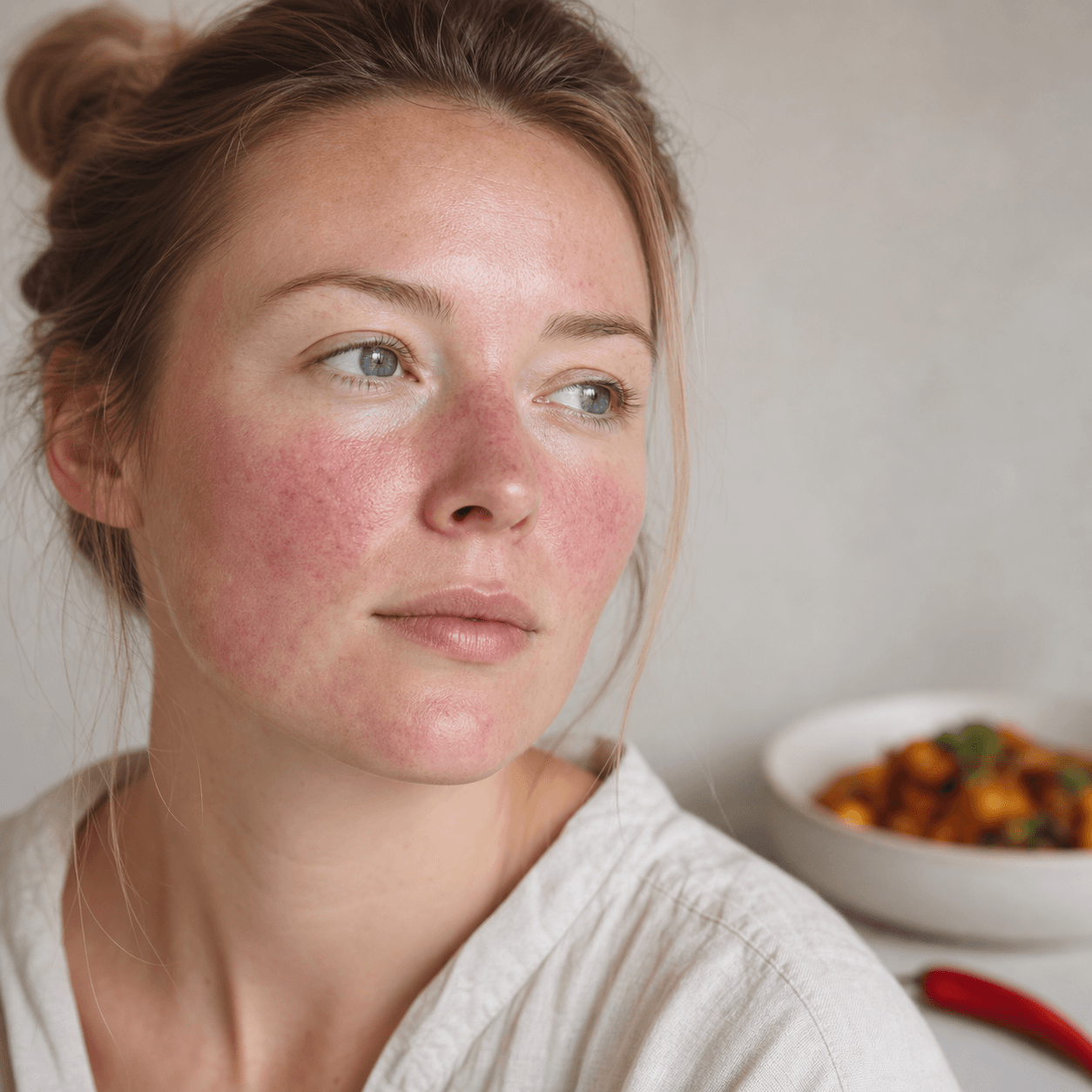
- redder across the cheeks and nose
- prickly or stingy
- sweaty
- slower to settle than expected
This temporary wave is flushing. It is different from background redness that remains between meals.
How common is spicy food as a trigger?
In a National Rosacea Society survey of 1,066 people, 45% reported spicy foods as a trigger[2]. Useful number, important limitation: it is self-reported survey data from people with rosacea, not a controlled trial showing that spice affects every person in the same way.
More than half did not report spicy food in that survey. Even among people who do react, the threshold varies. One person may flush after a small amount of hot sauce. Another may tolerate black pepper and a mild curry but not a bowl built around fresh chilli.
Your dinner is not a referendum on everyone else's rosacea.
Is the spice or the temperature causing the flare?
Sometimes both.
A dietary review[3] groups possible rosacea food triggers into heat-related, alcohol-related, capsaicin-related, and cinnamaldehyde-related categories. Capsaicin activates TRPV1. Cinnamaldehyde, found in cinnamon, can activate another sensory channel called TRPA1. Hot food adds a thermal signal on top.
Try asking:
- Does a steaming mild soup flush me?
- Does a cooled spicy dish still flush me?
- Is chilli fine at lunch but not beside wine in a warm restaurant?
- Does the reaction happen only when I am already stressed or overheated?
You do not need a laboratory kitchen. You need a repeatable comparison.
How to test spicy food without food fear
Choose one meal you genuinely like and can repeat. Do not start with the hottest version as a bravery test.
1. Let the meal cool
Eat it warm rather than steaming. This removes some thermal load while leaving the flavour reasonably similar.
2. Reduce the capsaicin dose
Use half the chilli or choose a milder sauce. You may have a tolerable threshold rather than a simple yes-or-no trigger.
3. Keep obvious trigger stacking low
For the test meal, skip the wine, sit somewhere cool, and avoid a hot shower immediately beforehand. Keep your skincare steady enough that the result stays readable.
4. Record the result briefly
Write down:
- what you ate
- how spicy and how hot it was
- when warmth or redness began
- how uncomfortable it felt from 0 to 10
- how long it took to settle
Repeat the comparison two or three times. One red face after a restaurant meal can be a clue. A repeated pattern is more useful.
The wider rosacea diet myths guide explains how to test dairy, gluten, sugar, histamine claims, and "anti-inflammatory" diets without building an unnecessary elimination plan.
What to do during a spicy-food flush
Pause and cool the situation, not the skin into submission.
- Stop eating if the reaction is uncomfortable.
- Move away from the hot kitchen or crowded room.
- Sip a cool drink.
- Place a cool, damp cloth around the neck if you feel overheated.
- Leave the face alone until it settles.
Do not rub, scrub, apply direct ice, or reach for a strong acid. Those actions add irritation to a response already in progress. If you need a simple plan for the hours after, use the rosacea flare reset.
Should you stop eating spicy food?
Stop or reduce it if careful testing shows that it reliably gives you a flare you do not want. That is a reasonable quality-of-life decision.
Keep a tolerable amount if milder spice gives you pleasure without meaningful symptoms. The goal is not to win a purity contest. The goal is fewer uncomfortable flares with as little disruption to normal life as possible.
Dietary changes do not replace rosacea treatment. See a qualified dermatologist if redness is becoming persistent, bumps or pustules keep appearing, skin is painful, the nose changes texture, or the eyes feel gritty, swollen, light-sensitive, or persistently red. A food diary can refine a treatment plan; it cannot diagnose the condition.
My calm rule is simple: let your own repeated response earn the restriction. Rosacea already asks for patience. It does not need a bigger blacklist than the evidence supports.
People also ask
Does spicy food always trigger rosacea?
No. Spicy food is a common reported trigger, but many people tolerate some spice or never react to it. Your repeated pattern matters more than a universal ban.
Why does chilli make rosacea flush?
Capsaicin activates the heat-sensitive TRPV1 channel. In rosacea-prone skin, sensory, vascular, and inflammatory signalling may be more reactive, so a meal can produce warmth and flushing.
Can I eat mild spicy food with rosacea?
Often, yes. Try a smaller amount, a milder version, and a meal served warm rather than steaming. Stop the test if it reliably causes an uncomfortable flare.
How long after spicy food can rosacea flare?
There is no reliable universal timing. Some people flush during the meal, while others notice a later reaction. Track the start, severity, and duration across repeated exposures.
Keep reading
Citations
- American Academy of Dermatology Association. How to prevent rosacea flare-ups.AAD
- National Rosacea Society. Rosacea Triggers Survey.NRS
- Weiss E, Katta R. Diet and rosacea: the role of dietary change in the management of rosacea. Dermatol Pract Concept. 2017;7(4):31-37.DOI 10.5826/dpc.0704a08
- Kim HB, Na EY, Yun SJ, Lee JB. The Effect of Capsaicin on Neuroinflammatory Mediators of Rosacea. Ann Dermatol. 2022;34(4):261-269.PMID 35948328