
Rosacea and hot showers: wash without turning up the flare
Hot showers can trigger rosacea through heat, steam, spray, and friction. Learn the small temperature and cleansing changes that make washing calmer.
On this page
I used to think a shower could only help irritated skin. Clean water, clean towel, fresh start. Then my own over-treated face taught me that ordinary water can sting when heat, friction, and a stressed barrier arrive together.
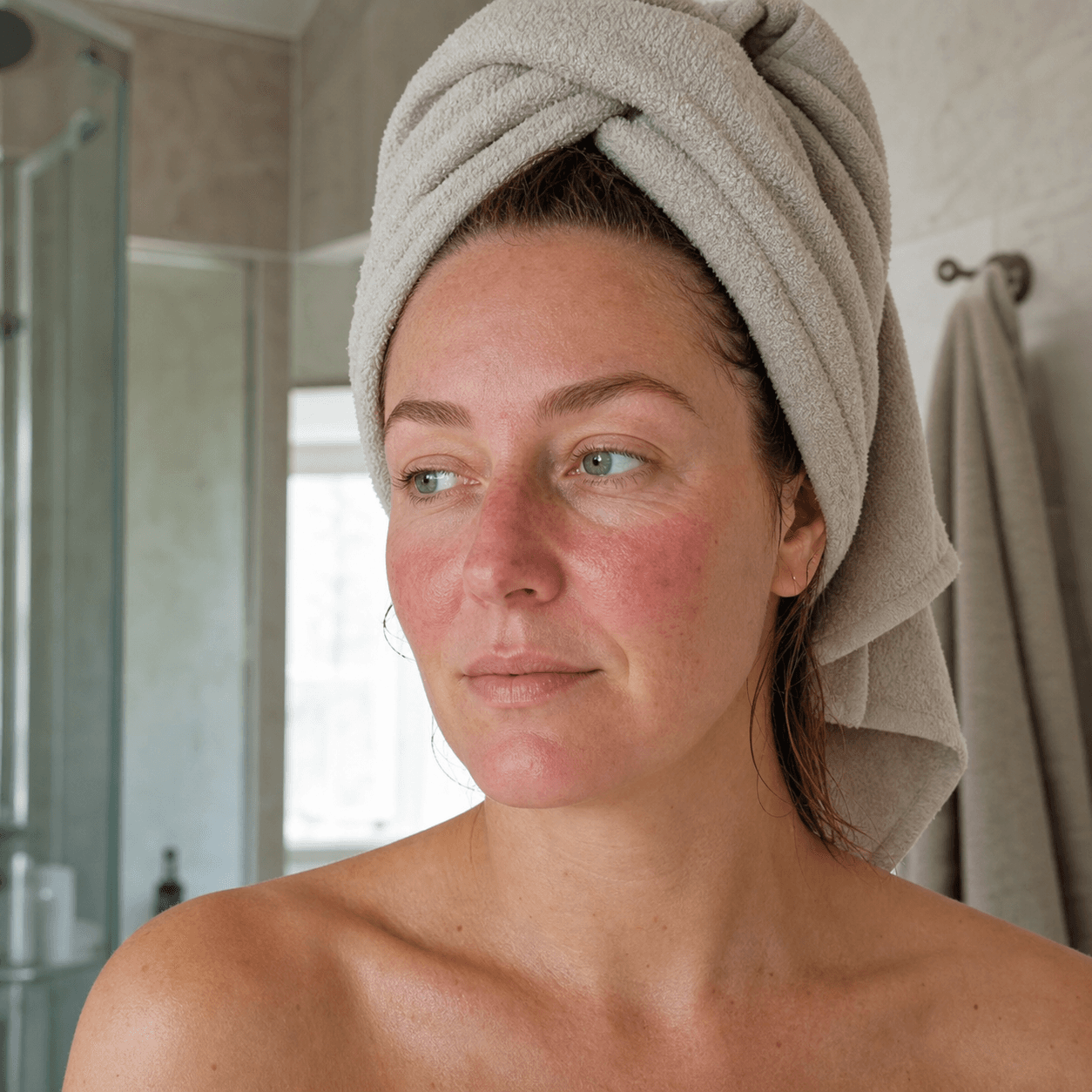
My history is acne and irritation, not a rosacea diagnosis. Still, the mirror-after-shower moment is familiar: cheeks much redder than they were ten minutes ago, skin too warm, and every product suddenly feeling louder.
For rosacea-prone skin, a hot shower can be a real trigger. The fix rarely requires cold-water heroics. A few small changes to temperature, time, spray, and towel use usually make more sense.
The short answer
Hot showers can trigger rosacea because heat raises skin temperature and encourages facial blood vessels to widen. Steam keeps that heat around the face. Direct spray, cleanser, shampoo runoff, and towel rubbing can add irritation.
The American Academy of Dermatology advises warm baths and showers rather than hot ones for people whose rosacea flares with overheating[1]. "Warm" is the useful word. You are allowed to be comfortable.
If your bathroom mirror fogs immediately, your skin stays hot for twenty minutes, and the redness burns rather than fading quietly, lower the temperature and shorten the shower before buying another calming serum.
Why heat matters so much in rosacea
Rosacea is not simply delicate surface skin. Vascular, immune, and sensory systems interact.
A study of rosacea tissue[4] found close associations between sensory nerves, blood vessels, and mast cells, along with changes in genes involved in vascular and nerve-driven inflammation. A broader skin review[3] explains that heat-sensitive TRP channels on nerves and skin cells can contribute to neuropeptide release, vasodilation, and neurogenic inflammation.
Plain translation: heat can press several rosacea buttons at once.
That does not mean every warm face after bathing is a disease flare. Heat makes many faces temporarily pink. Rosacea becomes a stronger possibility when redness is frequent, slow to fade, or accompanied by burning, stinging, bumps, visible vessels, or eye symptoms.
Hot water, steam, spray, or cleanser?
A shower bundles several possible triggers:
- high water temperature
- a warm, humid room
- a fast change from cold air to hot water
- direct water pressure on the face
- foaming cleanser used for too long
- shampoo or fragranced hair products running over the cheeks
- a rough towel
- strong skincare applied while the face is still hot
The National Rosacea Society's survey of 1,066 people found that 51% reported hot baths as a trigger and 41% reported indoor heat[2]. Those figures are self-reported, but the pattern is practical: overheating matters for many people and not for all.
Change one or two parts before blaming the entire shower.
A rosacea-friendly shower routine
1. Find comfortably warm
Turn the water down until it feels pleasant but does not make your face throb with heat. You do not need a thermometer. Use your skin and the room as clues:
- the mirror does not fog instantly
- you are not bright red before cleansing
- your face cools soon after the shower
- the skin does not feel tight or prickly
Very cold water is not automatically better. Sudden temperature swings can be uncomfortable too.
2. Keep your face away from direct spray
Let water run over the body, not pound the centre of the face. If control is difficult, cleanse at the sink after the shower with lukewarm water and fingertips.
This separates facial cleansing from the hottest part of the routine. The focused guide to a rosacea-friendly cleanser covers texture, technique, and low-friction removal.
3. Shorten the heat exposure
A long shower lets warmth accumulate. Try a shorter one before making the water miserably cold.
If you wash your hair, tilt the head back while rinsing. Keeping shampoo and conditioner off the cheeks removes one more variable.
4. Pat dry
Use a soft, clean towel and pat. The face is not a plate that needs polishing.
Rubbing adds mechanical irritation while heat has made the skin more reactive.
5. Let the face settle
Give visible heat a few minutes to ease. If the skin feels tight, apply a simple moisturiser gently. If it still burns, pause optional acids, retinoids, strong vitamin C, and fragranced products.
The existing guide to redness after a shower helps distinguish a short heat response from barrier irritation and possible rosacea signs.
What to do when you already overdid it
If you step out flushed:
- Move to a cooler room.
- Sip a cool drink.
- Put a cool, damp cloth around the neck.
- Leave the face uncovered and let heat escape.
- Avoid direct ice and aggressive rubbing.
- Use only familiar, gentle skincare once the skin feels calmer.
Direct ice can be painfully cold and create another abrupt vascular signal. A bathroom shelf full of new "soothing" products introduces five new questions when the face needs fewer.
For a longer flare, use the 48-hour rosacea reset, then return to prescribed care as directed.
Is shower redness definitely rosacea?
No. Temporary pinkness can come from:
- simple heat
- irritant contact dermatitis
- over-cleansing
- an impaired skin barrier
- eczema or seborrhoeic dermatitis
- allergy to a wash or hair product
If the redness is new, itchy, scaly, sharply outlined, weeping, or linked to one product, a clinician may need to consider something other than rosacea. If it comes with pustules, persistent central redness, recurrent burning, visible vessels, or gritty eyes, ask a qualified dermatologist.
The practical takeaway
A cooler, shorter, lower-friction shower can remove one daily trigger from a rosacea routine. It cannot treat the underlying condition on its own.
Keep the change small enough to live with:
- warm rather than hot
- face away from the spray
- fingertips rather than tools
- pat rather than rub
- familiar moisturiser rather than a rescue-product pile
That is not glamorous advice. It is repeatable, which is often more useful.
People also ask
Can a hot shower cause a rosacea flare?
Yes. Heat and overheating are common rosacea triggers, and hot showers combine thermal heat, steam, direct spray, and often towel friction.
Do showers need to be cold if I have rosacea?
No. Comfortably warm or lukewarm water is usually a more realistic target. The aim is to avoid overheating, not to make every shower unpleasant.
Should I wash my face in the shower with rosacea?
You can if the water is lukewarm and the spray is gentle. If the face becomes red or stings, cleansing at the sink gives better control of temperature and pressure.
What should I apply after a hot-shower flare?
Let the face cool, then use a simple moisturiser if it feels tight. Pause strong acids or retinoids while the skin is hot or burning.
Keep reading
- Ingredient · azelaic acid
- Ingredient · niacinamide
- Ingredient · panthenol
- Ingredient · glycerin
- Condition · rosacea
- Condition · sensitive skin
- Condition · dry skin
- Read · redness after shower
- Read · rosacea triggers
- Read · rosacea and spicy food
- Read · rosacea diet myths
- Read · rosacea friendly cleanser
- Read · how to calm rosacea flare
Citations
- American Academy of Dermatology Association. How to prevent rosacea flare-ups.AAD
- National Rosacea Society. Rosacea Triggers Survey.NRS
- Choi JE, Di Nardo A. Skin neurogenic inflammation. Semin Immunopathol. 2018;40(3):249-259.PMID 29713744
- Schwab VD, et al. Neurovascular and neuroimmune aspects in the pathophysiology of rosacea. J Investig Dermatol Symp Proc. 2011;15(1):53-62.PMID 22076328