
Perioral dermatitis around the eyes: periocular clues
Perioral dermatitis can appear around the eyes as periocular dermatitis. Learn the skin clues, common lookalikes, a low-friction routine, and urgent eye signs.
On this page
The skin around the eyes makes small problems feel enormous. It is thin, visible, and close enough to the eye that every new bump creates the same question: is this skincare irritation, or something that needs a doctor?
My own history is acne and irritated skin, not periocular dermatitis. I have learned, however, that the eye area is a poor place for brave experiments. When symptoms sit this close to an organ you rather enjoy using, calm observation beats a crowded routine.
Perioral dermatitis can appear around the eyes. The broader name, periorificial dermatitis, describes the pattern more accurately.
The short answer
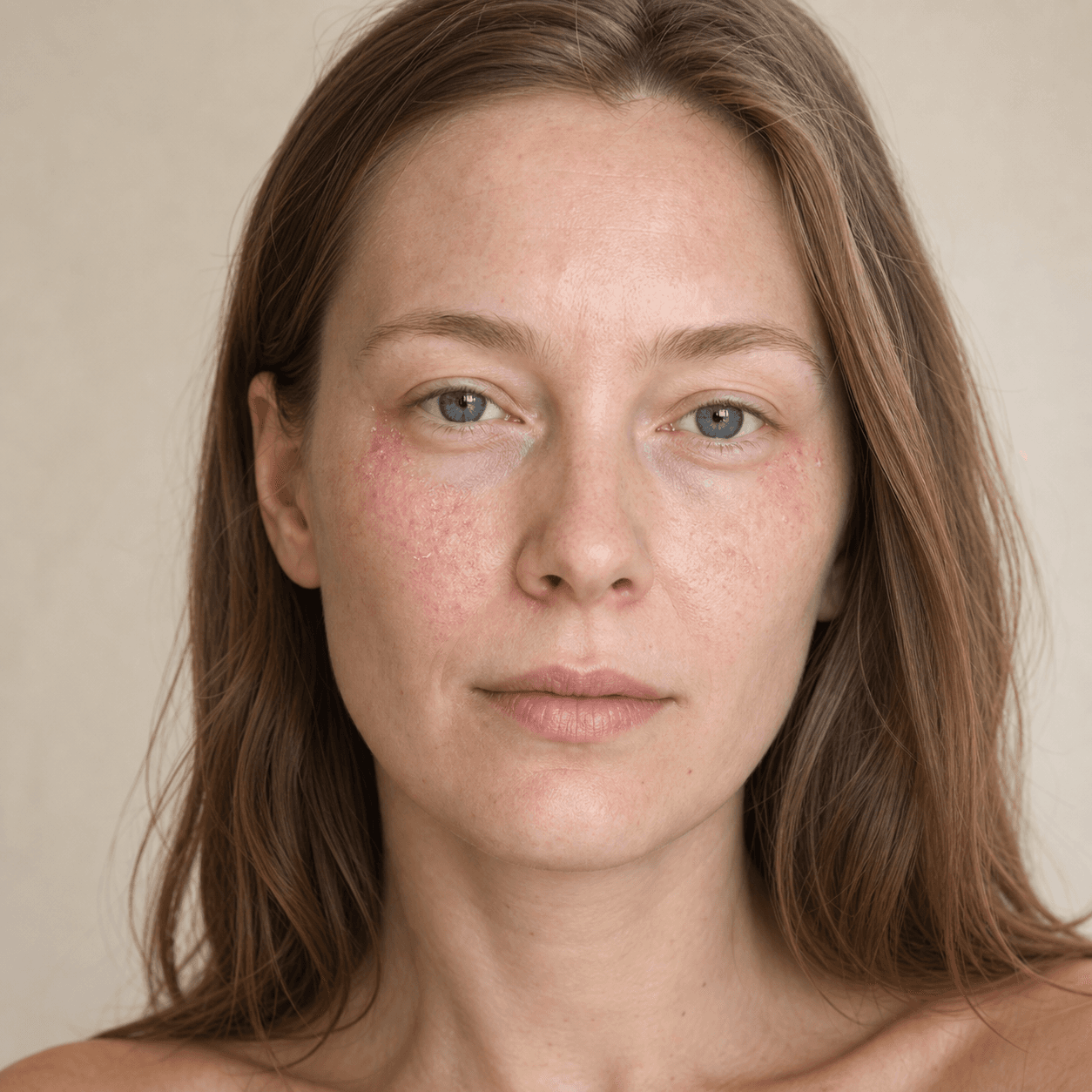
Periorificial dermatitis may cause tiny grouped bumps, pink or skin-coloured patches, fine scale, burning, or stinging around the eyes. This distribution is often called periocular dermatitis.
It can look similar to eyelid eczema, allergic contact dermatitis, rosacea, blepharitis, or infection. Stop optional eye-area products, avoid facial steroid cream unless a clinician has directed it, keep cleansing gentle, and arrange qualified assessment if the pattern persists.
Eye pain, visual change, light sensitivity, discharge, marked swelling, or rapidly spreading redness needs prompt medical care.
Why “perioral” dermatitis can reach the eyes
“Perioral” literally means around the mouth, but the same eruption can affect skin around other facial openings. The American Academy of Dermatology explains that it may appear around the mouth, nose, or eyes and uses peri-orificial dermatitis as the more precise term[2].
A 2026 dermatology review[1] describes periorificial dermatitis as a chronic papulopustular facial dermatitis shaped by aggravating exposures, barrier dysfunction, inflammation, and possibly microbiome changes. Its exact cause is still unsettled.
Plain translation: the name describes where the rash gathers better than it explains one universal cause.
What periocular dermatitis may look and feel like
Common skin clues include:
- tiny bumps beneath or beside the eyes
- grouped pink-red papules on lighter skin
- skin-coloured or darker bumps on deeper skin tones
- fine dryness or scale
- burning, tightness, or stinging
- involvement beside the nose or mouth at the same time
- relative sparing of the eyelid margin in some cases
The bumps are usually on the skin, rather than inside the eye. Blackheads and whiteheads are not typical.
Distribution helps, but it does not diagnose the rash. Periorificial dermatitis can overlap with several common eye-area problems.
The most important lookalikes
Allergic or irritant contact dermatitis
Contact dermatitis often itches, burns, swells, or forms a patch matching the place where a product lands. Eye cream, makeup, remover, fragrance, nail products transferred by fingers, and hair products can all be involved.
If the rash appeared soon after a new product, stop that optional product and keep its ingredient list. Recurrent eyelid dermatitis may need patch testing through a dermatologist.
Eyelid eczema
Eczema often brings pronounced itch, dryness, and recurring patches. A prescribed steroid or non-steroid medicine may be appropriate for genuine eyelid eczema. That is exactly why “never use steroids near the eyes” is too blunt. The diagnosis and the medicine both matter.
Ocular rosacea
Rosacea may affect the eyes themselves and the eyelid margins. Grittiness, watering, recurrent styes, light sensitivity, red eyes, and lash-line crusting fit that conversation more than a skin-only periocular rash.
The ocular rosacea symptoms guide compares those clues. Eye symptoms deserve qualified care because ocular rosacea can affect the surface of the eye.
Blepharitis or infection
Blepharitis often sits along the lash line with crusting or irritation. Infection may cause increasing pain, warmth, discharge, one-sided swelling, or rapid spread. Those patterns should not wait for a skincare reset to prove itself.
Why steroid cream needs caution
Topical corticosteroid exposure is the best-supported aggravating factor for perioral dermatitis in a 2021 evidence review[3]. Steroids can make a facial eruption look better quickly, then create rebound when stopped.
Around the eyes, there is an extra reason for precision: steroid strength, placement, and duration need medical supervision.
If you are already using a prescription steroid, contact the prescriber. Do not stop, taper, or restart it based on a blog. Read the focused guide to steroid cream and perioral dermatitis so you know what information to bring to that conversation.
A low-friction routine while you wait
Stop optional products on the affected skin
Pause:
- eye cream
- makeup and makeup remover on the rash
- retinoids and exfoliating acids near the eyes
- fragranced mist or serum
- essential oils
- heavy balm layers
- new “calming” treatments
Prescription eye drops, inhalers, nasal sprays, and skin medicines are different. Ask the prescriber before changing them.
Wash carefully
Use lukewarm water and clean hands. If a mild cleanser is necessary, keep it out of the eyes and rinse without repeated rubbing. Pat with a soft towel.
Avoid washcloths, cleansing brushes, cotton pads dragged back and forth, and very hot water.
Use only the treatment you were given
StatPearls notes that perioral dermatitis is usually diagnosed clinically, with additional testing considered when the presentation is unusual or treatment fails[4]. Depending on the diagnosis, a clinician may prescribe an oral antibiotic or a topical medicine such as metronidazole, erythromycin, or a calcineurin inhibitor.
Apply a prescription only where and how you were told. “Near the eye” and “in the eye” are not neighbouring instructions.
The perioral dermatitis skincare routine explains how a wider zero-therapy reset and later product reintroduction can work.
When to get prompt help
Seek prompt medical care for:
- eye pain
- blurred or changed vision
- light sensitivity
- marked eyelid swelling
- pus or eye discharge
- blisters
- fever
- rapidly spreading redness
- severe one-sided tenderness
Arrange routine dermatology care when bumps persist, recur, or resist a simple product pause. A dermatologist may need to separate periorificial dermatitis from eczema, contact allergy, rosacea, or infection.
The practical takeaway
Perioral dermatitis around the eyes is really a location clue: a periorificial eruption on delicate periocular skin.
Remove optional products, keep hands and cleansing gentle, avoid steroid guesswork, and watch for symptoms coming from the eye itself. Then let a qualified clinician name the condition before you build a treatment routine.
The calm approach may feel slower than trying three creams tonight. It is also far less likely to turn one uncertain rash into four uncertain reactions.
People also ask
Can perioral dermatitis occur only around the eyes?
Yes. Periorificial dermatitis can affect the skin around the eyes, nose, or mouth, and some people mainly have a periocular pattern.
How can I tell periocular dermatitis from eyelid eczema?
They overlap. Periocular dermatitis often forms small grouped bumps with scale or burning, while eczema may itch more. Contact allergy, rosacea, blepharitis, and infection also need consideration.
Can I put hydrocortisone around my eyes?
Do not start it by guesswork. Steroids can worsen periorificial dermatitis, and the eye area needs careful prescribing. Ask a qualified clinician.
When is an eye-area rash urgent?
Seek prompt care for eye pain, visual change, marked swelling, light sensitivity, discharge, blisters, fever, or rapidly spreading redness.
Keep reading
- Ingredient · pimecrolimus
- Ingredient · metronidazole
- Ingredient · niacinamide
- Condition · perioral dermatitis
- Condition · rosacea
- Condition · sensitive skin
- Read · perioral dermatitis skincare routine
- Read · steroid cream perioral dermatitis
- Read · ocular rosacea symptoms
- Read · rosacea vs perioral dermatitis
- Read · redness around nose
Citations
- Acevedo-Fontanez LA, Sánchez-Feliciano A, Ershadi S, Reichenberg J, Eichenfield LF, Barbieri JS. Periorificial dermatitis: Pathophysiology, diagnosis, and management. J Am Acad Dermatol. 2026;94(5):1483-1492. doi:10.1016/j.jaad.2025.10.138.PMID 41197738
- American Academy of Dermatology Association. Red rash around your mouth could be perioral dermatitis.AAD
- Searle T, Ali FR, Al-Niaimi F. Perioral dermatitis: Diagnosis, proposed etiologies, and management. J Cosmet Dermatol. 2021;20(12):3839-3848.PMID 33751778
- Tolaymat L, Syed HA, Hall MR. Perioral Dermatitis. StatPearls. Updated 2025.NCBI Bookshelf