
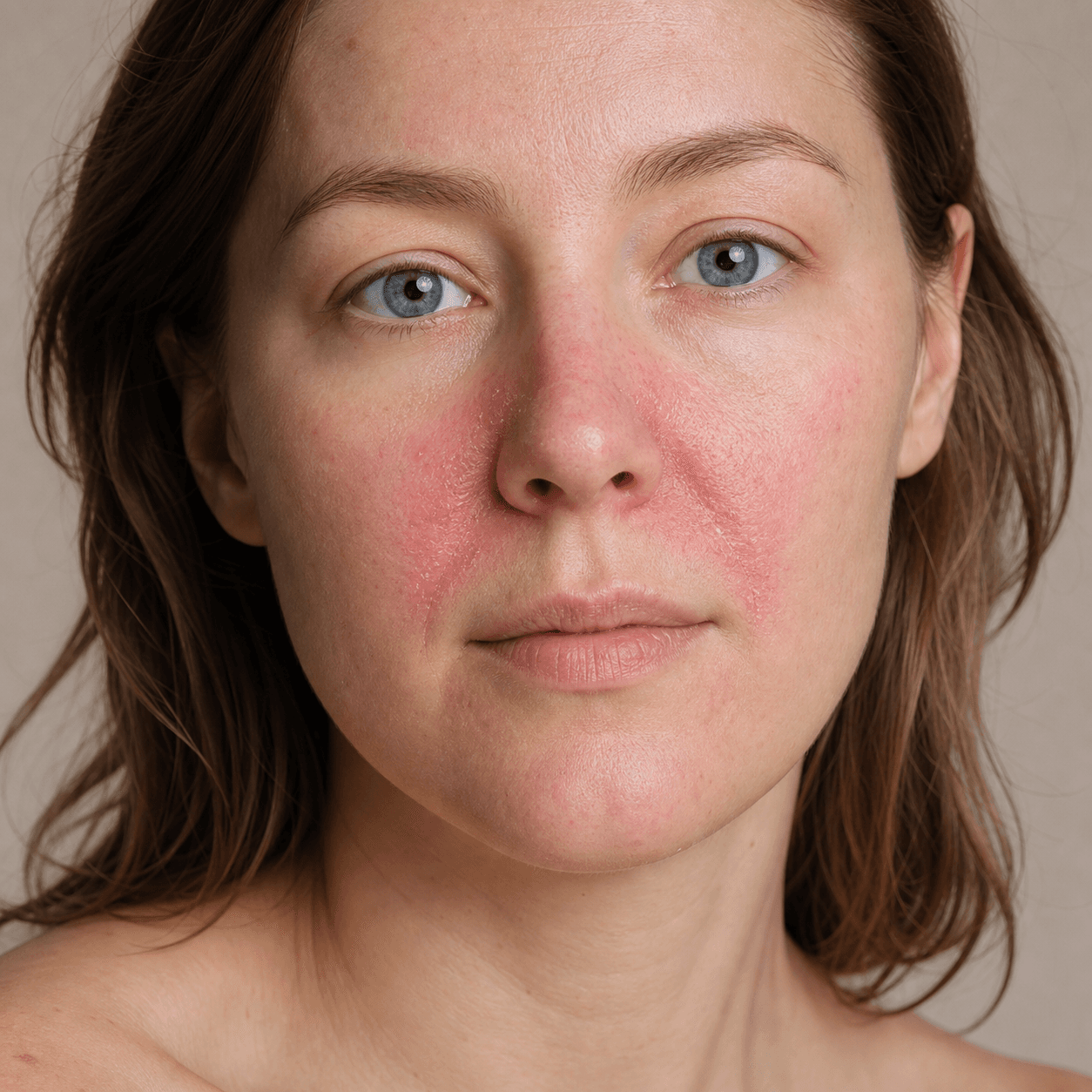
Redness around the nose: rosacea, dermatitis or irritation?
Redness around the nose can come from rosacea, perioral or seborrheic dermatitis, acne, or simple irritation. Learn the clues and when to get help.
On this page
Redness around the nose is one of those skin problems that looks simple until you try to name it.
I know the urge to treat first and investigate later. During my own years with acne, clogged pores, oily skin, and irritation, a red patch could send me straight toward a stronger cleanser or a determined spot treatment. That approach often produced a second problem on top of the first.
I have not personally been diagnosed with rosacea or dermatitis, so I will not turn my irritation story into one. What I can do is help you read the pattern calmly. Redness beside the nose may be rosacea, but it can also be perioral dermatitis, seborrheic dermatitis, acne, contact irritation, or skin that has had one product too many.
The short answer
Look at what comes with the redness:
- Flushing, heat, burning, or visible vessels can point toward rosacea.
- Small grouped bumps with dry, flaky skin may fit perioral or peri-orificial dermatitis.
- Greasy or powdery scale in the nose folds, brows, scalp, or ears can fit seborrheic dermatitis.
- Blackheads, whiteheads, or familiar inflamed spots make acne more likely.
- Sudden stinging after a new product, scrub, or active makes irritation or contact dermatitis worth considering.
These are clues, not a home diagnosis. More than one condition can exist at once, and facial rashes are annoyingly good at borrowing each other's clothes.
Clue 1: rosacea around the nose
Rosacea usually affects the centre of the face. The American Academy of Dermatology lists flushing, longer-lasting colour change, burning, stinging, acne-like bumps, visible vessels, and sometimes thickening skin among its signs[1].
Around the nose, rosacea may look like:
- redness that becomes stronger with heat, alcohol, spicy food, stress, exercise, or hot showers
- fine visible vessels along the nostrils or sides of the nose
- warmth, tingling, burning, or tenderness
- red bumps or pustules without many blackheads
- symptoms that settle and return in a recognisable pattern
Rosacea redness often spreads beyond one neat nose fold. It may involve the cheeks, bridge of the nose, chin, or area between the brows. The rosacea symptoms guide gives a fuller picture, while the guide to rosacea on the nose covers vessels, bumps, and thickening in more detail.
Clue 2: perioral dermatitis beside the nose
Despite the name, perioral dermatitis does not stay politely around the mouth. AAD guidance notes that it can also appear around the nose or eyes[2].
The rash often has:
- many small acne-like bumps
- dry or flaky skin between the bumps
- burning or itch
- a pattern around the mouth, nostrils, or eyes
- worsening after facial corticosteroid use
It can be mistaken for acne or rosacea, especially when the nostrils are involved. The rosacea versus perioral dermatitis guide helps compare the wider patterns. Please do not start or repeatedly stop a steroid cream on your face without medical advice. Steroids can temporarily hide redness while making perioral dermatitis harder to settle.
Clue 3: seborrheic dermatitis in the nose folds
Seborrheic dermatitis likes oil-rich areas. The AAD lists the sides of the nose, brows, eyelids, ears, scalp, mouth area, and beard area among common adult sites[3].
Beside the nose it may look red with white, yellowish, powdery, or slightly greasy scale. The scalp may also have stubborn dandruff, and the brows or ears can flake at the same time.
Rosacea and seborrheic dermatitis can coexist. When that happens, treating every flake as "dry skin" with richer and richer creams may not solve the cause. A clinician can decide whether an antifungal or another targeted treatment belongs in the plan.
Clue 4: acne or clogged pores
Acne around the nose usually brings familiar pore signs: blackheads, whiteheads, and individual inflamed spots. Salicylic acid may help clogged pores, but it will not treat every red rash. If the skin is burning, scaling, and forming many tiny uniform bumps, escalating acne treatment can make the picture noisier.
Do not squeeze the nose to run a diagnostic experiment. A squeezed pore tells you mainly that noses dislike being squeezed.
Clue 5: simple irritation or contact dermatitis
Think back over the previous few days. New cleanser? Strong acid? Retinoid increase? Fragranced balm? Tissue rubbing during a cold? An exfoliating brush with a little too much ambition?
Irritation often begins after a change and may feel tight, raw, or sting when water touches it. Allergic contact dermatitis may itch, swell, spread, or return whenever the same ingredient appears. The damaged barrier and rosacea guide explains why barrier irritation can resemble a flare without proving rosacea.
A calm routine while you work out the pattern
For several days, keep non-prescription skincare deliberately plain:
- Wash with lukewarm water and a mild cleanser only when needed.
- Pat dry instead of rubbing the nose folds.
- Use a simple moisturiser if it feels comfortable.
- Pause scrubs, masks, strong acids, and new actives.
- Use a sunscreen you tolerate when sun exposure is relevant.
- Leave prescription treatment alone unless the prescriber tells you to change it.
This reset may calm irritation. It will not diagnose or reliably treat rosacea, perioral dermatitis, seborrheic dermatitis, or infection.
Modern rosacea consensus recommends treating the signs present rather than forcing every face into one subtype[4]. That same practical mindset helps here: scale, pustules, vessels, flushing, pain, and eye symptoms each change what useful care looks like.
When professional care matters
See a qualified dermatologist if the redness persists, repeatedly returns, spreads, develops pustules, cracks, oozes, or becomes painful. Get prompt care for eye redness, gritty or light-sensitive eyes, eyelid swelling, or vision changes.
Also book an assessment if the nose begins to change shape or thicken. That does not mean a little redness is becoming severe rosacea, but progressive tissue change is not a skincare experiment.
My practical advice is simple: make the routine quieter, take a clear photo in neutral light, note the symptoms and triggers, and let a clinician name a persistent rash. Good skincare supports the skin. It should not ask you to diagnose five lookalike conditions in the bathroom mirror.
People also ask
Why is the skin around my nose red?
Common possibilities include irritation, rosacea, seborrheic dermatitis, perioral dermatitis, acne, or contact allergy. The useful clues are flushing, scale, bumps, itch, burning, and whether the pattern keeps returning.
Can rosacea affect only the nose?
Rosacea can be most obvious on the nose, although the cheeks, chin, forehead, eyes, or ears may also be involved. Persistent redness, visible vessels, burning, or acne-like bumps deserve a proper assessment.
Should I put hydrocortisone on redness beside my nose?
Do not start facial steroid cream by guesswork. Steroids may help some diagnosed rashes but can worsen perioral dermatitis and trigger rosacea-like problems. Ask a clinician when the cause is unclear.
When should nose redness be checked by a dermatologist?
Book an assessment if the redness persists, spreads, scales heavily, becomes painful, develops pustules, affects the eyes, or comes with a changing or thickening nose.
Keep reading
Citations
- American Academy of Dermatology Association. Rosacea: Signs and symptoms.AAD
- American Academy of Dermatology Association. Red rash around your mouth could be perioral dermatitis.AAD
- American Academy of Dermatology Association. Seborrheic dermatitis: Signs and symptoms.AAD
- Schaller M, et al. Recommendations for rosacea diagnosis, classification and management: update from the global ROSacea COnsensus 2019 panel. Br J Dermatol. 2020;182(5):1269-1276.PMID 31392722