
Keratosis pilaris vs folliculitis: how to read bumpy skin
Keratosis pilaris and folliculitis both affect hair follicles, but pain, pus, timing, and texture offer useful clues. Learn what to do without guessing at treatment.
On this page
When my skin was breaking out, I wanted every bump to have one name and one solution.
That would have made shopping easier. Skin remained committed to paperwork.
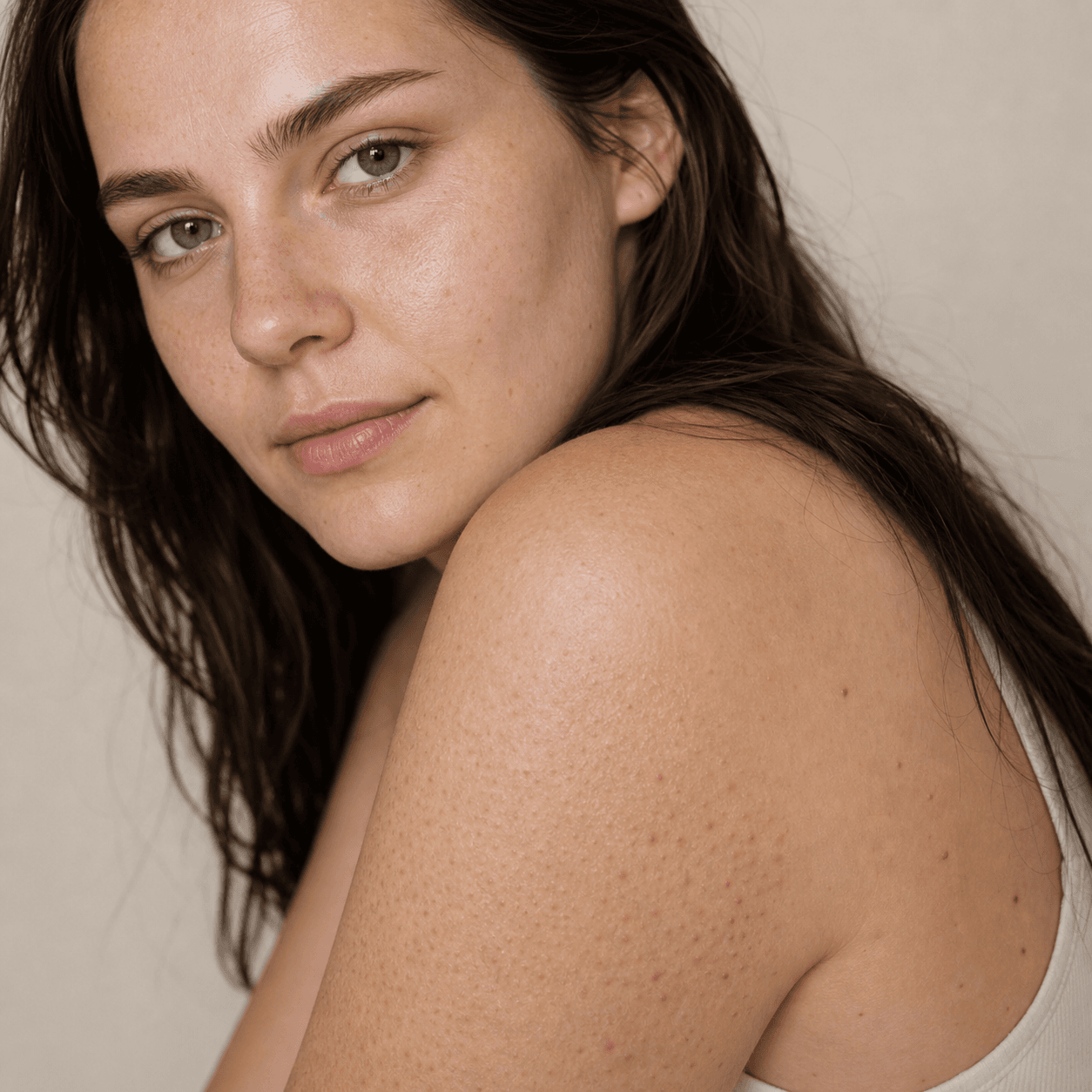
Keratosis pilaris and folliculitis both involve hair follicles. Both can show up on arms, thighs, buttocks, chest, or back. Both may look red, brown, or skin-coloured. The treatment can be quite different, which is why “body bumps” is a description, not a diagnosis.
The short answer
Keratosis pilaris usually creates many small, uniform, rough plugs that stay for months or years.
Folliculitis means inflamed hair follicles. It often arrives more suddenly and is more likely to itch, hurt, feel warm, or form a visible pustule around a hair.
The 2023 clinical update describes KP as a common follicular hyperkeratosis with small follicle-centred bumps and variable surrounding redness[1]. Folliculitis has several possible causes, including infection, irritation, occlusion, and hair removal. A mirror can suggest clues. It cannot identify the organism or rule out every lookalike.
The quickest comparison
| Clue | Keratosis pilaris | Folliculitis |
|---|---|---|
| Timing | Long-standing or seasonal | Often sudden or episodic |
| Feel | Rough, dry, sandpapery | Itchy, tender, sore, or warm |
| Appearance | Many similar tiny plugs | Inflamed spots, sometimes pustules |
| Pattern | Often symmetrical on upper arms or thighs | Can follow sweat, friction, shaving, or hot-tub exposure |
| Course | Improves slowly and often needs maintenance | May settle when the cause stops; some cases need medical treatment |
| Home approach | Moisture plus a tolerated keratolytic | Reduce friction and clarify the cause before adding strong actives |
None of these clues is perfect. Mild folliculitis may not hurt. Inflamed KP can look red and angry. The useful question is which pattern fits most of the story.
Clues that favour keratosis pilaris
KP often begins in childhood or adolescence and may run in families. The bumps tend to sit on the backs of the upper arms, fronts or outer thighs, buttocks, or cheeks.
Look for:
- a dry, rough texture you can feel with a flat hand
- bumps that are similar in size
- an even pattern on both sides of the body
- worse texture during dry or cold weather
- little pain and no obvious pus
- similar bumps in relatives
Picking can make KP inflamed and leave dark marks, but the original plug is made of keratin. It is not dirt and not automatically an infection.
The complete KP routine uses daily moisture, less friction, and one tolerated keratolytic rather than aggressive scrubbing.
Clues that favour folliculitis
The American Academy of Dermatology describes folliculitis as an acne-like eruption in damaged hair follicles. Shaving, plucking, waxing, tight clothing, skin-on-skin rubbing, heat, moisture, and poorly maintained hot tubs are common contexts[2].
Folliculitis is more likely when:
- spots appeared over hours or days
- each bump centres on a hair
- there are white or yellow pustules
- the area itches, hurts, or feels hot
- the outbreak followed shaving or waxing
- sweaty, tight clothing rubbed the same area
- bumps appeared under a swimsuit after a hot tub
- other people with the same exposure developed a similar rash
Folliculitis is a broad word. Bacteria are one cause, but yeast, irritation, medication, and other inflammatory conditions can produce follicle-centred eruptions. That is why copying an antibiotic, antifungal, or acid routine from a stranger can miss the cause completely.
What if the two overlap?
KP does not turn into folliculitis as a normal next stage. The same area can still have both rough keratin plugs and newly inflamed follicles.
Imagine upper arms with stable KP. Add a rough scrub, sweaty compression sleeves, repeated picking, and shaving over the bumps. The skin barrier becomes irritated and the follicles experience more friction. A new painful or pustular crop deserves a fresh read rather than another layer of acid.
Stop the friction. Pause hair removal. Change out of damp workout clothes. Avoid picking. Use a mild wash and a plain moisturiser if those feel comfortable.
Why the wrong treatment can make the picture noisier
Keratolytics such as urea, lactic acid, ammonium lactate, and salicylic acid can soften ordinary KP. A systematic review found several topical approaches may improve KP appearance, although the evidence is varied[3].
The same routine is not automatic folliculitis care. Applying strong acids to sore, infected, or freshly shaved follicles can add burning and barrier damage. Heavy occlusion may also feel uncomfortable on a hot, pustular outbreak.
Likewise, using antibacterial products indefinitely on stable KP exposes the skin to irritation without addressing the keratin plug.
A safe decision plan
If the bumps are long-standing, uniform, rough, and comfortable, start with KP basics:
- Short, lukewarm showers.
- Moisturiser on slightly damp skin.
- One keratolytic a few times per week.
- No picking or harsh scrubbing.
- An 8 to 12 week evaluation.
If the bumps are sudden, painful, itchy, warm, or pustular:
- Pause shaving and friction.
- Wash gently and keep the area dry and comfortable.
- Do not squeeze or share towels and razors.
- Ask a clinician or dermatologist whether testing or prescription care is needed.
Seek prompt medical help for rapidly spreading redness, fever, severe pain, large boils, red streaks, facial swelling, or illness. People with immune suppression or recurrent outbreaks should get individual advice earlier.
The practical takeaway
The difference is less about memorising pictures and more about reading behaviour.
KP behaves like persistent rough texture. Folliculitis behaves like inflamed follicles, often with a recent trigger and more symptoms. When the clues conflict, diagnosis is the useful next step.
You do not earn extra skincare points for treating uncertainty aggressively. Keep the area calm, note what changed, and let a qualified professional identify a painful or pustular pattern.
People also ask
How can I tell keratosis pilaris from folliculitis?
KP usually feels like long-standing, uniform rough plugs. Folliculitis often appears more suddenly and may itch, hurt, feel warm, or form pus-filled spots around hairs.
Can keratosis pilaris turn into folliculitis?
KP does not simply transform into an infection, but friction, shaving, picking, and irritated follicles can create overlapping inflammation or folliculitis in the same area.
Should I exfoliate folliculitis like keratosis pilaris?
Do not assume so. Strong acids and scrubs can aggravate painful or infected follicles. Pause irritating treatment and ask a clinician when pustules, pain, spreading redness, or recurrence are present.
When do follicle bumps need medical care?
Seek care for spreading redness, fever, increasing pain, large boils, drainage, scarring, repeated outbreaks, immune suppression, or a pattern you cannot identify confidently.
Keep reading
- Ingredient · ammonium lactate
- Ingredient · urea
- Ingredient · lactic acid
- Ingredient · salicylic acid
- Condition · keratosis pilaris
- Condition · acne and blemishes
- Condition · sensitive skin
- Read · how to get rid of keratosis pilaris
- Read · keratosis pilaris on arms
- Read · keratosis pilaris on legs
- Read · how to prevent workout breakouts
- Read · how to stop breakouts after shaving
Citations
- Kodali N, Patel VM, Schwartz RA. Keratosis pilaris: an update and approach to management. Ital J Dermatol Venerol. 2023;158(3):217-223. doi:10.23736/S2784-8671.23.07594-1.PMID 37166753
- American Academy of Dermatology Association. Acne-like breakouts could be folliculitis.AAD
- Maghfour J, Ly S, Haidari W, Taylor SL, Feldman SR. Treatment of keratosis pilaris and its variants: a systematic review. J Dermatolog Treat. 2022;33(3):1231-1242.PMID 32886029