
Skin ageing in darker skin: signs, pigmentation and care
Darker skin can show ageing through uneven tone, lines and changes in facial volume. Understand the differences without turning skin colour into a skincare diagnosis.
On this page
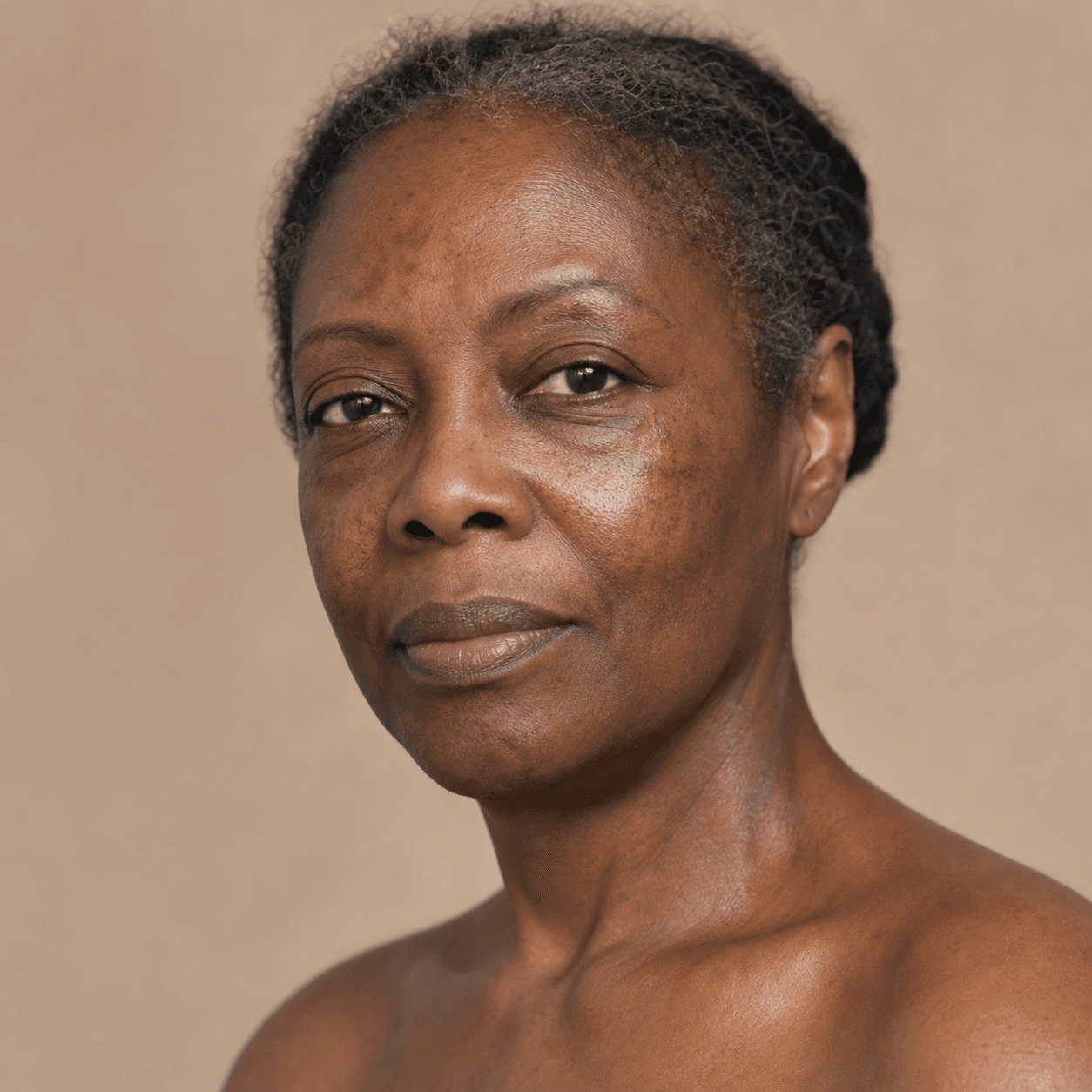
Darker skin ages, and the changes do not always begin with wrinkles. Uneven tone or changing facial contours may catch your eye first. Research describes differences between populations, but it cannot tell you what your face should look like at a particular birthday.[1]
I want this guide to help you name the change you see before buying something for it. “Anti-ageing” covers a lot of different promises. A cream for dry cheeks and a treatment for a persistent brown patch are answering different questions, even if the packaging puts them on the same shelf.
Why the pattern can look different
Melanin contributes to skin colour and offers some protection against ultraviolet radiation. That helps explain why certain sun-related lines tend to appear later in more pigmented skin. It does not stop photoageing. A review of skin structure also found that the evidence on differences in barrier function was inconsistent, with substantial variation between individuals.[2]
That is why I would not choose your moisturiser from your ethnicity. Your skin can feel oily, dry, comfortable or reactive; the useful information is how it behaves. Broad labels such as “skin of colour” help researchers discuss representation and treatment risks, but they do not describe one uniform skin type.
Ageing also involves more than the skin surface. The 2016 review describes pigment changes, loss of elasticity, lines and changes in facial volume across the populations studied.[1] If you notice a different contour around your cheeks, buying another exfoliant because the jar says “renewal” does not address the question you started with.
Is it ageing, a dark mark or dryness?
A brown mark where a pimple healed may be post-inflammatory hyperpigmentation. It can follow inflammation or injury and tends to be more persistent in darker skin. It is not proof that your skin has suddenly aged. The treatment evidence also varies: a 2024 systematic review found important gaps rather than a reliably successful treatment for everyone.[3]
Before choosing a product, ask what happened in that area. Was there a spot, a rash, picking or a reaction to a new formula? Write that down. If you seek advice, that history is more helpful than describing every brown patch as an age spot.
For tight or flaky skin, start with the separate question of dryness. Notice whether the skin feels uncomfortable after washing or whether a new product started the problem. Do not assume roughness needs more exfoliation. You can discuss persistent dryness with a clinician without treating normal lines as something that needs fixing.
Changes in contour deserve equally realistic expectations. If your concern is hollowing or a deeper fold, ask a dermatologist what contributes to it. Do that before spending months comparing creams advertised with photographs of entirely different lighting and facial expressions.
Sun protection belongs in the routine
The American Academy of Dermatology recommends broad-spectrum, water-resistant sunscreen with SPF 30 or higher, alongside shade and protective clothing, for darker skin too. For dark spots, it recommends a tinted formula containing iron oxides because visible sunlight can contribute to hyperpigmentation.[4]
A usable tint needs to match your skin. Check the finish in daylight and choose a formula you can apply as directed, rather than applying a tiny amount to hide a grey cast. Follow the label for application and reapplication. A tinted makeup product is not a substitute unless it also provides the appropriate labelled sun protection and you apply it accordingly.
If every sunscreen you try feels unpleasant, make comfort the next problem to solve. Compare a few textures rather than adding several brightening serums around a sunscreen you keep avoiding. Our pigmentation guide explains how this fits into a broader plan.
Add one treatment with a clear purpose
Retinol belongs to the retinoid family. Dermatologists use different retinoids for concerns including mild fine lines and uneven pigmentation, but the products are not interchangeable. Prescription treatment and a cosmetic retinol formula can differ in strength, formulation and tolerability.[5]
The same guidance warns that irritation can trigger dark marks in darker skin. Introduce treatment slowly, use moisturiser and follow the label or your prescriber’s plan. Avoid retinoids during pregnancy. If your skin already feels inflamed or persistently irritated, get advice before adding one.[5]
A practical evening can be as uncomplicated as cleansing, the chosen treatment when scheduled, and moisturiser. Keep the rest familiar while introducing it. When you change four things together, you lose the chance to work out which product caused trouble.
Burning and persistent peeling are reasons to pause and seek advice, not to increase the dose. Bring the product names and your actual schedule to the appointment. “Twice a week” means something different from “twice a week, plus an acid toner every morning.” Our guide to retinol peeling helps you review that routine.
Before booking a laser or peel
Darker skin can benefit from selected cosmetic procedures, but that does not make every device or peel suitable. A clinical review emphasises the risk of unwanted pigment change with resurfacing treatments, while the 2024 pigmentation review reports some cases of worsening after laser treatment.[6][3]
Ask the clinician to explain the diagnosis, the proposed treatment and the alternative of doing less. Useful questions include:
- How often do you treat this concern in my skin tone?
- Could the area become darker or lighter, and what would you do then?
- Is a test spot appropriate for this treatment?
- What does aftercare involve, and who handles complications?
Request examples relevant to your concern, with comparable lighting. A smooth result on a different skin tone does not answer your question about pigment risk. You should leave the consultation knowing what is realistic, including the possibility of incomplete improvement.
Changes worth getting checked
Arrange an assessment for a new or changing growth, a bleeding spot or a sore that does not heal. Skin cancer can occur in darker skin, including on palms, soles and around nails. The AAD also highlights new nail changes and persistent rough patches as reasons to seek a dermatologist’s assessment.[4]
You do not need to diagnose a mark yourself before asking for help. A photograph and a note about when it appeared are enough to start the conversation.
My preference is a routine that answers your actual concern and leaves room to live your life. Choose comfortable daily care, introduce treatment deliberately, and ask for qualified help when the diagnosis is uncertain. Your skin colour belongs in that conversation; it should never be the whole conversation.
People also ask
Does darker skin age more slowly?
Some sun-related lines appear later on average in more pigmented skin, but ageing and sun damage still happen. Uneven tone and facial volume changes can be prominent. There is no timetable that predicts an individual face.
What are early signs of ageing in darker skin?
Changes may include uneven pigmentation, fine lines, dryness, texture and altered facial contours. Dark marks after acne can occur at any age, so a new patch should not automatically be labelled an age spot.
Can I use retinol on darker skin?
People of all skin tones can use retinoids when appropriate, but irritation can trigger dark marks. Start cautiously, moisturise and seek advice if irritation persists. Avoid retinoids during pregnancy.
Are lasers safe for darker skin?
Some laser treatments are suitable, but safety depends on the device, settings, diagnosis and clinician. Ask a qualified dermatologist about darker or lighter pigment after treatment and their experience with your skin tone.
Keep reading
- Ingredient · retinol
- Ingredient · niacinamide
- Ingredient · azelaic acid
- Ingredient · l ascorbic acid
- Condition · signs of ageing
- Condition · pigmentation
- Condition · dry skin
- Condition · sensitive skin
- Read · best ingredients for acne scars and marks
- Read · how to fade post acne marks
- Read · dehydration lines vs wrinkles
- Read · menopause skin changes
- Read · why does retinol make my skin peel
Citations
- Vashi NA, de Castro Maymone MB, Kundu RV. Aging Differences in Ethnic Skin. J Clin Aesthet Dermatol. 2016;9(1):31-38.PMID 26962390
- Rawlings AV. Ethnic skin types: are there differences in skin structure and function? Int J Cosmet Sci. 2006;28(2):79-93.PMID 18492142
- Mar K, Khalid B, Maazi M, et al. Treatment of Post-Inflammatory Hyperpigmentation in Skin of Colour: A Systematic Review. J Cutan Med Surg. 2024;28(5):473-480.PMID 39075672
- American Academy of Dermatology. Finding skin cancer in darker skin tones. Accessed September 10, 2026.American Academy of Dermatology
- American Academy of Dermatology. Retinoid or retinol? Updated May 25, 2021. Accessed September 10, 2026.American Academy of Dermatology
- Davis EC, Callender VD. Aesthetic dermatology for aging ethnic skin. Dermatol Surg. 2011;37(7):901-917.PMID 21585594