
Demodex and rosacea: what the mites really mean
Demodex mites live on most adult faces. Rosacea research finds more of them in some affected skin, but that does not mean poor hygiene or prove they caused every flare.
On this page
The first time people hear that tiny mites live in facial follicles, the reaction is rarely calm curiosity. It is usually closer to: Please remove my face immediately.
I understand the feeling. My own skin history involved acne, oil, clogged pores, dehydration, and plenty of irritation. I have not had rosacea as a diagnosis, so I will not turn Demodex into a personal survival story. What I have seen in years of questions from readers is how quickly the word “mite” creates shame and frantic cleansing.
Let us remove that part first. Demodex mites do not mean your skin is dirty.
The short answer
Demodex are microscopic mites that live in and around facial hair follicles and oil glands. Most adults have them. They usually exist quietly as part of the skin’s small ecosystem.
Research does find a connection with rosacea. A 2017 analysis of 23 case-control studies involving 1,513 people with rosacea found both a higher likelihood of Demodex infestation and a higher average mite density than in controls[1]. The association appeared in both erythematotelangiectatic and papulopustular rosacea.
That finding matters, but it has a limit: the studies could not prove that mites caused rosacea. Higher density might contribute to inflammation, thrive because rosacea skin has changed, or do a bit of both.
Normal resident does not mean harmless in every context
Think of Demodex like guests who are usually quiet. A few people sitting in a room is unremarkable. If the room becomes crowded and everyone starts shouting, the host notices.
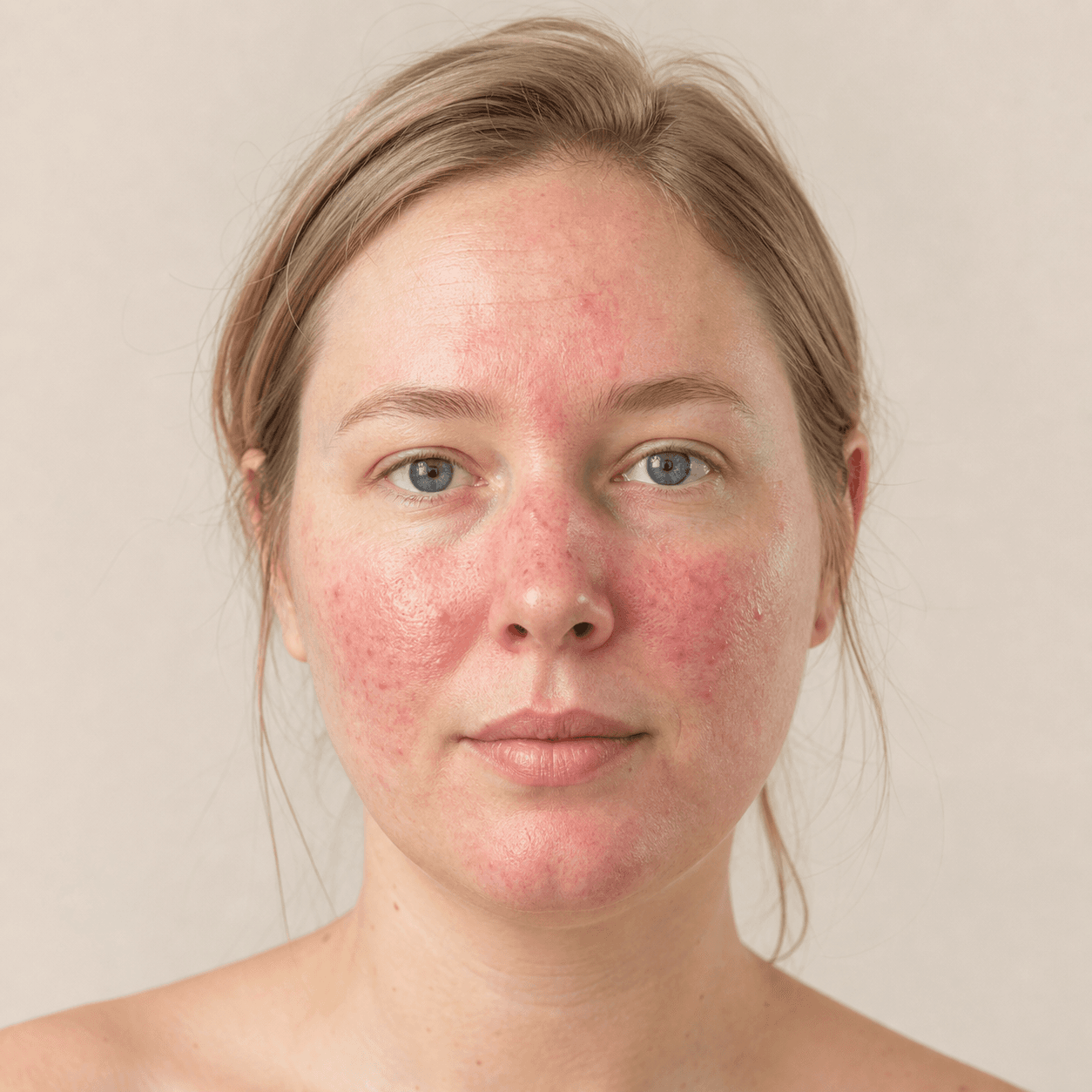
In some rosacea-prone skin, a higher mite density may interact with the immune system and follicle environment. That can be relevant when the main signs are papules and pustules: red or skin-coloured bumps, sometimes with pus, concentrated across the central face.
This is not the complete rosacea story. NIAMS describes rosacea as a long-term inflammatory condition influenced by increased skin sensitivity, environmental factors, microbes, genetics, and other pathways that researchers are still untangling[2]. Heat, light, stress, vascular reactivity, barrier damage, and inflammation do not disappear because Demodex entered the conversation.
One cause, one cure would be emotionally satisfying. Skin biology has declined the invitation.
The useful clues, and the clues that mislead
Papulopustular rosacea can resemble acne. The rosacea acne guide explains the overlap in detail, but a few clues can help you ask better questions:
- bumps cluster on the cheeks, nose, chin, or central forehead
- the background skin flushes, burns, or stings
- visible blackheads are absent or uncommon in the affected area
- hot rooms, exercise, alcohol, spicy food, or irritating products worsen the pattern
- ordinary acne treatment makes the face feel raw without clearing the bumps
None of these proves a Demodex problem. Demodicosis, acne, perioral dermatitis, seborrheic dermatitis, and rosacea can imitate one another. A dermatologist may diagnose from the pattern and history; occasionally, microscopy or another test helps.
Please do not buy a magnifying camera and begin counting suspicious dots. Pores, sebaceous filaments, and dry flakes are not visible mites.
Why harder cleansing is the wrong move
The hygiene story sounds logical: mites live in follicles, so clean the follicles more aggressively. In practice, that plan often produces hotter, tighter, angrier skin.
Rosacea-prone skin commonly has burning, dryness, and barrier impairment. Scrubs, cleansing brushes, undiluted essential oils, harsh soap, and repeated washing cannot sterilise a face. They can remove protective lipids and add another inflammatory signal.
Keep cleansing deliberately boring:
- Use lukewarm water.
- Massage a mild cleanser with fingertips, not a device.
- Rinse without holding the face under a hot shower.
- Pat dry.
- Apply a simple moisturiser if the skin feels tight.
If everything stings, the damaged barrier and rosacea guide gives you a short reset without pretending barrier care replaces medical treatment.
Where ivermectin fits
Topical ivermectin 1% is a prescription treatment for inflammatory rosacea lesions in several countries. It has anti-inflammatory and acaricidal activity, meaning it acts against mites, although the exact mechanism by which the approved cream improves rosacea is not fully settled.
The 2019 National Rosacea Society management update[3] recommends choosing treatment by the signs present rather than forcing every face into one old subtype. For papules and pustules, options can include topical ivermectin, azelaic acid, metronidazole, or other clinician-selected therapies.
A 2018 systematic review[4] found topical ivermectin effective for moderate-to-severe papulopustular rosacea and somewhat more effective than metronidazole in the included trials. It also found an unglamorous truth: relapse after treatment stopped was common in both groups.
That is why the ivermectin ingredient guide treats it as a useful prescription, not a permanent mite eraser.
When professional care matters
Book qualified medical care when bumps or pustules persist, acne treatment keeps failing, burning is significant, or the diagnosis is unclear. Seek prompt assessment for gritty, painful, light-sensitive, red, or vision-affected eyes. Ocular rosacea needs more than a new cleanser.
The practical aim is not to wage war on every organism living on your skin. It is to reduce the inflammation that is bothering you, protect the barrier, and use the right treatment for the signs you have.
Demodex may be one piece of rosacea. It is not a verdict on your hygiene, and it is definitely not a reason to scrub harder.
People also ask
Does everyone with rosacea have Demodex mites?
Most adults have some Demodex mites, whether or not they have rosacea. Studies find higher mite density on average in rosacea, but that association does not prove mites cause every case.
Can I wash Demodex mites off my face?
No. They live in hair follicles and sebaceous areas, and trying to scrub them away can worsen irritation. Gentle cleansing is better for rosacea-prone skin.
How do I know if my rosacea is caused by Demodex?
You cannot tell from a mirror alone. Papules and pustules may fit a Demodex-associated pattern, but acne, dermatitis, and other conditions can look similar. A dermatologist can assess the whole picture.
Does topical ivermectin cure rosacea?
No. It can reduce inflammatory papules and pustules in suitable patients, but rosacea is chronic and relapse after stopping treatment is common.
Keep reading
Citations
- Chang YS, Huang YC. Role of Demodex mite infestation in rosacea: A systematic review and meta-analysis. J Am Acad Dermatol. 2017;77(3):441-447.e6.PMID 28711190
- National Institute of Arthritis and Musculoskeletal and Skin Diseases. Rosacea: Symptoms, Causes, & Risk Factors.NIAMS
- Thiboutot D, et al. Standard management options for rosacea: The 2019 update by the National Rosacea Society Expert Committee. J Am Acad Dermatol. 2020;82(6):1501-1510.PMID 32035944
- Ebbelaar CCF, Venema AW, Van Dijk MR. Topical Ivermectin in the Treatment of Papulopustular Rosacea: A Systematic Review of Evidence and Clinical Guideline Recommendations. Dermatol Ther (Heidelb). 2018;8(3):379-387.PMID 29943217