
Ivermectin
A well-supported prescription active for inflammatory papules and pustules of rosacea. Useful in the right diagnosis, but not an over-the-counter general redness ingredient.
At a glance
What Ivermectin does for skin, and how to read the practical safety signals.
- Prescription role: Topical ivermectin 1% is approved in the US for inflammatory rosacea lesions.
- Best fit: Evidence is strongest for moderate-to-severe papulopustular rosacea, not isolated flushing or visible vessels.
- Mechanism: It has anti-inflammatory and antiparasitic activity, although the approved label says the exact rosacea mechanism is unknown.
- Type
- Prescription antiparasitic
- Rating
- Pregnancy
- Discuss with a clinician
- Comedogenic rating
- 0/5 (Won't clog pores)
- Vegan
- Yes
- Suited skin types
- All skin types
On this page
The short answer
Topical ivermectin is a prescription medicine used for the inflammatory papules and pustules of rosacea. In the US, the approved cream contains 1% ivermectin and is applied to affected facial areas as directed by a clinician.
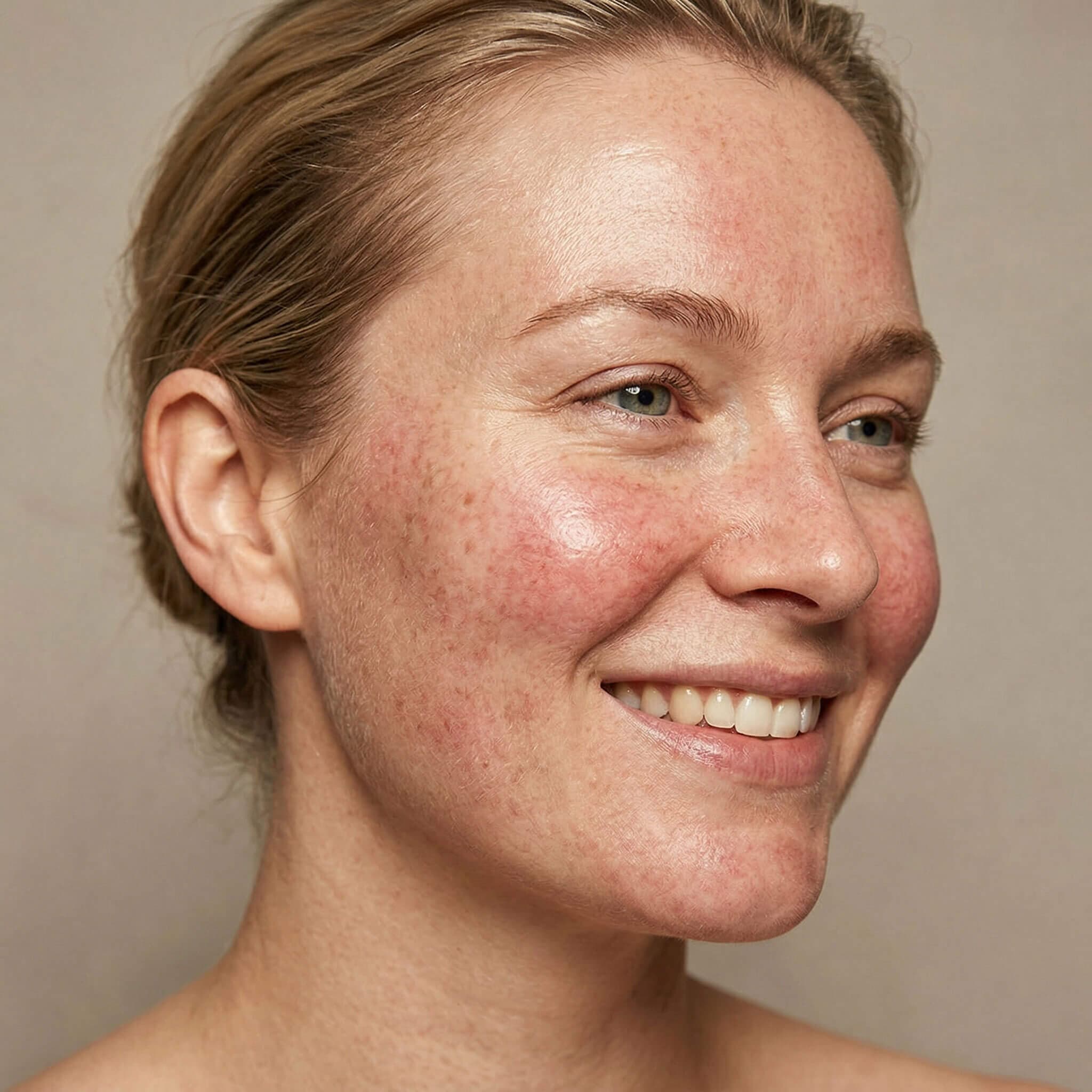
It is especially relevant when rosacea looks acne-like but does not behave like ordinary acne. It is not a general cosmetic ingredient for every red, sensitive face, and it does not treat every rosacea sign equally well.
What ivermectin is
Ivermectin belongs to the avermectin family. The active is derived from compounds produced through fermentation by Streptomyces avermitilis.
In dermatology it is known for antiparasitic activity. That explains the attention around Demodex and rosacea, because people with rosacea have higher Demodex density on average. Ivermectin also has anti-inflammatory effects.
The important nuance is on the official label: the mechanism by which ivermectin cream improves rosacea lesions is unknown[1]. “It kills mites” is too neat as a complete explanation.
What the clinical trials show
Two 12-week randomised trials included 1,371 adults with moderate-to-severe papulopustular rosacea. Once-daily ivermectin 1% cream produced higher clear-or-almost-clear rates and larger reductions in inflammatory lesion counts than its vehicle[2]. Differences appeared from week four in the trials.
A separate 16-week trial with 962 participants compared once-daily ivermectin 1% with twice-daily metronidazole 0.75%. Inflammatory lesions fell by 83.0% with ivermectin and 73.7% with metronidazole; clear-or-almost-clear ratings also favoured ivermectin[3].
Those are meaningful results for papules and pustules. They do not show that ivermectin removes fixed telangiectasia, cures rosacea, or suits an undiagnosed rash.
A 2018 systematic review found ivermectin effective for moderate-to-severe papulopustular rosacea but emphasised that relapse after treatment stopped was common[4]. Chronic skin conditions have an annoying habit of remaining chronic even after a good trial result.
Who it may suit
A clinician may consider topical ivermectin when:
- papules and pustules are prominent
- bumps sit in a rosacea pattern across the central face
- ordinary acne care has failed or caused irritation
- another rosacea treatment did not control inflammatory lesions
- a simple once-daily prescription fits the treatment plan
It is less likely to be the main answer when the concern is only flushing, persistent background colour, or visible vessels. Those signs may need trigger management, vascular treatment, or a different prescription approach.
How prescription use works
Follow the instructions supplied with your prescription. The US label directs a thin layer once daily to affected areas, using a pea-sized amount for each involved facial area and avoiding eyes and lips[1].
That is product-label information, not a personalised dosing instruction from me. Formulations and approvals differ by country, and your prescriber may adapt the plan.
Keep the surrounding routine quiet:
- cleanse with lukewarm water and a mild cleanser
- let skin dry without rubbing
- apply the medicine as prescribed
- use a plain moisturiser if the prescribed sequence allows
- wear sunscreen you tolerate
- avoid introducing several strong actives at the same time
If the rest of the face is raw and tight, use the damaged barrier and rosacea guide to simplify non-prescription skincare. Ask the prescriber before changing the medication itself.
Side effects and safety
The DailyMed label lists skin burning and irritation among the most common adverse reactions, each occurring in no more than 1% of people in controlled trials[1]. Post-marketing reactions can include contact dermatitis and allergic dermatitis.
Contact the prescriber if burning is strong, swelling develops, the rash spreads, or symptoms worsen. Avoid the eyes and mouth, and do not use veterinary or oral ivermectin products on the face. A prescription cream has a tested concentration and vehicle; horse paste is not a skincare shortcut.
The label states that it is not known whether topical ivermectin can harm an unborn baby or pass into breast milk. That is why this directory marks pregnancy as “discuss with a clinician,” not as a simple yes.
The practical takeaway
Topical ivermectin is a solid evidence-based option for inflammatory rosacea bumps when a qualified clinician has made the diagnosis. It earns respect as a prescription, not hype as a universal anti-mite hack.
My goal with this guide was to gather the useful science in one place so you can ask better questions and keep the rest of the routine calm. That is also why I created the Danish Skin Care Kit: a simple support routine built after helping more than 100,000 people with problem skin. It does not replace a prescription, but it can keep cleansing, moisture, and daytime care from becoming another source of chaos. Email info@danishskincare.com if you have a routine question; ask your prescriber about the medicine.
Common questions
What does topical ivermectin treat?
Topical ivermectin 1% is a prescription treatment for inflammatory papules and pustules of rosacea. It is not designed to erase isolated flushing or visible facial vessels.
Does ivermectin kill Demodex mites?
Ivermectin has acaricidal activity against mites, but rosacea is not simply a mite infestation. Its anti-inflammatory action may also matter, and the product label says the exact rosacea mechanism is unknown.
Can I use ivermectin during pregnancy?
The US label says it is not known whether topical ivermectin can harm an unborn baby. Discuss pregnancy, trying to conceive, and breastfeeding with the prescribing clinician.
Reading a real label?
Scan a product to see how it is formulated
Upload a photo of the ingredient list and get a quick ingredient-by-ingredient read against the evidence-led database.
Skin conditions it actively helps with
Where the published evidence puts Ivermectin on the short list of active ingredients worth reaching for.
Related ingredients
Citations
- DailyMed. SOOLANTRA (ivermectin) cream, 1%, prescribing information. — DailyMed
- Stein L, et al. Efficacy and safety of ivermectin 1% cream in treatment of papulopustular rosacea: results of two randomized, double-blind, vehicle-controlled pivotal studies. J Drugs Dermatol. 2014;13(3):316-323. — PMID 24595578
- Taieb A, et al. Superiority of ivermectin 1% cream over metronidazole 0.75% cream in treating inflammatory lesions of rosacea: a randomized, investigator-blinded trial. Br J Dermatol. 2015;172(4):1103-1110. — PMID 25228137
- Ebbelaar CCF, Venema AW, Van Dijk MR. Topical Ivermectin in the Treatment of Papulopustular Rosacea: A Systematic Review of Evidence and Clinical Guideline Recommendations. Dermatol Ther (Heidelb). 2018;8(3):379-387. — PMID 29943217