
Can you wear makeup over sunscreen without ruining it?
Yes, makeup can go over sunscreen. Apply a full SPF layer first, let it settle, then press on thin makeup layers without mixing or aggressively rubbing.
On this page
Yes, you can wear makeup over sunscreen. The two products are not natural enemies. They become enemies when we rush, rub, layer six slippery formulas, and expect the final result to behave like one perfectly tested product.
The calm order is moisturiser if needed, sunscreen, then makeup. Build the sunscreen layer properly, give it a moment to settle, and apply makeup with less friction than you would use to clean a frying pan.
The short answer
Apply a generous, even sunscreen layer first. Wait until it feels settled rather than wet, then press or tap thin makeup layers over it.
Do not mix foundation into sunscreen. Do not reduce sunscreen to a pea-sized amount so the makeup looks smoother. If the combination pills, simplify the skincare underneath or change one texture at a time.
Makeup with SPF can add coverage, but it rarely replaces a dedicated sunscreen layer because most people do not apply foundation evenly or thickly across every exposed area.
Does makeup ruin sunscreen?
Not automatically. A laboratory study simulating typical consumer use[1] found that layering facial makeup over sunscreen increased measured SPF and made coverage more even. The makeup acted as an additional layer rather than wiping away the sunscreen.
That is reassuring, but technique still matters. The study does not mean any amount of vigorous buffing is harmless. Real faces have dry patches, facial hair, oil, moving expressions, and brushes that may have been used with yesterday's foundation.
Aim to disturb the sunscreen as little as reasonably possible. You do not need to hover above your face like a conservator restoring a painting. A gentle, thin application is enough.
The right order
Use this sequence:
- Cleanse or rinse.
- Apply moisturiser only if your skin needs it.
- Apply the full sunscreen amount.
- Let the sunscreen settle.
- Add makeup in thin layers.
If you are unsure about the middle steps, the guide to moisturiser before sunscreen explains when a separate cream is useful and when sunscreen can do both jobs.
The order is the same for mineral and organic-filter sunscreen. Both rely on a reasonably even film. A modern filter such as bemotrizinol does not need bare-skin access before moisturiser; it needs to be present in a well-formulated sunscreen used as directed.
How long should sunscreen set?
Wait until the surface no longer feels wet or very tacky. For many formulas, a few minutes is enough. There is no universal scientific rule that the face must remain untouched for exactly 15 minutes before foundation.
Use the time to brush your teeth, make coffee, or locate the earring that disappeared while you were standing still.
If sunscreen still feels greasy after a long wait, the issue may be amount, formula finish, or too much moisturiser underneath. Waiting longer cannot turn every rich sunscreen into a matte primer.
Apply makeup with less movement
Choose the tool that lets you work gently:
- Fingers: warm and press small amounts of base onto the skin.
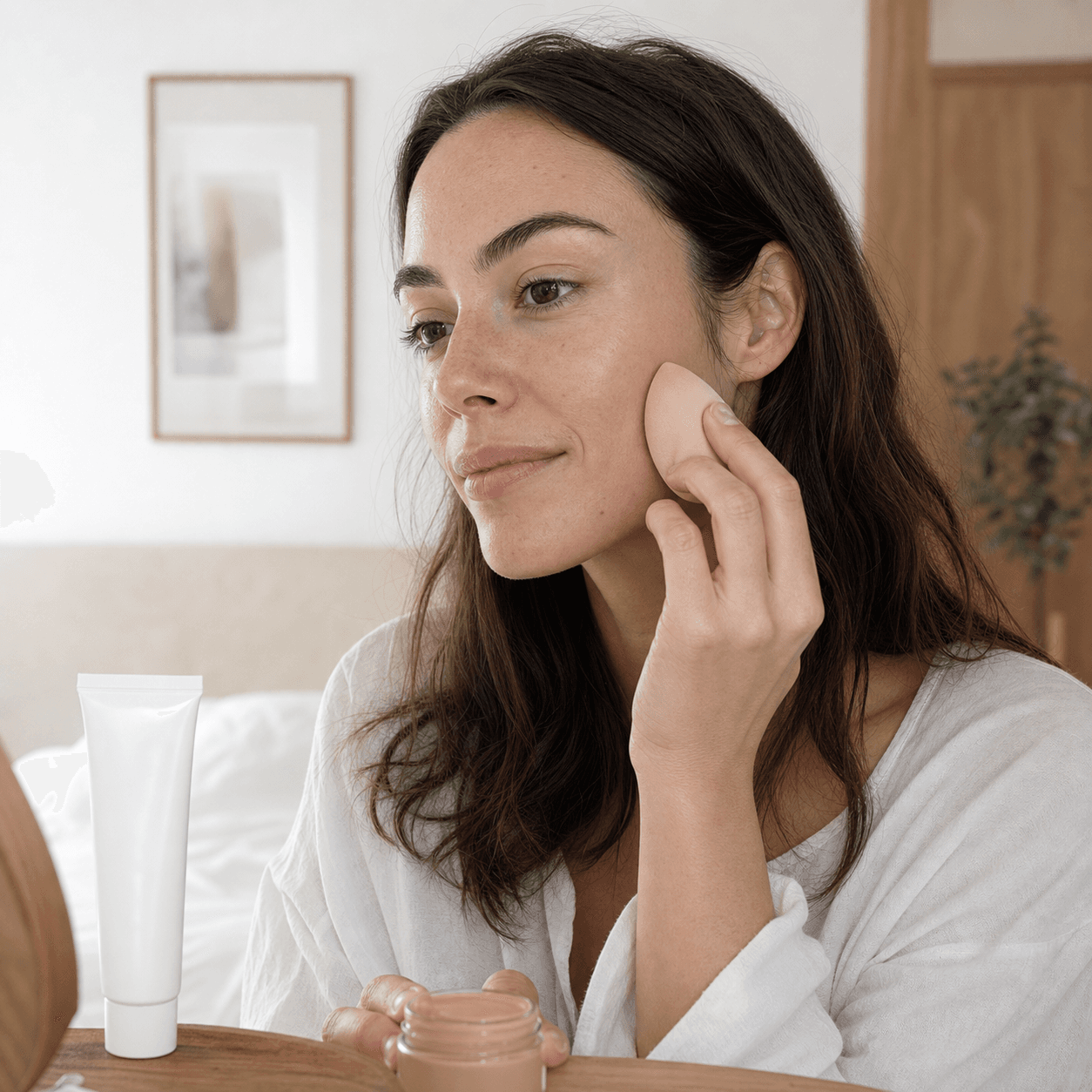
- Damp sponge: tap rather than drag; avoid repeatedly bouncing over the same area for five minutes.
- Brush: use light stippling or short strokes instead of forceful circular buffing.
- Powder: press or sweep lightly after the liquid layers have settled.
Start with less makeup and add coverage only where you want it. Full sunscreen underneath plus a thin cosmetic layer often looks better than a tiny sunscreen layer under heavy foundation.
Around the nose, hairline, brows, and jaw, check for rolling or bare patches. These are the places where repeated blending tends to move product.
Why mixing foundation and sunscreen is a bad shortcut
Mixing changes the ratio and distribution of the sunscreen you apply. The labelled SPF belongs to the finished product tested on its own at a defined amount.
A human study of two sunscreens[2] found that protection fell steeply when application amount decreased. A large beige mixture in your palm may look generous while containing very little sunscreen.
Use separate layers. If you want tint and UV protection in one product, buy a tested tinted sunscreen and use the amount on its label. Home mixing is not formulation chemistry; it is breakfast improvisation.
Can SPF foundation replace sunscreen?
In theory, an SPF foundation can deliver its labelled protection when applied in the tested amount and evenly across all exposed skin. In practice, foundation is normally used more selectively:
- thinner around the hairline
- lighter over textured areas
- absent on ears and much of the neck
- removed around the nose during the day
- applied according to coverage preference, not sunscreen testing
Treat SPF makeup as a useful extra. Put dedicated sunscreen underneath. This also frees you to wear the makeup amount you enjoy rather than the amount a laboratory test demands.
What if everything pills?
Pilling usually means too many films, too much friction, or a formula mismatch.
For three mornings, test a simpler base:
- Light moisturiser only if needed.
- Sunscreen in two even passes.
- One thin makeup layer.
Let each layer stop feeling wet before the next. If the sunscreen pills before makeup arrives, the problem is lower in the routine. If it pills only with one foundation or primer, those textures may not suit each other.
The focused guide to sunscreen pilling has a full troubleshooting test. Resist the urge to solve rolling product by adding another gripping primer. Sometimes the shelf has contributed enough.
How to reapply over makeup
During sustained outdoor exposure, the FDA label direction is to reapply sunscreen at least every two hours, and sooner after swimming or sweating[3]. Makeup makes that less elegant, not less important.
The most reliable practical method is:
- blot sweat and excess oil gently
- press lotion sunscreen over the face in sections
- let it settle
- touch up concealer, blush, or powder only where you care to
A stick, cushion, mist, or powder may be easier, but ease does not guarantee enough product. Follow the directions, use multiple passes when instructed, and combine the touch-up with shade, a hat, and shorter direct exposure.
For a normal indoor day, top up before meaningful afternoon sun rather than rebuilding your face every two hours beside the photocopier. The guide to sunscreen reapplication separates those situations.
If makeup makes you break out
The sunscreen layer is not necessarily the culprit. Foundation, brushes, sponges, sweat, removal, and repeated face touching can all matter.
Clean tools regularly, avoid sleeping in makeup, and use a gentle evening cleanse that removes the day's layers without leaving skin tight. If breakouts keep appearing, makeup-related acne deserves its own calm test rather than a ban on every product at once.
The practical takeaway
Sunscreen first, makeup second. Apply enough sunscreen, let it settle, and use thin cosmetic layers with gentle pressure.
Makeup can sit over sunscreen without cancelling it. The routine works best when protection is treated as the foundation and foundation is allowed to remain makeup.
People also ask
How long should I wait before applying makeup over sunscreen?
Wait until the sunscreen feels settled and no longer wet or very tacky. This may take a few minutes; the formula and amount matter more than an exact timer.
Does foundation remove sunscreen?
Aggressive rubbing can disturb the sunscreen film. Thin makeup layers pressed on gently are less likely to move it, and one laboratory study found makeup layered over sunscreen improved coverage under real-use conditions.
Can foundation with SPF replace sunscreen?
Usually not. Most people apply foundation too thinly and selectively to rely on its labelled SPF. Use a dedicated sunscreen layer, then treat SPF makeup as extra coverage.
How do I reapply sunscreen over makeup?
Blot gently, press sunscreen over the skin in small sections, let it settle, and repair makeup where needed. For strong or long exposure, protection matters more than preserving an untouched base.
Keep reading
- Ingredient · bis ethylhexyloxyphenol methoxyphenyl triazine
- Ingredient · zinc oxide
- Ingredient · titanium dioxide
- Ingredient · dimethicone
- Condition · pigmentation
- Condition · sensitive skin
- Condition · acne and blemishes
- Read · how much sunscreen should you use on your face
- Read · should you apply moisturizer before sunscreen
- Read · how often should you reapply sunscreen
- Read · why does sunscreen pill on my face
- Read · why does makeup break me out
Citations
- Kim MA, Jung YC, Bae J, Ha J, Kim E. Layering sunscreen with facial makeup enhances its sun protection factor under real-use conditions. Skin Res Technol. 2021;27(5):750-757.PMID 33660348
- Schalka S, Reis VMS, Cucé LC. The influence of the amount of sunscreen applied and its sun protection factor (SPF). Photodermatol Photoimmunol Photomed. 2009;25(4):175-180.PMID 19614894
- U.S. Food and Drug Administration. Questions and Answers: FDA announces new requirements for over-the-counter sunscreen products marketed in the U.S.FDA