
How much sunscreen should you use on your face?
Most people apply less sunscreen than the test amount. Learn a practical face-and-neck method that gives your SPF a fair chance without turning mornings into a lab experiment.
On this page
When I had acne, I treated sunscreen like seasoning. A little on the nose, a hopeful swipe on each cheek, then I would wonder why a product with a large SPF number did not feel especially convincing by lunchtime.
It was not a lack of good intentions. I simply had no idea that the amount mattered as much as the number on the tube. Most people do not. The bottles look small, sunscreen can be expensive, and a generous layer sounds like an invitation to look shiny in every group photo.
After helping more than 100,000 people with problem skin, I have learned that this is where sunscreen advice needs to become practical. Nobody needs a bathroom calculation. They need a method they can repeat.
The short answer
For the face and neck, two full finger-length lines of sunscreen is a useful everyday guide. Another commonly used guide is roughly a quarter teaspoon for the face alone, though measuring spoons are not required for a normal Tuesday morning.
The point is to use a generous, even layer. SPF is tested with sunscreen applied at 2 mg per square centimetre of skin[1]. In real life, people usually apply less, which means the protection on your face can be lower than the label promises.
If two long lines sound like too much for your formula, apply one layer, let it settle, then apply a second. Two calm layers beat one tiny, beautifully blended layer that leaves half your face under-protected.
Why the amount changes the protection
The SPF number is not a magical property of the liquid inside the bottle. It is the result of a standard test using a specific amount.
A 2009 human study[2] applied SPF 15 and SPF 30 products at 2, 1.5, 1.0, and 0.5 mg/cm². Protection fell significantly as the applied amount fell. The relationship was not neat or forgiving: it was exponential.
That explains a frustrating sunscreen truth. Applying half as much does not mean you receive half the labelled protection. It may be substantially less.
UVA protection also depends on the amount you use. In a study measuring UVA protection factor, investigators found an exponential relationship between application amount and UVA protection too[3]. This matters if you are trying to limit pigmentation, protect post-acne marks, or simply give your sunscreen a fair chance across the day.
A simple face-and-neck method
The two-finger guide is popular because it is quick. Run sunscreen along the length of your index and middle finger, then apply it to the face and neck.
It is a guide, not a constitutional law. Finger size, face size, product thickness, and how much neck you expose all vary. The useful habit is building a visibly even film rather than stretching one small blob until it disappears.
Try this:
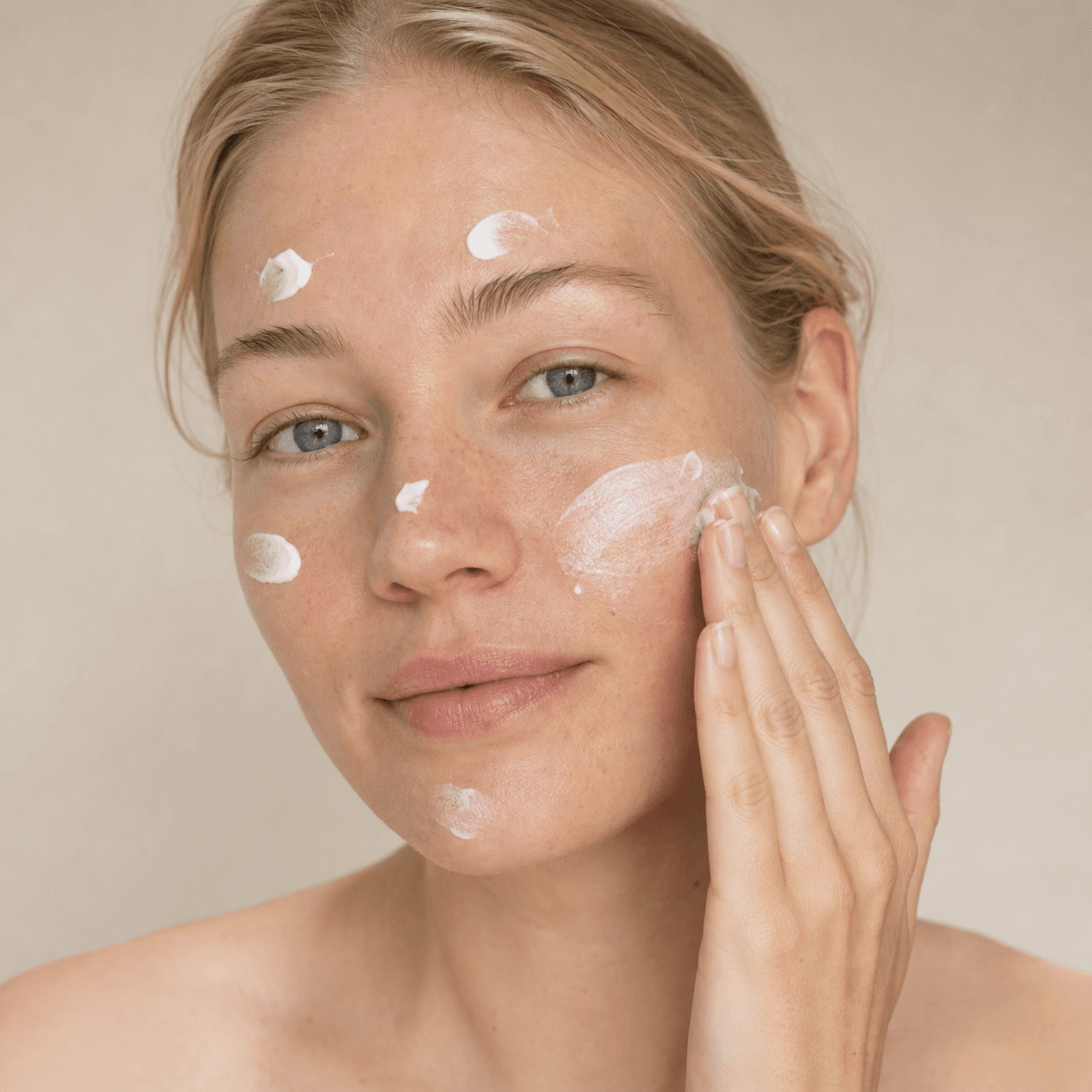
- Dot the first half across forehead, cheeks, nose, chin, and neck.
- Spread gently without racing or scrubbing.
- Add the second half to the same areas, including the hairline and ears.
- Check the parts you usually forget: jawline, sides of the face, upper neck, and exposed chest.
If your skin is sensitive or you wear a sunscreen that pills, two layers often feel easier. Let the first one sit for a minute. The aim is coverage, not speed-running a skincare challenge.
What about only the face?
If you only protect the face, you may need a little less than the face-and-neck guide. But in practice, most people expose the ears, neck, and upper chest more often than they realise.
I would rather make the routine slightly simpler: use the two-finger guide across face and neck when those areas are exposed. Add a separate body sunscreen to the ears, chest, shoulders, or scalp line when needed.
This is also a good reason to choose a sunscreen you enjoy. A formula that feels too heavy will make you ration it. A comfortable formula is much more likely to get the amount it was tested with.
Makeup, moisturiser, and sunscreen
Sunscreen goes after moisturiser and before makeup. The guide to moisturiser before sunscreen explains when you need both; the guide to makeup over sunscreen shows how to add the next layer without rubbing the SPF around.
Foundation, tinted moisturiser, and powder with SPF can be useful additions, but they are usually applied too thinly and unevenly to replace dedicated sunscreen. Treat them as makeup with a bonus, not your entire protection plan.
If everything begins to pill, do not immediately add another primer. Reduce the number of layers, use less moisturiser underneath, or wait a little longer between steps. Our guide to why sunscreen pills can help you untangle that without turning the bathroom shelf into a chemistry set.
The areas people miss
Even careful people often miss:
- the eyelids and the inner eye area, if the product is suitable there
- ears and behind the ears
- the hairline and temples
- the sides of the nose
- jawline and upper neck
- the parting in the hair or a thinning scalp
Do not force a sunscreen into your eyes if it stings. Find a different formula, wear sunglasses and a hat, and apply carefully around the orbital bone. Comfort matters because discomfort is excellent at destroying consistency.
Does a higher SPF mean you can use less?
No. SPF 50 is not permission to use a tenth of the product. It gives you a larger margin for ordinary under-application, but it still needs a decent, even layer.
Choose broad-spectrum sunscreen with an SPF that suits your exposure, then use enough of it. For long outdoor time, swimming, heavy sweating, or towelling, reapply. The fuller guide to how often to reapply sunscreen covers timing; this one is about getting the first layer right.
The practical takeaway
Do not save sunscreen for a special occasion. Put on a generous, even layer for your face and neck, use a second layer if that makes application easier, and choose a formula you can keep using.
That is it. No heroic measuring, no shiny-face shame, no chasing a perfect routine. Your sunscreen works best when it reaches your skin in the amount the label assumes.
People also ask
Is two fingers of sunscreen enough for the face?
Two full finger-length lines are a useful practical guide for the face and neck together. Face sizes and product textures differ, so aim for a generous, even film rather than a tiny precise-looking dab.
How much sunscreen should I use on my face if I wear makeup?
Apply the full sunscreen layer before makeup. Makeup with SPF is rarely applied evenly or generously enough to replace a dedicated sunscreen layer.
Can I apply sunscreen in two layers?
Yes. Two lighter, even layers can make it easier to reach a generous amount, especially with a fluid or a formula that pills when applied all at once.
Should sunscreen go on before or after moisturiser?
Sunscreen is usually the final skincare step before makeup. Let moisturiser settle first if you use one, then apply your sunscreen evenly.
Keep reading
- Ingredient · diethylamino hydroxybenzoyl hexyl benzoate
- Ingredient · zinc oxide
- Ingredient · avobenzone
- Ingredient · ethylhexyl triazone
- Condition · pigmentation
- Condition · sensitive skin
- Condition · signs of ageing
- Read · how often should you reapply sunscreen
- Read · should you apply moisturizer before sunscreen
- Read · can you wear makeup over sunscreen
- Read · does sunscreen expire
- Read · can you tan with sunscreen
- Read · why does sunscreen pill on my face
Citations
- U.S. Food and Drug Administration. Labeling and Effectiveness Testing: Sunscreen Drug Products for Over-the-Counter Human Use — Small Entity Compliance Guide.FDA
- Schalka S, Reis VMS, Cucé LC. The influence of the amount of sunscreen applied and its sun protection factor (SPF): evaluation of two sunscreens including the same ingredients at different concentrations. Photodermatol Photoimmunol Photomed. 2009;25(4):175-180.PMID 19614894
- Hwang YJ, Park HJ, Hahn HJ, et al. Immediate pigment darkening and persistent pigment darkening as means of measuring the ultraviolet A protection factor in vivo: a comparative study. Br J Dermatol. 2011;164(6):1356-1361.PMID 21250967