
Melasma during pregnancy: what is safe and what can wait
Pregnancy melasma is common, harmless and emotionally difficult. Learn why it appears, which routine changes are sensible, and which actives should wait.
On this page
Pregnancy already gives you enough decisions. A dark patch appearing across both cheeks should not require a second career in cosmetic chemistry.
My own skin history is acne, oiliness, dehydration and irritation, not pregnancy or melasma. I will not turn somebody else's hormonal skin change into a personal anecdote. What I have learned from helping readers with problem skin is that the worry often arrives before the pigment itself: Can I treat this, and will I harm the baby if I choose the wrong bottle?
The calm answer is that melasma is harmless, treatment can wait, and a short routine is usually the most sensible place to begin.
The short answer
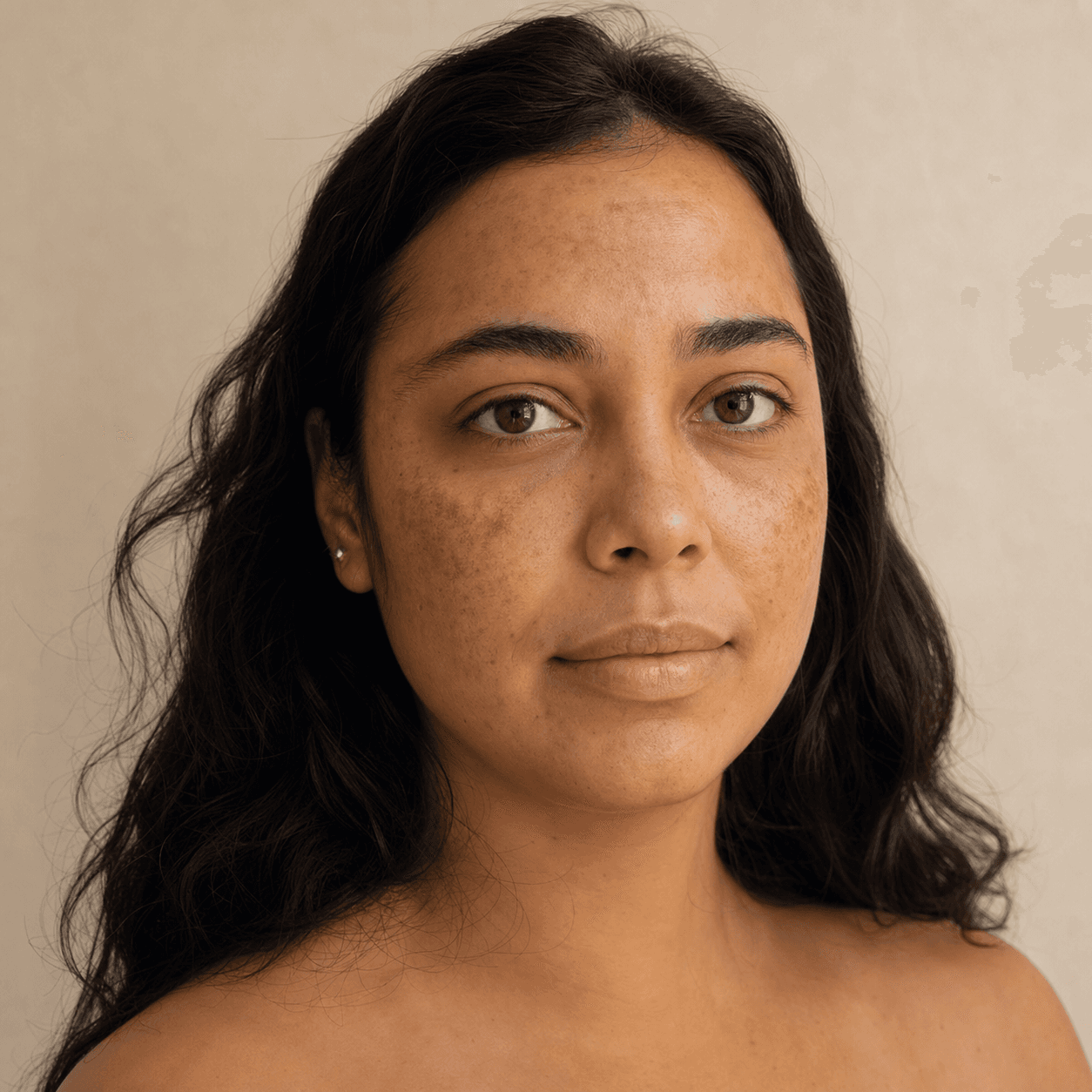
Pregnancy can trigger melasma: flat, usually symmetrical brown or grey-brown patches on the cheeks, forehead, nose or upper lip. Hormonal changes make pigment-producing cells more responsive, while daylight helps keep that pigment signal switched on.
Some pregnancy-triggered melasma fades after birth. Some stays for longer. Neither outcome says anything about how well you cared for your skin.
During pregnancy, focus on gentle cleansing, moisturiser when needed and sun protection you can use consistently. The American Academy of Dermatology advises avoiding retinoids and hydroquinone during pregnancy[1]. Ask your obstetrician or dermatologist to review every prescription and active product rather than trying to judge safety from an ingredient's reputation online.
What pregnancy melasma looks like
Melasma tends to make patches rather than individual spots. The colour may be light brown, deep brown or grey-brown depending on skin tone and pigment depth. Common areas include:
- both cheeks
- the centre of the forehead
- the bridge of the nose
- the skin above the upper lip
- sometimes the jawline
The symmetry is a useful clue. So is the fact that the skin surface usually feels normal: no scale, no crust and no raised edge.
That does not make a mirror a diagnostic tool. A new mark that is one-sided, raised, itchy, sore, bleeding or changing deserves qualified assessment. Melasma is common, but not every dark patch is melasma.
Why pregnancy can trigger it
The AAD lists pregnancy as a recognised melasma trigger and explains that rising oestrogen and progesterone are thought to play a part[2]. Genetics and baseline skin tone also affect who develops it.
The biology is more involved than "hormones equal brown patches." A 2022 review of melasma pathogenesis[3] describes a network involving active melanocytes, hormonal signals, solar radiation, inflammation and communication between cells in the epidermis and upper dermis.
Think of the melanocyte as a pigment workshop. Pregnancy can turn up several instructions arriving at the workshop, while light supplies another repeat order. The workshop does not become damaged or dirty. It becomes more active in certain areas.
This also explains why scrubbing does so little. The colour is being made and distributed within living skin. It is not a surface stain.
A pregnancy-safe routine starts with subtraction
This is not the season for six brightening serums.
Morning
- Cleanse only as much as you need. Lukewarm water may be enough if the skin feels comfortable. Otherwise use a gentle cleanser and fingertips.
- Moisturise if the skin feels tight. Choose a plain formula you already tolerate.
- Use broad-spectrum sun protection. Add a hat or shade when exposure is long. The routine has to fit real life, not an imaginary day spent perfectly indoors.
Evening
- Remove sunscreen and makeup without rough cloths or repeated rubbing.
- Use moisturiser if needed.
- Stop there unless your obstetrician or dermatologist has approved a specific treatment.
The simplicity is deliberate. Pregnancy can change sensitivity, and irritation can leave extra post-inflammatory pigment. A routine that makes the face sting is not working harder; it is making the picture noisier.
What should wait
The AAD's current pregnancy skincare guidance says to avoid retinoids, including prescription tretinoin and cosmetic retinol, and to avoid hydroquinone[1]. That is a clear reason to check labels and prescriptions early.
Do not stop a prescribed medicine silently after reading one paragraph. Contact the prescriber and explain that you are pregnant or trying to conceive. They can replace, pause or continue treatment based on the actual medicine and your health.
Also skip:
- home peels bought because they promise "professional strength"
- lemon juice, vinegar and DIY bleaching mixtures
- aggressive scrubbing
- unlabelled lightening creams
- combining several acids because one product feels too slow
Melasma moves slowly. Irritation can arrive before breakfast.
Sun protection matters, without turning this into a sunscreen article
Light exposure helps sustain melasma, so daily protection is part of medical reality. It is not a moral score.
A randomised study in people being treated for melasma found that a sunscreen designed to cover visible light as well as UV improved outcomes more than UV-only protection[4]. This is why dermatologists may suggest tinted formulas with iron oxides, especially when melasma is persistent or the skin tone develops visible-light pigmentation easily.
Use what you tolerate and can apply properly. A hat, shade and avoiding deliberate tanning also count. No skincare product needs to carry the whole job alone.
Which brightening ingredients can you use?
Pregnancy safety data are uneven because pregnant people are rarely enrolled in cosmetic trials. That means "no known problem" is not the same as "proved safe for everyone."
Azelaic acid and vitamin C are often discussed as pregnancy-compatible options, but product strength, the rest of the formula and your medical history still matter. Ask your clinician before beginning a treatment active. If the pigment is not causing distress, choosing no brightener at all is valid.
The goal during pregnancy can simply be to prevent extra irritation and wait.
What happens after birth?
Hormone levels change again after delivery, and melasma may gradually soften. Give it months rather than inspecting it every three days under a bathroom spotlight.
If pigment persists, a dermatologist can confirm the diagnosis and discuss options such as azelaic acid, prescription combinations, tranexamic acid, procedures or later use of hydroquinone. Breastfeeding, skin tone, sensitivity and the pigment's depth all change that conversation.
Seek care sooner when:
- you are unsure the patch is melasma
- the mark changes, bleeds, itches or becomes raised
- pigmentation follows a rash or a strong procedure
- the emotional effect is becoming heavy
- you need help checking medication safety
Melasma is medically harmless, but feeling upset by a visible change is not vanity. You are allowed to ask for help.
My practical advice is pleasantly boring: protect the skin, avoid known pregnancy-incompatible actives, keep irritation low and let a qualified clinician handle the uncertain parts. There will be time for a more active pigment plan later.
People also ask
Does pregnancy melasma go away after birth?
It may fade as hormone levels settle, but the timeline varies and some pigment persists. Give the skin time, keep sun protection consistent, and ask a dermatologist about treatment if it continues to bother you.
Can I use retinol or hydroquinone for melasma while pregnant?
The American Academy of Dermatology advises avoiding retinoids and hydroquinone during pregnancy. Review every prescription and cosmetic active with your obstetrician or dermatologist.
Is melasma during pregnancy dangerous?
Melasma itself is harmless. A new mark that is raised, bleeding, painful, itchy, one-sided or changing in shape or colour is not a typical melasma pattern and should be assessed.
When can I treat melasma after pregnancy?
That depends on whether you are breastfeeding, which treatment is being considered and your medical history. A dermatologist can build a plan that fits the timing rather than applying one rule to every parent.
Keep reading
Citations
- American Academy of Dermatology. Dermatologist-approved pregnancy skin care. Updated June 26, 2025.AAD
- American Academy of Dermatology. Melasma: Causes.AAD
- Espósito ACC, et al. Update on Melasma-Part I: Pathogenesis. Dermatol Ther (Heidelb). 2022;12(9):1967-1988.PMID 35904706
- Castanedo-Cazares JP, et al. Near-visible light and UV photoprotection in the treatment of melasma: a double-blind randomized trial. Photodermatol Photoimmunol Photomed. 2014;30(1):35-42.PMID 24313385