
Homosalate
A UVB filter permitted under specific EU concentration and product restrictions; assess the protection and suitability of the finished sunscreen.
At a glance
What Homosalate does for skin, and how to read the practical safety signals.
- Role: Homosalate absorbs UVB radiation.
- EU limit: Up to 7.34% in face products, excluding propellant sprays.
- Safety context: The SCCS assessment applies to specified uses and exposure.
- Type
- UV filter
- Rating
- Pregnancy
- Discuss with a clinician
- Comedogenic rating
- Not established
- Vegan
- Depends on source
- Suited skin types
- Depends on formula
On this page
Homosalate is an organic sunscreen filter that absorbs UVB radiation.[3] It is one part of a sunscreen formula. I would start with the finished product's protection claims and directions, rather than deciding whether a bottle is good or bad from this name alone.
What the EU permits now
The EU cosmetics regulation, consolidated on 1 May 2026, allows homosalate at up to 7.34% in face products, excluding propellant spray products.[1] That distinction includes the intended body area and type of packaging. It is not a general 7.34% allowance for every sunscreen.
The amendment set two transition dates: non-compliant products could no longer be placed on the EU market from 1 January 2025 or made available from 1 July 2025.[4] An older article quoting the former 10% allowance needs that update. Rules in another market should not be treated as the current EU rule.
Why the permitted use became narrower
The European Commission requested a safety assessment after concerns about possible endocrine-disrupting properties. In its December 2021 advice, the SCCS concluded that homosalate was safe as a UV filter up to 7.34% in face cream and pump spray, considering those concerns and the assessed exposure.[2]
The earlier broad use at up to 10% did not receive the same conclusion. The regulation explains that the later calculation used a facial-product exposure scenario.[4] Applying a product to a limited area and applying it more widely are different exposure assumptions. That is why the product restriction belongs beside the percentage whenever the rule is explained.
This does not support calling every use harmless or every product dangerous. It supports a specific conclusion within specified conditions. If you prefer a different filter, you can make that choice without turning a regulatory assessment into a prediction about your own health.
Read the finished sunscreen label
Homosalate's UVB absorption does not establish a product's UVA protection or tested SPF.[3] Look for the protection stated on the bottle. The American Academy of Dermatology recommends broad-spectrum, water-resistant SPF 30 or higher together with shade and protective clothing.[5]
If you are comparing filters, the separate guides to avobenzone and zinc oxide explain their roles. A longer ingredient list is not, by itself, a useful reason to reject a sunscreen. You still need to know what the complete product is designed to do.
Follow the directions for the intended area, amount and reapplication. The sunscreen reapplication guide can help with that routine. Do not dilute a sunscreen or try to mix your own concentration from this regulatory number.
What I would not infer from the name
These sources do not give a universal pore-clogging score, verify vegan sourcing or answer a pregnancy-specific question for your finished product. Those fields remain unknown here. The manufacturer can answer sourcing questions, while a qualified clinician can discuss individual medical circumstances.
The same limit applies when choosing for sensitive or acne-prone skin: this page cannot promise that a particular bottle will suit you. If you have reacted to a product, keep its packaging and ingredient list for the person helping you assess it. Replacing one named ingredient without understanding the reaction can leave you guessing.
I gathered the useful information here so you can read the label, understand the restriction and return to a simple routine. The Danish Skin Care Kit is the routine I created after helping more than 100,000 people with problem skin. That is routine context, not a claim that the Kit contains homosalate or was evaluated in this regulatory assessment. If you have questions, email me at info@danishskincare.com.
Common questions
Is homosalate banned in the EU?
No. The consolidated EU cosmetics regulation permits up to 7.34% in face products, excluding propellant spray products. That is a restriction on concentration and use, not a complete ban.
Does homosalate provide complete sun protection?
Homosalate absorbs UVB. Its presence alone does not establish broad-spectrum protection or a particular SPF for a finished product. Check the sunscreen label.
Why did the EU restrict homosalate?
The safety assessment considered concerns about potential endocrine-disrupting properties and exposure. The SCCS supported up to 7.34% for face cream and pump spray, a narrower scenario than the earlier use conditions.
Can an ingredient list confirm pregnancy safety or vegan status?
The ingredient name alone cannot provide those assurances for your product. Ask a qualified clinician about pregnancy-specific use and the manufacturer about ingredient sourcing.
Reading a real label?
Scan a product to see how it is formulated
Upload a photo of the ingredient list and get a quick ingredient-by-ingredient read against the evidence-led database.
Skin conditions it actively helps with
Where the published evidence puts Homosalate on the short list of active ingredients worth reaching for.
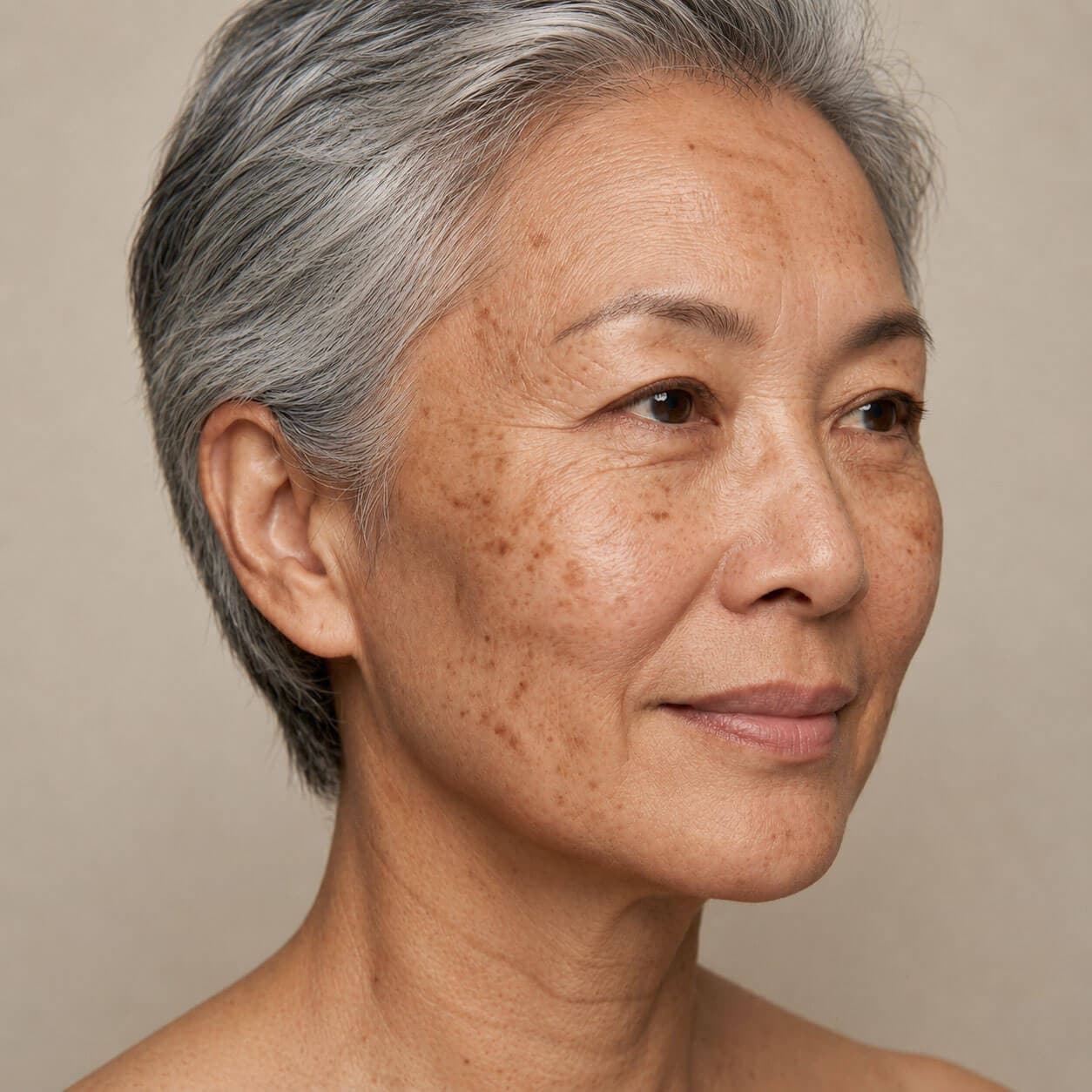
Pigmentation
Pigmentation is one of the most-asked-about, most-misunderstood skin concerns. Here's what's happening in your skin and the slow, evidence-led routine that actually fades it.

Signs of ageing
Wrinkles, sallowness, slack tone, and uneven pigment all share the same drivers. Here's the unglamorous routine that genuinely slows them.
Related ingredients
Citations
- European Union. Regulation (EC) No 1223/2009 on cosmetic products. Consolidated version of May 1, 2026. Annex VI, entry 3: Homosalate. — EU 1223/2009, Annex VI
- Scientific Committee on Consumer Safety. Scientific Advice on the safety of Homosalate (CAS No 118-56-9, EC No 204-260-8) as a UV-filter in cosmetic products. December 2, 2021. SCCS/1638/21. — SCCS/1638/21
- National Center for Biotechnology Information. PubChem Compound Summary for CID 8362, Homosalate. Accessed September 18, 2026. — PubChem CID 8362
- European Commission. Commission Regulation (EU) 2022/2195 of November 10, 2022. Homosalate restrictions and transition dates. — EU 2022/2195
- American Academy of Dermatology. Sunscreen FAQs. Accessed September 18, 2026. — American Academy of Dermatology