
How to test a new skincare product
A practical first-use guide: where to try a new moisturiser, how long to observe your skin, what a home check cannot tell you and when to ask a dermatologist.
On this page
I would rather you open one new bottle this week than replace your whole bathroom shelf in an evening. When you change everything together, even deciding which product feels comfortable becomes difficult. A little patience gives you a clearer starting point.
For an ordinary new moisturiser, the American Academy of Dermatology recommends testing a small area twice daily for seven to ten days before wider use.[1] That gives you a chance to notice a reaction on a limited area. It cannot promise that your face will tolerate the product indefinitely.
Check that a home test fits the situation
This guide is for trying an ordinary cosmetic product you have not used before. If a product has already caused a rash, swelling or a significant reaction, ask a clinician before retrying it. I would not turn a previous reaction into a home experiment.
Choose calm, intact skin for the test. DermNet advises using an area without dermatitis; it also explains that open application testing does not assess immediate allergic reactions such as anaphylaxis.[2] If you have a known allergy, follow your clinician's avoidance advice rather than testing whether you can tolerate the ingredient this time.
Read the directions before opening the tube. A weekly exfoliant, a prescription treatment and a daily moisturiser need different instructions. Do not apply a strong active twice daily because you saw that schedule in a general skincare guide. Ask your prescriber how to introduce a medicine, and do not change prescribed treatment to make room for a cosmetic test.
Set up one small, repeatable check
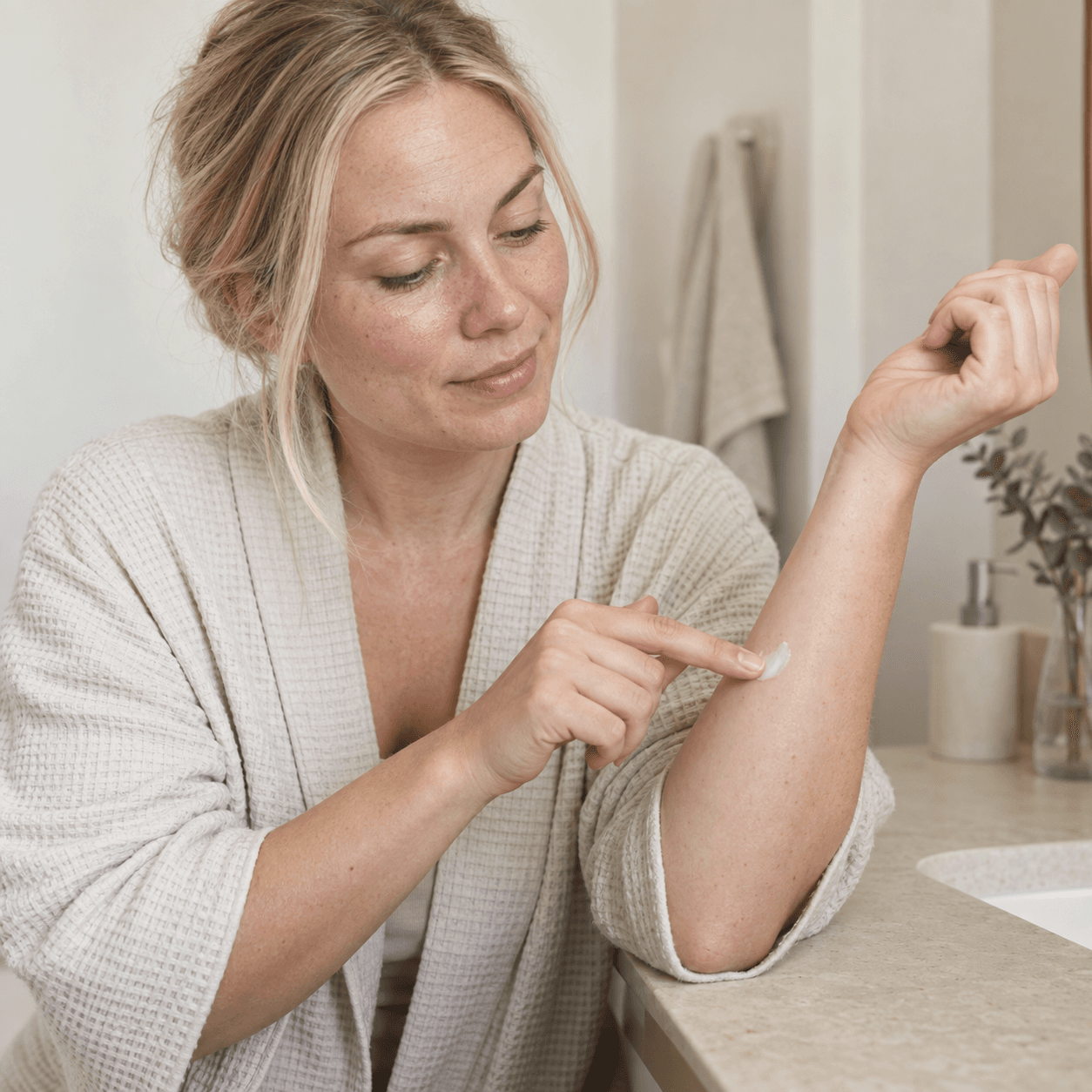
For an ordinary moisturiser, choose a coin-sized spot on the inner arm or elbow bend. Apply the normal amount for that small area, twice daily for seven to ten days, following the AAD's method.[1] Keep the product uncovered. You are trying it on your skin, not creating a medical patch test with tape from a drawer.
Leave a leave-on product on for its usual time. Rinse off a cleanser according to its instructions; a wash-off formula does not become a better test if you leave it overnight. DermNet makes the same distinction between leave-on products and products that need rinsing.[2]
Pick a week when the check is easy to remember. Keep the tube beside your usual moisturiser, and write the start date in your phone. If you miss an application, note it rather than applying extra next time. More product would change the conditions you were trying to observe.
Use the same product and the same spot. Testing three new formulas together leaves you with the same question you started with: which one caused the change? There is no prize for getting through a parcel of skincare faster.
Notice comfort as well as appearance
Before applying again, look at the area and consider how it feels. Note itching, burning, soreness, swelling or a new rash. A quick photograph in similar lighting can help you describe a change later, but it does not diagnose its cause.
If a reaction develops, gently wash the product off and stop using it. The AAD suggests a cool compress or petroleum jelly for relief.[1] Seek medical advice for a severe or persistent reaction. Do not keep applying the product to complete the full testing period.
A simple note is enough: product name, date, application site and what changed. Keep the ingredient list too. Writing down "itchy after the second evening" is more useful than deciding that an entire ingredient family must be unsuitable for you.
Understand what a quiet test area means
An uneventful test means that this patch of skin tolerated those applications over those days. Your face is a different location, and the conditions can change when you use the product in your usual routine.
A 2005 controlled exposure study tested a moisturiser with different concentrations of one preservative in sensitised volunteers and controls. Reactivity varied by body site, increasing from the upper arm to the neck and possibly the face.[3] That is a useful reason to avoid treating an arm test as a guarantee for facial skin.
The participants with allergy were already sensitised, and the researchers studied a particular preservative and formulation. The study does not tell us what percentage of all shoppers will react to a new cream. Nor does it show that preservatives as a group should be avoided.
A home check also does not measure whether a product will treat your acne, fade a mark or prevent clogged pores. Keep those questions separate. Buying something labelled for sensitive skin still leaves you with a product to introduce thoughtfully, rather than a personalised promise.
Introduce the product without changing everything else
If the check stays uneventful, begin ordinary use according to the label while keeping the rest of your routine familiar. Resist adding the new serum, cleanser and mask on the same evening. You will have a clearer record if discomfort appears later.
For example, if you bought a replacement moisturiser, start by making that the only change. Keep a note of when you began using it on your face. There is no need to grade your skin every hour or take daily comparison photographs unless a clinician has asked you to.
If your face reacts despite a quiet arm test, stop the new cosmetic and seek advice if symptoms persist or worry you. You have not failed the test. The home observation had limits, which is why it should never overrule a reaction you can feel now.
Know when medical patch testing is the useful next step
Repeated or unexplained rashes deserve an assessment. Medical patch testing helps a dermatologist investigate delayed contact allergy by applying selected allergens under patches and checking the skin at later visits.[4] A small dab of your own cream cannot identify which ingredient caused a reaction.
Bring the products and your notes to the appointment. Ask how to read ingredient labels once the clinician identifies a relevant allergy. The practical aim is to find products you can use, without guessing your way through every bottle in the shop.
Sudden swelling of the lips, mouth, tongue or throat, or trouble breathing or swallowing, needs emergency help.[5] Do not wait for the test period to finish or try another skincare product to calm it.
At Danish Skin Care, I favour routines with few moving parts. You do not need a new kit to test one moisturiser. Start with one product, follow its directions and let comfort decide whether it deserves a place beside the products you already use.
People also ask
How long should I test a new moisturiser?
The AAD suggests applying an ordinary skincare product to a small test area twice daily for seven to ten days. Follow product directions; this schedule does not override restrictions on exfoliants, retinoids or medicines. Stop if a reaction develops.
Where should I test a new skincare product?
Use a small area of intact, calm skin on the inner arm or elbow bend for an ordinary moisturiser. Do not use broken or inflamed skin, and do not tape the product under a patch. An arm check cannot guarantee that facial skin will tolerate it.
Does a clear home test rule out allergy or breakouts?
No. The result only describes that product on that area during those days. It cannot identify an allergen, exclude every later reaction or establish that the product will not cause facial breakouts.
Should I test a product again if it previously caused a rash?
Ask a clinician before trying it again. Repeated or unexplained rashes may need medical patch testing. Sudden swelling of the lips, mouth, tongue or throat, or breathing or swallowing difficulty, needs emergency help.
Keep reading
Citations
- American Academy of Dermatology. How to test skin care products. Updated August 10, 2021.American Academy of Dermatology
- Ryder E; Oakley A, editor. Open application test. DermNet. July 2014.DermNet
- Zachariae C, Hall B, Cottin M, Cupferman S, Andersen KE, Menné T. Experimental elicitation of contact allergy from a diazolidinyl urea-preserved cream in relation to anatomical region, exposure time and concentration. Contact Dermatitis. 2005;53(5):268-277. doi:10.1111/j.0105-1873.2005.00712.x.PMID 16283905
- American Academy of Dermatology. Patch testing can find what's causing your rash.American Academy of Dermatology
- NHS. Angioedema. Reviewed August 25, 2026.NHS