
Can hair dye cause a rash? Allergy, irritation and next steps
An itchy hairline, sore ears or facial rash after colouring can involve irritation or contact allergy. Learn what to stop, why old favourites can cause trouble and how medical patch testing helps.
On this page
Yes. Hair dye can cause an itchy rash, burning, soreness or blisters. Symptoms sometimes take up to 72 hours to appear, so a reaction need not start while the colour is developing.[1]
I would keep the dye box before replacing your face cream. If your hairline or ears become uncomfortable after colouring, the product name, shade and timing give a clinician something useful to investigate. A new skincare routine can wait until you know what you are dealing with.
What should you do if a reaction starts?
Stop using the dye. If symptoms start during colouring, wash your hair and scalp thoroughly with mild shampoo. A pharmacist can advise on mild symptoms; get medical advice if the reaction worsens or does not settle.[1]
Sudden swelling of the mouth, tongue or throat, trouble breathing or swallowing, or collapse needs emergency help immediately. Call your local emergency number. Serious allergic reactions to hair dye are rare, but these symptoms should never wait for a salon appointment.[1]
Keep the packaging and take photographs once you have dealt with any immediate symptoms. You do not need to identify the culprit ingredient before asking for help.
Why can a hair product affect your face?
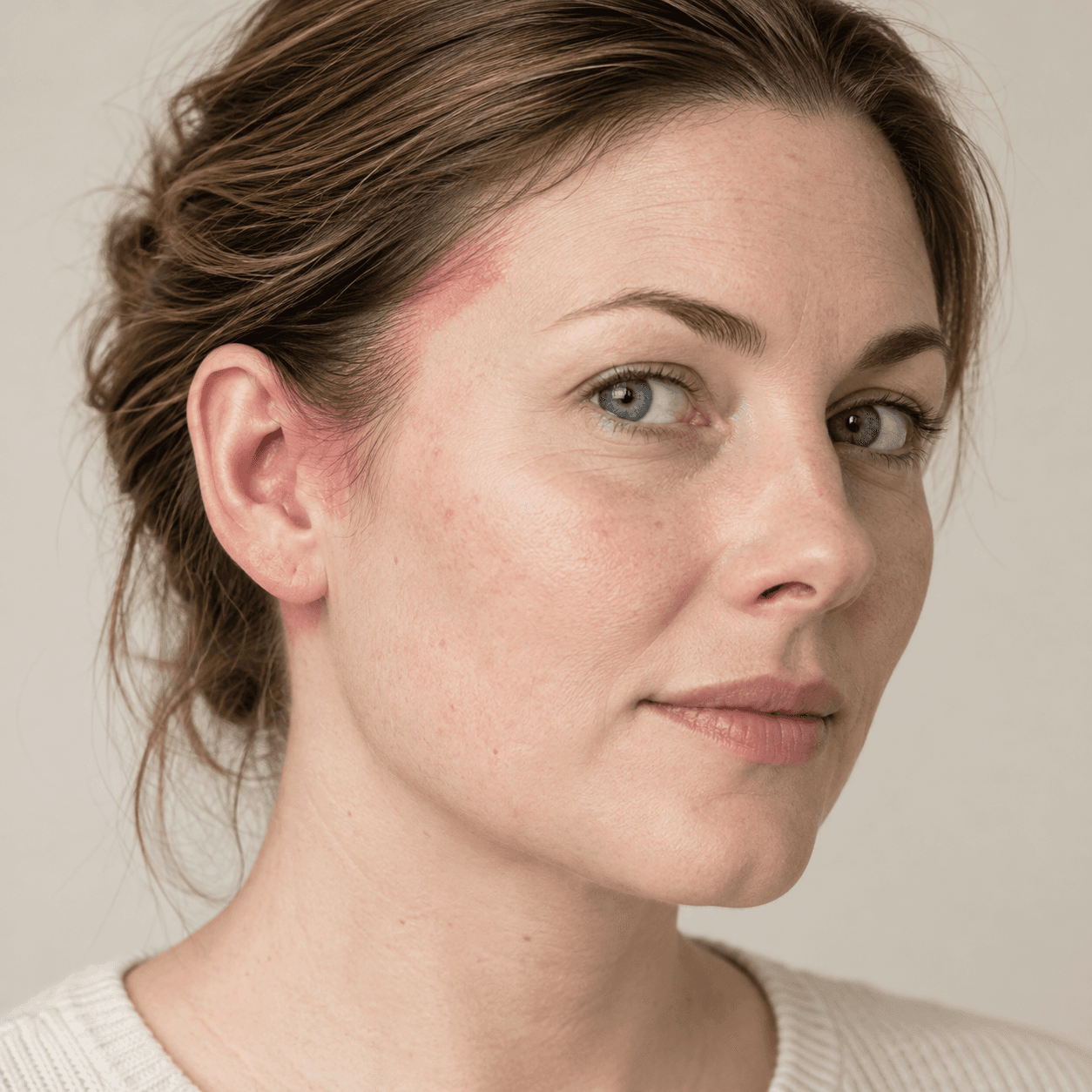
Hair dye allergy can appear around the ears or eyelids, with more extensive reactions involving the scalp, face and neck. DermNet describes both mild itchy patches and more severe swelling or blistering.[2] A rash does not have to stay neatly inside the hairline.
A 2018 study examined 105 patients with patch-test-confirmed hair dye allergy. The face was affected in 57.1%, compared with 36.2% for the scalp. Itch was the most common symptom.[3] Those findings explain why a facial rash belongs in the conversation about colouring.
They do not mean that more than half of people who colour their hair will get a facial rash. Everyone in the study already had diagnosed allergy. The researchers reviewed hospital records and interviewed patients; they did not follow a representative group of hair-dye users to measure their risk.
Small clogged bumps after styling products raise a different question. Our guide to hair products and breakouts covers that pattern. It should not be used to explain away swelling, blistering or an itchy rash after dye.
Irritation and allergy are different possibilities
PPD, short for paraphenylenediamine, is a dye ingredient that can cause allergic contact dermatitis. Other dye ingredients, preservatives or fragrances may be responsible too. Hair treatments can also cause irritant dermatitis, without an allergy to PPD.[2]
Allergic contact dermatitis involves the immune system reacting to a particular substance. The British Society for Cutaneous Allergy explains that identifying that substance guides what a person needs to avoid.[4] Calling every reaction “sensitive skin” loses that useful distinction.
Burning, itching and timing are clues to report, not a reliable home test that separates irritation from allergy. Give the clinician the full story rather than deciding from one symptom which mechanism must be responsible.
Our broader sensitive-skin guide discusses everyday product tolerability. A recurring reaction linked to colouring deserves its own assessment.
Can an old favourite suddenly cause trouble?
Yes. The FDA notes that sensitivities can develop with repeated exposure and that formulations can change. Years of uneventful colouring do not guarantee that the next application will be uneventful.[5]
That can be frustrating when you have already found a shade you like. I would still pause the next application rather than trying to finish the box. Familiarity is useful history for the appointment; it cannot clear a product that now causes symptoms.
Write down whether the brand, shade, developer or salon service changed. Include products applied before and after the colour, and say whether a similar reaction happened previously. If you colour your hair professionally, ask the salon for the exact product information rather than relying on a description such as “our gentle colour.”
Why “PPD-free” is not a personal safety guarantee
The British Society for Cutaneous Allergy warns that related dye substances can also cause problems in people allergic to PPD. Its guidance includes salon and home products, and cautions against assuming that temporary, semi-permanent or PPD-free alternatives will suit everyone.[4]
A small 2016 study tested 15 commercial dyes promoted with claims such as hypoallergenic, non-allergenic or no PPD. Of 23 participants with PPD allergic contact dermatitis, 20 reacted to at least one product during patch testing.[6]
This was a selected group of allergic patients, a small product sample and a clinical test setting. The authors also acknowledged possible false-positive reactions. The result does not establish that 87% of customers will react, that every PPD-free product contains PPD, or that today's formulas match those tested.
The practical point is narrower: a front-label claim cannot select your next dye for you. Bring the complete ingredient list and your allergy results to someone qualified to interpret them. There is no need to abandon every cosmetic ingredient with an unfamiliar name.
What medical patch testing can tell you
A dermatologist may recommend patch testing when a rash persists or keeps returning. Selected allergens go under patches, commonly on the back, and the clinic checks for delayed reactions over several visits. This differs from a skin-prick test, which looks for immediate allergy.[7]
Tell the clinic about previous dye reactions, your work if it involves colouring hair, and any black henna tattoos. Those tattoos can be a source of PPD exposure, even if you have never coloured your hair before.[2]
A negative first series does not always identify or exclude every relevant trigger. The AAD explains that a clinician may test additional substances when the cause remains unclear.[7] Follow the clinic's instructions and attend the later readings; the interpretation needs more than a photo of the patches on day one.
Once you have results, ask for the allergen names in writing and a practical explanation of which products to avoid. “Hair dye allergy” is useful shorthand, but the specific findings are what you and your hairdresser need for future decisions.
A box test is different from an allergy investigation
For ordinary use before any suspected reaction, follow the dye's directions, including its preliminary skin test. The FDA recommends testing before every application and warns that even a negative result cannot guarantee you will not react during colouring. It also advises against dyeing an irritated or damaged scalp.[5]
After a suspected reaction, ask for medical advice before trying the same dye or an alternative. Do not use repeated home tests to give yourself permission to recolour. A strand test on hair and an investigation of delayed skin allergy answer different questions.
Our guide to testing a new skincare product concerns ordinary finished skincare. It is not a protocol for investigating a hair-dye reaction.
Give the next appointment useful information
Keep a short record:
- The colouring date and when the first symptom appeared.
- The exact products and shade, including developer and aftercare.
- Photographs showing where the rash appeared and how it changed.
- Earlier dye reactions, tattoo history and treatments already tried.
I favour simple routines, but simplicity here starts with pausing the suspected exposure and finding the cause. There is no reason to buy a collection of soothing serums before that conversation. Get the rash assessed, then decide what belongs in your bathroom and what needs to leave it.
People also ask
Can hair dye cause a rash on my face or ears?
Yes. Hair dye contact allergy can affect the face, eyelids, ear rims or neck as well as the scalp. In a study of 105 patients with confirmed hair dye allergy, the face was the most common affected area. The location alone cannot diagnose the cause.
Can I react to a hair dye I have used for years?
Yes. Previous use without a reaction does not rule out later sensitization, and formulas can change. Stop a dye that causes symptoms and seek advice before using it again, even if it is a familiar brand and shade.
Is PPD-free hair dye safe if I have a hair dye allergy?
A PPD-free label does not guarantee that a dye suits you. Related dye ingredients or other substances can still matter. If you have reacted before, discuss the exact formula and your test results with a dermatologist rather than trying another product at home.
Does a negative home hair dye test rule out an allergy?
No. The FDA warns that a reaction can still occur during colouring after a negative preliminary skin test. Follow product instructions before ordinary use, but after a suspected reaction seek medical advice rather than using another home test to clear yourself for recolouring.
Keep reading
Citations
- NHS. Hair dye reactions. Reviewed December 29, 2025. Accessed October 12, 2026.NHS
- Ngan V. Allergy to paraphenylenediamine. Updated by Gomez J. DermNet. August 2018. Accessed October 12, 2026.DermNet
- Han JH, Lee HJ, Bang CH, Lee JH, Park YM, Lee JY. P-Phenylenediamine Hair Dye Allergy and Its Clinical Characteristics. Annals of Dermatology. 2018;30(3):316-321. doi:10.5021/ad.2018.30.3.316.PMID 29853746
- British Society for Cutaneous Allergy. Paraphenylenediamine (PPD). Patient information leaflet. Accessed October 12, 2026.British Society for Cutaneous Allergy
- U.S. Food and Drug Administration. Hair Dyes. Accessed October 12, 2026.U.S. Food and Drug Administration
- Lee HJ, Kim WJ, Kim JY, Kim HS, Kim BS, Kim MB, Ko HC. Patch tests with commercial hair dye products in patients with allergic contact dermatitis to para-phenylenediamine. Indian Journal of Dermatology, Venereology and Leprology. 2016;82(6):645-650. doi:10.4103/0378-6323.186495.PMID 27451929
- American Academy of Dermatology. Patch testing can find what's causing your rash. Written by Paula Ludmann, MS. Updated March 15, 2021. Accessed October 12, 2026.American Academy of Dermatology