
Can deodorant cause an underarm rash?
Deodorant and antiperspirant can irritate underarm skin or trigger contact allergy. Learn what to stop, how to care for a mild rash and when testing or medical advice helps.
On this page
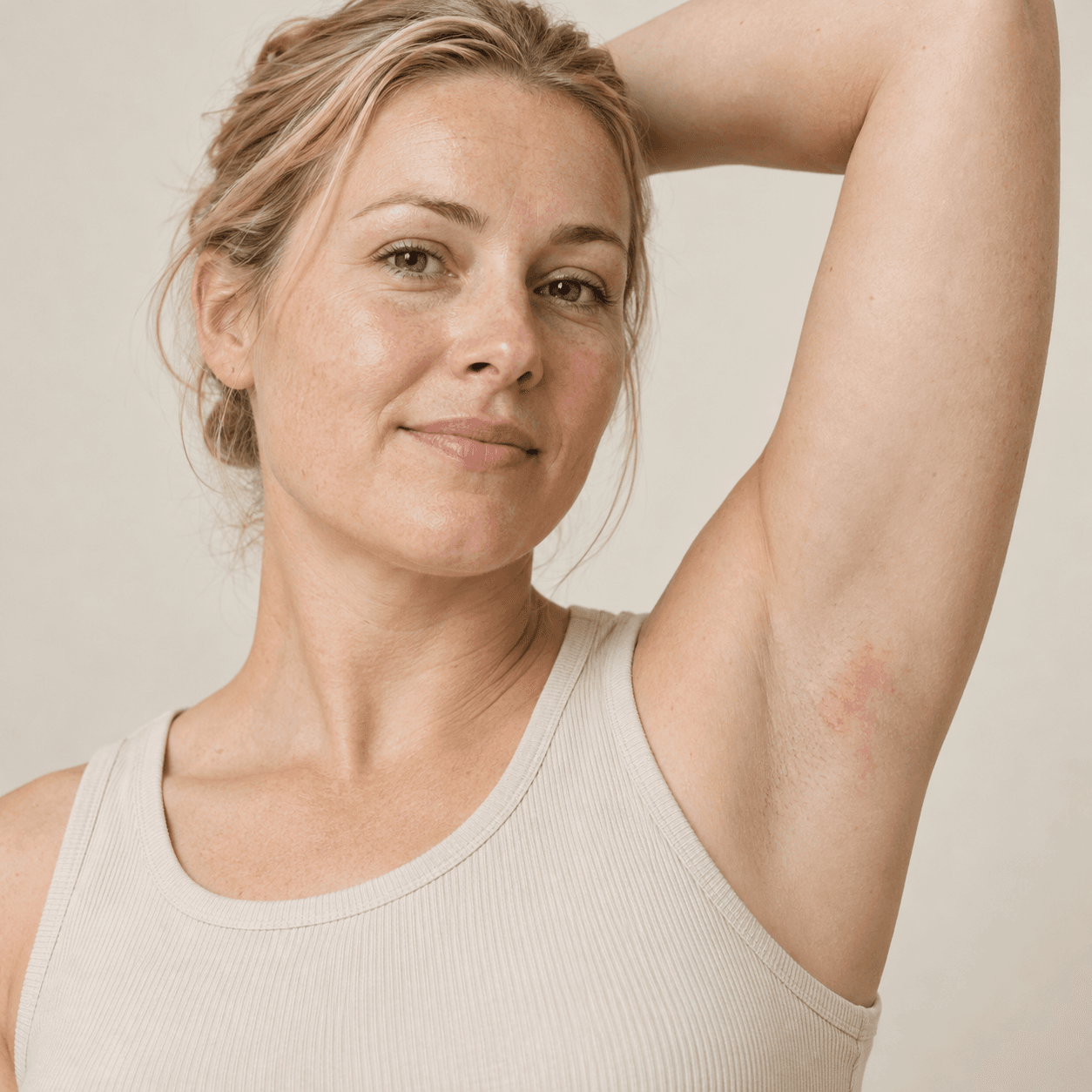
Yes. Deodorant and antiperspirant can cause an underarm rash through irritation or contact allergy. Stop the product you suspect rather than applying another layer over sore skin. A rash that persists, keeps returning or becomes severe deserves medical assessment.[1][2]
I would keep the bottle, even if you never want to use it again. Its ingredient list is more useful for finding the cause than buying three replacements labelled for sensitive skin. For now, give the irritated area fewer things to deal with.
Is it irritation or an allergy?
Irritant contact dermatitis happens when an exposure damages the skin's outer barrier. Allergic contact dermatitis involves an immune response to a substance your skin has become sensitised to. Both can produce an uncomfortable rash, so appearance alone cannot settle the question.[2]
An itchy, dry or cracked patch may look red on lighter skin. On darker skin, the colour change can look dark brown, purple or grey. Notice texture, soreness and itching as well as colour; you do not need bright redness for a rash to matter.[2]
Contact allergy often appears a day or more after exposure. You can also become allergic after using an ingredient for years without trouble.[3] That makes the timing less tidy than “I used it this morning and immediately reacted.” A familiar deodorant still belongs on the list of products to discuss with your clinician.
Write down when the discomfort began, which products touch the area and whether you recently changed hair removal, clothing or antiperspirant strength. These are clues to share, not a way to diagnose yourself from a checklist.
What a deodorant study tells us about fragrance
In a 1998 study, 14 eczema patients with known fragrance-mix sensitivity tested deodorants that had previously given them an underarm rash. Across 20 deodorants, 12 triggered eczema in the armpit during repeated use testing.[4]
This was a small, selected group with an existing allergy and a history of reacting to those products. The result does not mean that 60% of deodorants cause rashes in everyone. It also cannot tell you which products on today's shelf you will tolerate.
The researchers found an important difference between sites: some products caused an armpit reaction without a reaction on the upper arm. That is a reason to take your symptoms seriously even if an earlier arm check looked fine. It is not an invitation to repeat the study on your own irritated skin.
For ordinary first-use checks, see how to test a new skincare product. If a product already caused a rash, ask a clinician before trying it again. A home check has limits, especially when you are trying to explain a reaction that keeps coming back.
Read beyond “natural” and “unscented”
The American Academy of Dermatology recommends fragrance-free products when fragrance is a concern. “Unscented” is a different claim: a product can contain ingredients that mask its smell.[5] Our fragrance-free guide explains that label distinction.
“Natural” does not guarantee comfortable underarms either. Essential oils, including tea tree and lemongrass oils, can cause allergic contact dermatitis.[6] A botanical scent is still an exposure to consider. Do not add undiluted essential oils to an existing rash in an attempt to soothe it.
Keep the question personal and specific: which ingredient, if any, are you reacting to? There is no need to declare every fragranced product dangerous because one formula disagreed with your skin. If testing identifies an allergy, follow the clinician's ingredient-avoidance advice when choosing a replacement.
Photograph the full ingredient list before throwing the packaging away. A product name or a picture of the front label may not tell the clinician enough, particularly if several variants share similar packaging.
Care for a mild irritated patch
Pause the suspected deodorant or antiperspirant. Wash gently, avoid scrubbing and pat the fold dry. Leave hair removal over the sore area until it is comfortable again, and choose clothing that does not keep rubbing it.
For an itchy, mildly dry patch, the AAD recommends a cool damp compress and a fragrance-free moisturiser. Avoid scratching, which can worsen the rash.[7] Start with a moisturiser you already tolerate rather than turning this into another product trial. Stop if it makes the area more uncomfortable.
Skip exfoliating acids, scrubs, perfume and improvised remedies on the rash. A sore underarm does not need a more ambitious routine. Keeping that area simple also makes it easier to explain what changed if you need help.
Ask a pharmacist or clinician before treating an uncertain underarm rash with a steroid or antifungal cream. Skin-fold rashes have different causes, and stronger steroid creams can thin skin in these areas.[8] Using whatever tube happens to be in the bathroom can delay finding the right treatment.
When you are ready to choose another product
Deodorants address odour; antiperspirants reduce sweating. A single product can do both. DermNet notes that antiperspirants can irritate underarm skin and that higher-strength preparations carry a greater risk of side effects.[1] Switching between these categories does not, by itself, identify the ingredient behind a rash.
Once the skin has recovered, choose a replacement around the information you have: any confirmed allergy, the label instructions and how your skin responded before. If you use a prescribed product for sweating, ask the prescriber how to manage the reaction.
Apply antiperspirant to dry skin as directed, and follow the particular product's instructions about timing and hair removal. Do not increase the amount or frequency to make up for the days you paused it. If the new product causes discomfort or a rash, stop and reassess.
When the rash needs another explanation
Not every underarm rash comes from deodorant. DermNet's guidance on intertrigo describes inflammation in skin folds from several possible causes, including friction, contact reactions and infection.[8] A persistent patch, recurrent painful lumps or a moist, worsening rash needs assessment rather than repeated product swaps.
Medical patch testing helps investigate delayed contact allergy. A dermatologist chooses the relevant allergens and interprets the results alongside your history.[3] Bring your deodorant, other products used in the area and your notes. The aim is to find workable choices, not hand you a longer list of things to fear.
Seek prompt medical advice if symptoms worsen rapidly, the skin starts discharging fluid, pain increases or you feel unwell or shivery. These can be signs of infection.[9]
For a small product-related rash, the useful first step is usually to stop adding to it. Keep the label, keep care gentle and get help when the pattern will not settle. You should be able to get dressed without planning your morning around an itchy armpit.
People also ask
Can I become allergic to a deodorant I have used for years?
Yes. Contact allergy can develop after earlier use without problems. A new rash does not prove allergy, though: irritation and other underarm conditions can look similar. Stop the suspected product and seek advice if symptoms persist or return.
Is natural deodorant less likely to cause a rash?
The word natural does not guarantee tolerance. Essential oils used for fragrance can cause contact allergy. Choose around any confirmed allergy and read the ingredient list; changing the label style does not identify the cause of your rash.
Can I keep using deodorant if my armpits are itchy?
Pause the product you suspect rather than applying it over the rash. Use gentle care and avoid adding acids or scented remedies. Seek advice for a persistent or recurring rash, and prompt medical help for rapidly worsening symptoms, discharge, increasing pain or feeling unwell.
Does a clear arm test mean a deodorant is safe for my underarms?
No. Different body areas can react differently. A small study in people with known fragrance allergy found more reactions in the armpit than on the upper arm. Do not retry a product that caused a rash without clinical advice; medical patch testing investigates allergy.
Keep reading
Citations
- Bandla M. Antiperspirant. DermNet. August 2022. Accessed October 26, 2026.DermNet
- NHS. Contact dermatitis. Accessed October 26, 2026.NHS
- Oakley A, Post R, Fuller JS. Allergic contact dermatitis. DermNet. Reviewed August 2025. Accessed October 26, 2026.DermNet
- Johansen JD, Rastogi SC, Bruze M, Andersen KE, Frosch P, Dreier B, Lepoittevin JP, White I, Menné T. Deodorants: a clinical provocation study in fragrance-sensitive individuals. Contact Dermatitis. 1998;39(4):161-165. doi:10.1111/j.1600-0536.1998.tb05887.x.PMID 9817220
- American Academy of Dermatology. Itchy rash could be contact dermatitis. Accessed October 26, 2026.American Academy of Dermatology
- Ismail FF, Nixon RL. Allergic contact dermatitis to essential oils. DermNet. January 2020. Accessed October 26, 2026.DermNet
- American Academy of Dermatology. Eczema types: Contact dermatitis tips for managing. Accessed October 26, 2026.American Academy of Dermatology
- Oakley A, Dennis J. Intertrigo. DermNet. Updated November 2018; copy edited January 2020. Accessed October 26, 2026.DermNet
- NHS. Contact dermatitis: Symptoms. Reviewed May 3, 2023. Accessed October 26, 2026.NHS