
How to care for dry, cracked heels
Dry heels need regular moisture and less pressure, but an open crack needs more care than another layer of foot cream. Learn where urea fits, what to avoid and when to see a professional.
On this page
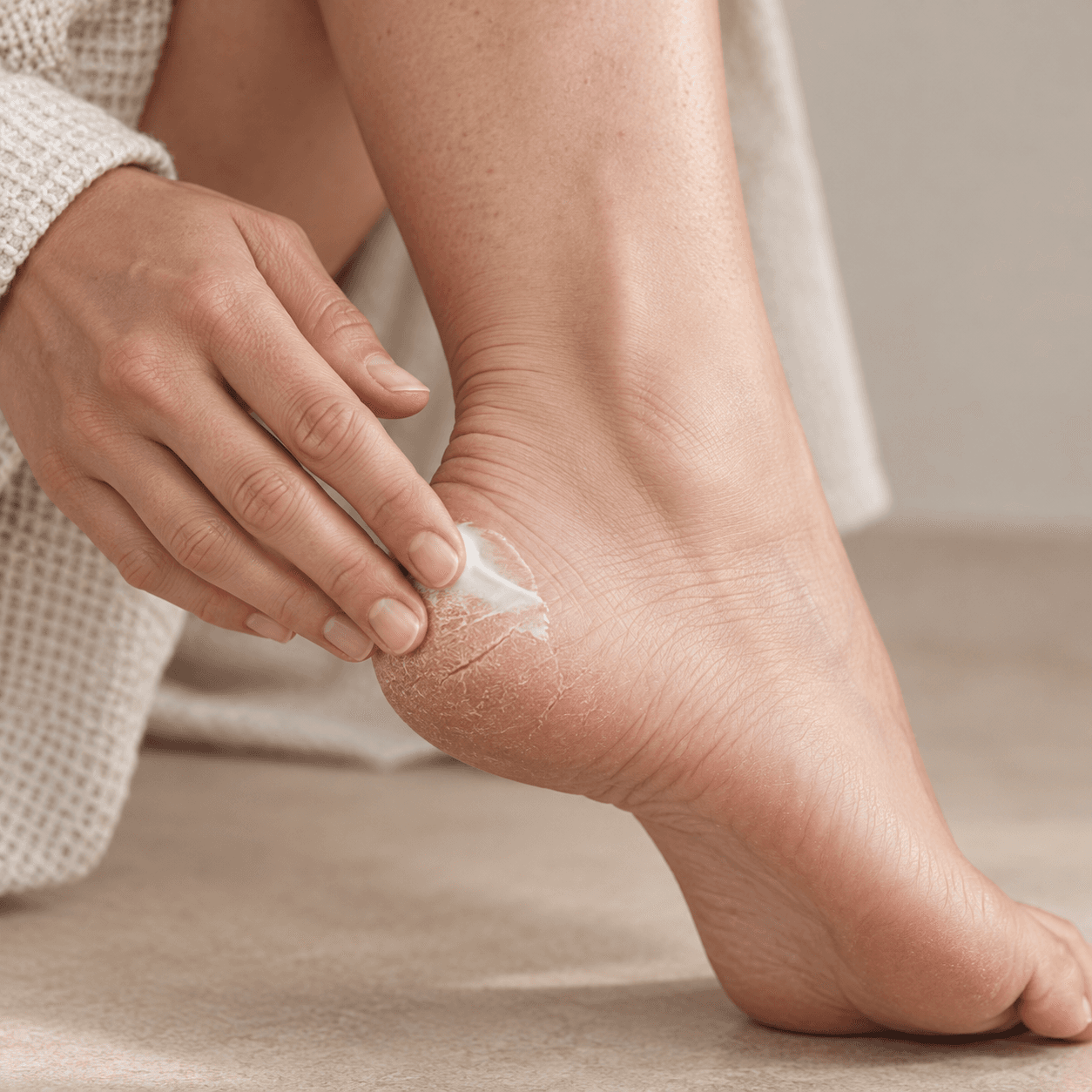
For dry, rough heels, start with regular moisturising and shoes that support the heel. Plain petroleum jelly at bedtime is one option; a suitable heel cream can help with thickened skin.[1] An open or painful crack deserves more attention than a rough patch.
I would start by looking at the skin before buying the strongest foot cream. A heel that catches on your socks and a split that hurts with every step need different decisions. You do not have to make your feet photograph-ready. Comfortable walking is a much more useful goal.
Check the crack before treating the dryness
If you have diabetes, contact your doctor or podiatrist about dry, cracked foot skin rather than waiting for your next routine appointment. Diabetes can affect sensation and blood flow, so a foot injury may go unnoticed or heal poorly.[2]
Known poor circulation or reduced feeling in your feet also deserves an individual care plan. Do not use this guide as permission to file away calluses or start strong peeling products.
Get prompt advice for a deep or bleeding crack, pain when walking, swelling, redness or a sore that is not healing. Severe heel fissures can become infected.[3] Those are reasons to have someone examine your foot, even if the rest of your skin feels fine.
The routine below is for uncomplicated dry, intact heel skin. Keep treatment of an open wound separate.
Why heels become dry and split
A dry, thick rim of callus often forms first. When you stand, the pad beneath the heel spreads sideways. That movement can split the hardened skin around it. Long periods standing on hard floors and shoes without heel support can contribute.[3]
This explains why moisturiser is only part of the answer. Think about the shoes you wear through the longest part of your day, including slippers. A cream applied at night cannot change the fit of a shoe you wear all afternoon.
Dryness elsewhere may fit a broader dry-skin pattern. But repeated heel cracks can also accompany conditions such as eczema or psoriasis.[3] You cannot identify the cause from the depth of a crack or the colour of the callus alone.
Choose a cream for intact heel skin
Urea helps skin hold water and softens its hardened outer layer.[4] That combination makes it useful when the heel feels both dry and thick. The American Academy of Dermatology lists creams with 10-25% urea among its heel-care options.[1]
Keep the distinction between thick skin and broken skin clear. DermNet advises against applying urea preparations to cracked or bleeding skin, infected or oozing areas, or severely reddened skin. Urea can also sting.[4] Use it on the intact dry areas, follow the label and ask a pharmacist or clinician what belongs on an actual fissure.
A 2021 trial randomly assigned 60 adults aged 20-35 to a placebo cream, 5% urea cream or 20% urea cream. The 20% formula improved measured foot hydration compared with placebo, but the comparison between 5% and 20% was not statistically significant.[5]
This was a hydration study, not proof that a particular strength closes heel wounds. It also does not establish that higher percentages always work better. I would choose a product you can use comfortably according to its instructions before chasing the largest number on the tube.
Fit heel care into an ordinary evening
Keep bathing brief and use a gentle cleanser. After washing, apply your heel moisturiser while the skin is still slightly damp. Before bed, plain petroleum jelly is an option for dry heels; socks help keep it off your sheets. These are practical steps recommended by the AAD.[1]
Dry carefully between your toes and leave those spaces free of cream. The CDC includes that distinction in its foot-care advice because moisture between the toes can encourage infection.[2] Moisturising a dry heel does not mean coating every part of the foot.
Put the tube somewhere that fits the habit: beside your evening socks, for example. A routine that requires a foot bath, three products and a spare half-hour is easy to abandon on a Tuesday.
Use the amount and frequency on the label. If the product burns or leaves the skin more irritated, stop using it and ask for advice. Applying another layer is not a useful way to test whether discomfort will disappear.
Be careful with files, blades and peeling products
Gentle pumice use can remove some excess callus on otherwise healthy, intact skin. Cutting thick skin with scissors or a razor at home risks taking too much off and causing infection.[3] Leave blades out of the bathroom routine.
Do not file directly over a crack, bleeding area or sore patch. If you have diabetes, the CDC advises against removing corns or calluses yourself or using over-the-counter removal products.[2] Poor circulation or reduced sensation is also a reason to get professional advice first.
I would leave strong peeling socks out of a routine for already cracked heels. You need to see whether the skin is improving, and adding a large-area peel makes that harder to judge. A podiatrist can assess how much hard skin needs removing and whether pressure relief would help.
What can you expect from moisturising?
Research supports care over time, but it does not justify an overnight repair promise. A 2017 trial studied 167 people with diabetes and a deep heel fissure. Participants used a cream containing urea, glycerine and petrolatum, or placebo, for four weeks.[6]
Complete healing of the target fissure occurred in 46.3% versus 33.3%, a difference that was not statistically significant. Several secondary measures, including persistence of a deep open fissure and dryness, favoured the test cream. Several authors listed an affiliation with the Pierre Fabre research institute.[6]
That is evidence about one formula in a particular patient group. It cannot tell us that every urea cream heals cracks, or that people with diabetes should treat open wounds on their own. It also gives no reason to expect the same result after one night.
For mild dryness, watch for a more comfortable, less rough heel rather than counting how much skin peels away. If there is no improvement after a week of home care, DermNet recommends seeing a podiatrist. Seek help sooner for worsening symptoms.[3]
Keep the care going when your heels feel better
Well-fitting shoes with heel support and continued moisturising help address the conditions that allowed the skin to crack.[1] You may need to rethink an everyday shoe as much as the cream beside your bed.
My preference is a small habit you can repeat: check your feet, care for the dry skin and take a painful split seriously. You can leave the elaborate pedicure for another day.
People also ask
What can I put on dry heels overnight?
For uncomplicated dryness, plain petroleum jelly is a simple bedtime option. Socks can protect your bedding. A deep, bleeding or painful crack needs assessment, and diabetes or reduced foot sensation changes what is safe to manage yourself.
Is urea cream suitable for cracked heels?
Urea helps dry, thickened heel skin retain water and soften. The AAD lists 10-25% urea creams among heel-care options. Do not apply urea to open, bleeding, infected or oozing skin unless your clinician specifically directs you to do so; follow the product label.
Should I file or cut off the hard skin?
Never cut heel callus with scissors or a blade. Gentle pumice use may suit intact callus in otherwise healthy feet, but avoid filing cracked, sore or bleeding skin. If you have diabetes, poor circulation or reduced sensation, ask your foot-care professional before removing hard skin.
When should I get cracked heels checked?
Get advice promptly for deep or bleeding cracks, pain when walking, redness, swelling or a sore that is not healing. With diabetes, report dry, cracked foot skin without waiting for a routine appointment. Otherwise, see a professional if a week of gentle home care brings no improvement.
Keep reading
Citations
- American Academy of Dermatology. How to care for dry, cracked heels. Updated January 31, 2022. Accessed October 15, 2026.American Academy of Dermatology
- Centers for Disease Control and Prevention. Your Feet and Diabetes. May 15, 2024. Accessed October 15, 2026.Centers for Disease Control and Prevention
- Ngan V. Cracked heel. DermNet. 2006. Accessed October 15, 2026.DermNet
- Ngan V. Urea. DermNet. 2005. Accessed October 15, 2026.DermNet
- Cobos-Moreno P, Astasio-Picado Á, Martínez-Nova A, Sánchez-Rodríguez R, Escamilla-Martínez E, Gómez-Martín B. Influence of creams with different urea concentrations on plantar skin hydration. Journal of Tissue Viability. 2021;30(4):608-611. doi:10.1016/j.jtv.2021.05.001.PMID 34090765
- Gin H, Rorive M, Gautier S, Condomines M, Saint Aroman M, Garrigue E. Treatment by a moisturizer of xerosis and cracks of the feet in men and women with diabetes: a randomized, double-blind, placebo-controlled study. Diabetic Medicine. 2017;34(9):1309-1317. doi:10.1111/dme.13402.PMID 28627029