
How to prevent skin chafing and care for sore skin
Sore skin where thighs, clothing or straps rub needs less friction. Learn how to prevent chafing, care for a small rubbed patch and recognise a rash that needs assessment.
On this page
To prevent skin chafing, reduce repeated rubbing, change damp clothing and protect a known trouble spot before activity. A little petroleum jelly can help where skin or fabric keeps catching. Once the area hurts, give it a break from that friction.[1]
I would check the seam before buying another cream. If the same edge rubs your upper arm with every step, a more elaborate skincare routine will leave the main problem in place. The useful question is simple: what keeps touching this sore patch?
What chafing means
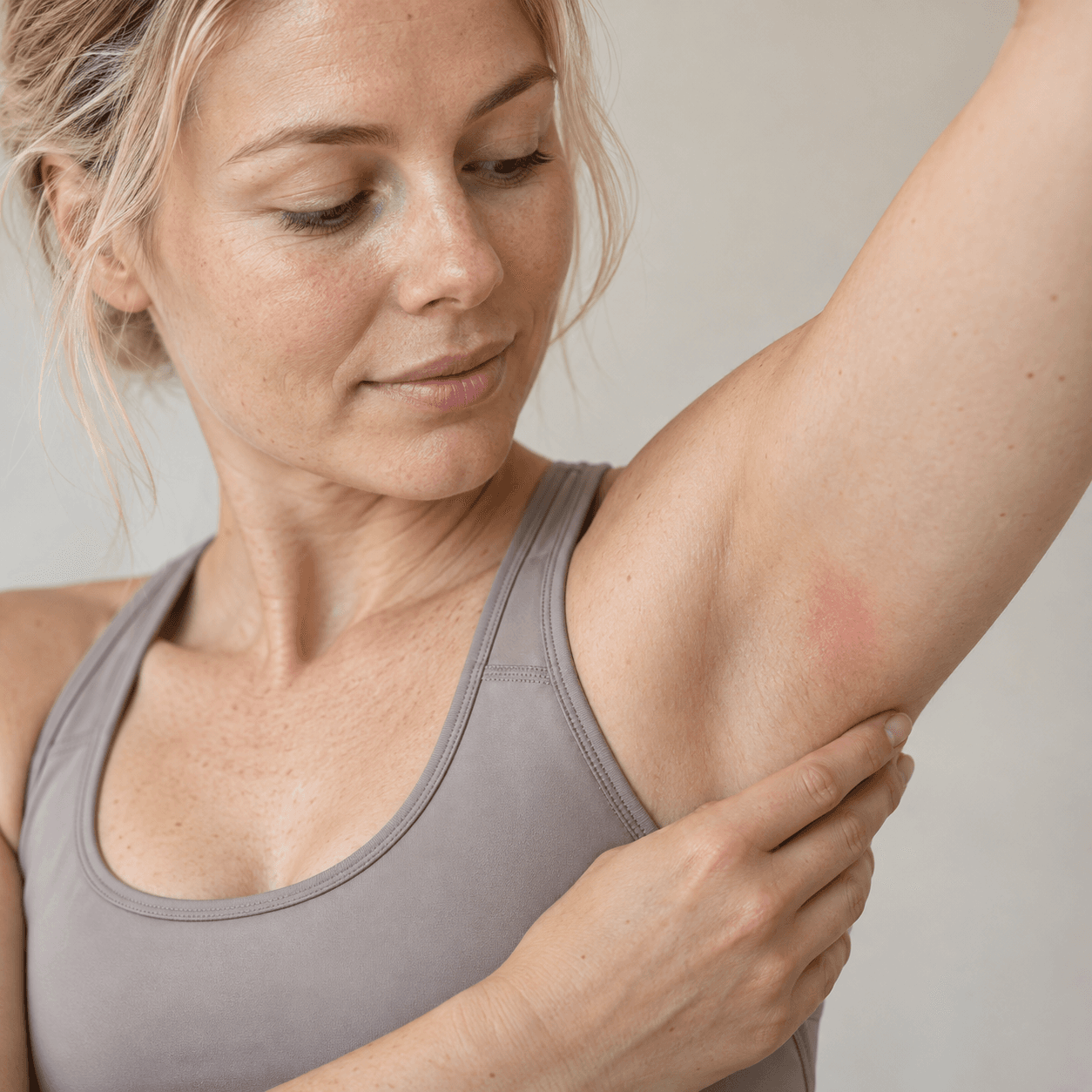
Chafing is irritation from skin rubbing against skin, clothing or another surface. Inner thighs and upper arms are familiar examples; a waistband or sports-top edge can create its own trouble spot. MedlinePlus recommends matching your clothing to the activity and keeping it clean and dry.[1]
Notice the pattern. Does discomfort appear along one seam, during a long walk or after time in damp exercise clothes? Those details help you change the exposure. They do not prove that every rash in the same area is chafing.
Small clogged pores or pimples after exercise are a different question, covered in preventing workout breakouts. This guide concerns rubbed, uncomfortable skin. An acne treatment is not the next thing I would put on a raw patch.
Why damp skin and fabric can make rubbing worse
A 2008 experiment measured friction between the inner forearm and a hospital textile in 22 adults. Researchers found that friction increased with skin hydration. With completely wet fabric, measured friction was more than twice that of natural skin against dry fabric.[2]
This was a controlled experiment, not a trial of running shorts, anti-chafing balms or skin healing. It helps explain why moisture matters, but it cannot rank clothing brands or predict exactly when your thighs will become sore.
The practical interpretation is to pay attention when fabric stays wet and rubs. It is not a reason to deliberately dry out your skin with alcohol or skip everyday moisturiser. Normal skin hydration and spending an afternoon in a damp, rubbing garment are different situations.
Choose clothing around the spot that rubs
For sweaty activity, the American Academy of Dermatology recommends moisture-wicking clothing and cautions that cotton can hold sweat. It also recommends stopping when rubbing causes pain or discomfort, before a blister develops.[3]
Fit deserves as much attention as the fibre label. A garment can feel soft in your hand and still have an irritating edge. Before a longer outing, walk around in it, sit down and move your arms. Check whether the fabric rides up, bunches or presses into the exact place that usually becomes sore.
For thigh rubbing, clothing that separates the touching surfaces can be useful. MedlinePlus gives athletic tights and cycling shorts as examples of clothing chosen for the activity.[1] You do not need to turn every walk into a sportswear shopping trip. Start by checking what you already own.
If one pair works and another repeatedly causes soreness, note the difference: leg length, seam position, fabric or fit. That comparison is more useful than assuming your skin needs to become tougher.
Use a small amount of friction protection
The AAD recommends petroleum jelly on chafing-prone places such as the thighs or feet.[4] Apply a little to the local trouble spot before the rubbing begins. Plain petrolatum is an option; an expensive balm is not a requirement.
Keep the purpose specific. You are helping two surfaces move past each other more comfortably. This advice does not mean covering every sweaty or acne-prone area in a thick ointment.
Try changes on an ordinary short outing first. A new product, new shorts and a much longer walk on the same day make it difficult to know what helped or irritated you. Stop a product if it stings or causes a new rash.
If you are considering tape for a recurring spot, remember that adhesives can cause their own reactions. The bandage-rash guide explains that separate problem. Putting adhesive over already irritated skin deserves care.
Care for a small sore patch
Remove the rubbing garment and avoid repeatedly testing the sore area with your fingers. Gently clean it and pat it dry. Petroleum jelly can be used on minor chafed areas while they recover.[1] Skip scrubs, exfoliating acids and fragranced experiments on that patch.
If rubbing has caused a small superficial break in the skin, use basic wound care. The AAD advises gentle washing, petroleum jelly and a sterile covering for minor wounds. It recommends against routine topical antibiotic ointment because these products can irritate skin.[5] Ask a pharmacist about a suitable dressing if the location makes covering it difficult.
A blister needs protection too. Avoid deliberately popping it, keep it covered and pause the activity that caused it until it has healed.[3] Get help with a large, very painful blister rather than improvising with a needle.
Check how daily movements affect the area. If your usual walk still hurts at the same spot, change the route length, clothing or activity while the skin recovers. A product does not cancel continued rubbing.
A persistent skin-fold rash needs another look
A rash under the breasts, in the groin or another fold can involve more than friction. DermNet uses the term intertrigo for inflammation in these areas and explains that infections and other skin conditions can contribute. Treatment depends on the cause.[6]
Arrange assessment if the rash persists after you remove the rubbing, keeps returning or develops an unusual smell or discharge. A clinician may need to examine it or take a sample. Do not assume that every damp rash needs an antifungal, or borrow a strong steroid cream: potent steroids can damage the thin skin in folds.[6]
Seek urgent medical advice if skin becomes hot, painful and swollen, especially if you feel unwell. These are possible signs of cellulitis. Redness can be less obvious on brown or black skin, so warmth, swelling and pain matter too.[7]
For straightforward chafing, my approach stays small: find the rubbing, protect the spot and allow it to recover. That fits the simple-care philosophy behind Danish Skin Care. You should be able to enjoy a walk without making your bathroom shelf responsible for an uncomfortable seam.
People also ask
What helps prevent chafing between my thighs?
Reduce skin-to-skin rubbing with comfortable clothing that stays in place. A little plain petroleum jelly on the trouble spot before activity can help. Change damp clothing and pause if the skin starts to hurt.
Is petroleum jelly useful for chafing?
Yes. Dermatology guidance recommends it to reduce friction on chafing-prone areas. Apply it locally rather than coating your whole body. It does not treat every rash in a skin fold or replace care for an infection.
Should I exfoliate skin that has chafed?
No. Avoid scrubs and exfoliating acids on the sore area. Reduce rubbing and use gentle care while it heals. A raw patch needs protection, and broken or infected skin may need advice from a pharmacist or clinician.
When should I get help for a chafing rash?
Get advice if it does not improve after you remove the rubbing, keeps returning, develops pus or becomes increasingly painful or swollen. Seek urgent assessment for skin that is hot, painful and swollen, especially if you feel unwell.
Keep reading
Citations
- MedlinePlus. Chafing. Reviewed July 3, 2025. Accessed October 22, 2026.MedlinePlus
- Gerhardt LC, Strässle V, Lenz A, Spencer ND, Derler S. Influence of epidermal hydration on the friction of human skin against textiles. J R Soc Interface. 2008;5(28):1317-1328. doi:10.1098/rsif.2008.0034.PMID 18331977
- American Academy of Dermatology. How to prevent and treat blisters. Updated July 6, 2026. Accessed October 22, 2026.American Academy of Dermatology
- American Academy of Dermatology. 5 ways to use petroleum jelly for skin care. Accessed October 22, 2026.American Academy of Dermatology
- American Academy of Dermatology. How to treat minor cuts. Updated February 11, 2022. Accessed October 22, 2026.American Academy of Dermatology
- Oakley A, Dennis J. Intertrigo. DermNet. Updated November 2018; copy edited January 2020. Accessed October 22, 2026.DermNet
- NHS. Cellulitis. Accessed October 22, 2026.NHS