
How to care for sunburned skin: cooling, comfort and warning signs
A practical guide to caring for mild sunburn, choosing simple moisturising care, leaving peeling skin alone and recognising symptoms that need medical help.
On this page
When skin already hurts, I want a routine to ask less of it. That is the approach I take at Danish Skin Care, and it matters when your face or shoulders feel sore after a day outside. Start by getting indoors. The first decision is whether simple home care fits your symptoms or whether you need medical help.
For mild sunburn, cool the skin, use an unperfumed moisturiser if comfortable and protect the area from further sun. These are symptom-care steps recommended by the NHS; they are not an overnight repair treatment.[1] There is no need to assemble a new shelf of products this evening.
Check the warning signs first
Seek urgent medical advice if sunburn causes blisters or swelling, or if you have fever, chills, dizziness, nausea, headache or muscle cramps. A baby or young child with sunburn also needs urgent advice. The NHS includes these situations in its sunburn warning signs.[1] Use the urgent-care service where you live or are travelling.
Confusion, a seizure, loss of consciousness or other signs of heatstroke require emergency help. Someone who remains unwell after 30 minutes of cooling, rest and fluids also needs emergency assessment under NHS guidance.[2] Do not spend that time comparing aftersun gels if the person already has emergency symptoms.
Those thresholds come before the rest of this guide. If you are caring for someone else, ask how they feel overall rather than looking only at the colour of the burn. On brown or black skin, a colour change can be less obvious even when the skin feels hot and painful.[1]
Cool the skin without rubbing it
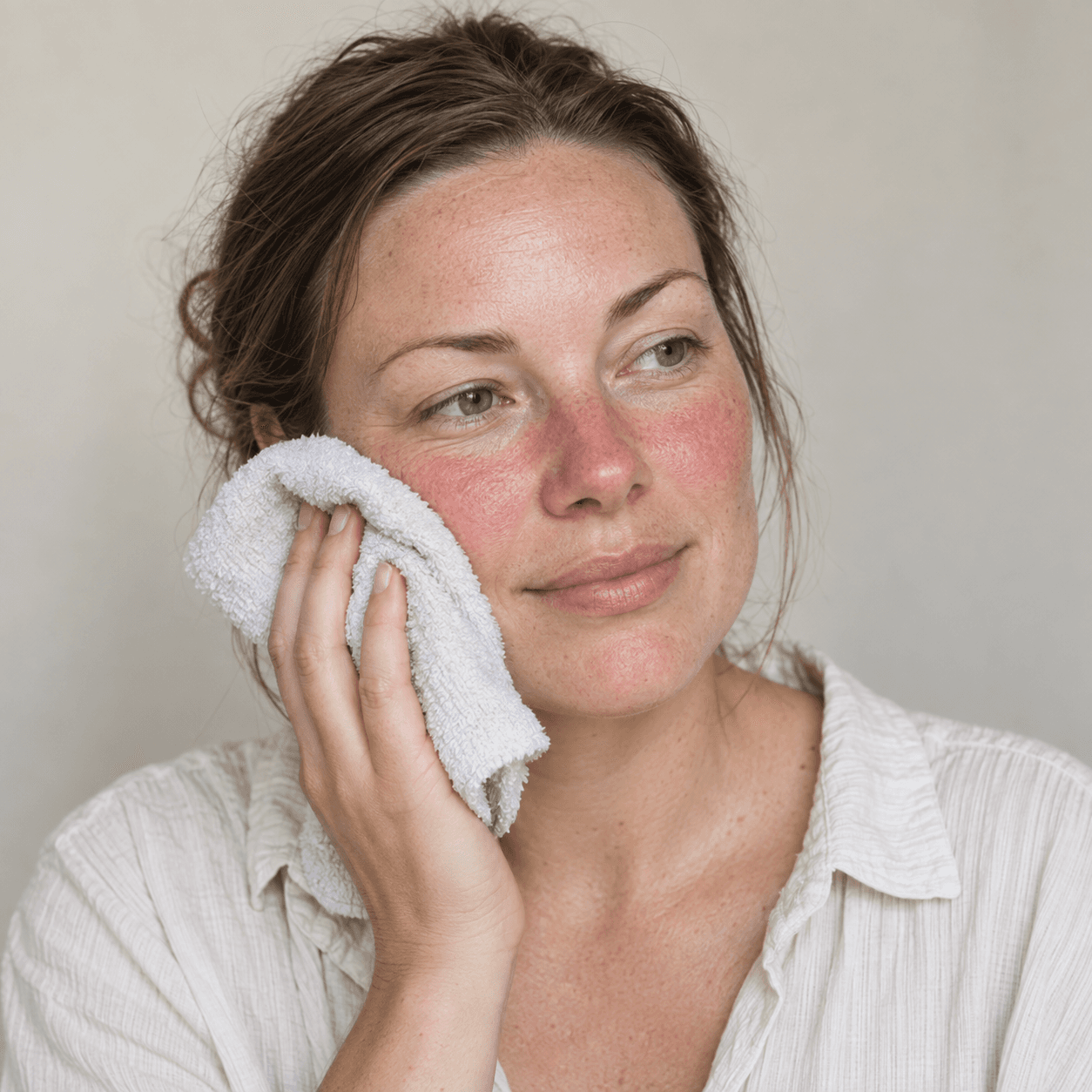
Once you are out of the sun, try a cool shower or lay a clean, cool damp cloth gently over the sore area. The American Academy of Dermatology recommends cool baths or showers and gentle patting dry to ease discomfort.[3] Choose whichever is easiest for the part of your body that hurts.
Make a little space for this. Put a clean towel within reach and take off anything that presses on the affected area. A shoulder strap that usually feels fine may be the last thing you want against sore shoulders. Loose clothing is the more comfortable option; the NHS advises against tight clothes over sunburn.[1]
Do not put ice or an ice pack directly onto sunburned skin.[1] Cooling does not need to feel intense to count. A washcloth should rest against the skin, not become a way to scrub away redness. If you need advice about pain relief, a pharmacist can help choose an appropriate option; follow the medicine's instructions.[1]
Choose comfortable moisturising care
An unperfumed moisturiser is a reasonable option on intact, mildly sunburned skin. The AAD also suggests moisturisers containing aloe vera or soy for soothing comfort, applied while skin is still damp.[3] That recommendation does not mean every product with aloe on the label performs identically, or that an aloe gel reverses sun damage.
Start with a familiar product if you already have one that fits. There is no prize for using a new botanical blend because the bottle says “after sun”. If applying it makes the area more uncomfortable, stop and ask a pharmacist about suitable care. You do not have to finish the application because you bought the product for this purpose.
Keep a glass of water nearby and drink regularly. Both NHS and AAD sunburn guidance recommend water to help prevent dehydration.[1][3] Think about the rest of the evening too: somewhere cool to sit, comfortable clothing and a plan that does not take you back into direct sunlight.
Leave peeling skin and blisters alone
Peeling can appear several days after sunburn. The NHS advises leaving loose skin alone and not bursting blisters.[1] Do not turn peeling into an exfoliation task. A flake catching the light in the mirror does not need to be removed before you can leave the bathroom.
For this recovery routine, set aside scrubs, exfoliating acids and retinoids on the affected area. That is a practical way to keep the routine limited to comfort while skin is sore, rather than a claim that a particular pause length has been proven in a trial. Ask the prescriber what to do if a prescribed treatment normally goes there.
Blistering changes the plan: get medical advice. Guidance about ointments differs by context. The NHS advises against petroleum jelly on sunburn, while the AAD describes it for protecting blisters.[1][3] Rather than applying a general facial “slugging” routine to a burn, ask the clinician how to care for your specific blistered or broken skin.
What about hydrocortisone or a stronger treatment?
Steroid-cream evidence is more limited than a confident social-media tip suggests. In a 2008 randomised study, researchers exposed small areas of the backs of 20 healthy volunteers to UVB. Moderate- or high-potency corticosteroids applied six or 23 hours later did not provide clinically useful improvement in the acute sunburn reaction.[4]
A different small trial, published in 2002, studied 24 volunteers with skin type III. It reported benefits with two corticosteroid preparations used twice daily over seven days, with significant differences from untreated skin on days four to five.[5] The studies used different protocols; neither gives a universal home-treatment recipe for a burned face.
My practical conclusion is to ask a pharmacist or clinician before adding a steroid cream for sunburn. Do not borrow a prescription or assume a stronger cream means faster recovery. These experiments do not establish that treating the visible reaction cancels the UV exposure that caused it.
Give tomorrow's routine less to do
Mild sunburn often improves within a week, according to the NHS, but that is a general expectation rather than a deadline for every burn.[1] If symptoms worsen or you are unsure about the severity, get advice instead of waiting for a calendar reminder to expire.
Keep the affected skin covered from direct sunlight until it has healed.[1] For future days outdoors, the AAD recommends shade, sun-protective clothing and broad-spectrum, water-resistant SPF 30 or higher on uncovered skin.[3] Sunscreen is one part of that plan; it does not make another afternoon of direct exposure harmless.
The guide to tanning with sunscreen explains why a change in colour is not proof of complete protection. For the next outing, review when to reapply sunscreen before you pack your bag.
For now, keep the task small: arrange comfortable care, leave peeling skin alone and change tomorrow's plans if they mean more sun on the burn. That is enough skincare work for one evening. If the symptoms need medical help, let that be the next step.
People also ask
Can I make sunburn disappear overnight?
No reliable overnight fix is established. Cool the skin, use comfortable moisturising care and prevent more sun exposure. Mild sunburn often improves within a week, but blistering or feeling unwell needs medical advice.
Do I need a special aftersun product?
An unperfumed moisturiser is an option for mild sunburn on intact skin. You do not need a separate aftersun purchase. Stop using a product that adds discomfort and ask a pharmacist if care is difficult.
Should I remove peeling skin?
Do not pick, scrub or pull it away. Leave blisters intact too. Seek urgent medical advice for blistering or swelling rather than treating those changes as a normal exfoliation stage.
When does sunburn need medical attention?
Get urgent advice for blistering, swelling, fever, chills, dizziness, headache, nausea or cramps, and for a baby or young child with sunburn. Confusion, seizures, collapse or other signs of heatstroke require emergency help.
Keep reading
Citations
- NHS. Sunburn. Reviewed November 24, 2025.NHS
- NHS. Heat exhaustion and heatstroke. Reviewed May 28, 2026.NHS
- Ludmann P, Schleehauf B. How to treat sunburn. American Academy of Dermatology. Updated May 20, 2024.American Academy of Dermatology
- Faurschou A, Wulf HC. Topical corticosteroids in the treatment of acute sunburn: a randomized, double-blind clinical trial. Arch Dermatol. 2008;144(5):620-624. doi:10.1001/archderm.144.5.620.PMID 18490588
- Duteil L, et al. A randomized, controlled study of the safety and efficacy of topical corticosteroid treatments of sunburn in healthy volunteers. Clin Exp Dermatol. 2002;27(4):314-318. doi:10.1046/j.1365-2230.2002.01033.x.PMID 12139679