
How to care for a foot blister from rubbing shoes
Leave an intact foot blister alone. If it has burst, clean it and keep the loose skin in place. Here’s how to cover it, spot infection and find the part of your shoe that rubs.
On this page
Take off the shoe that rubbed your foot. If the blister is closed, leave it closed and cover it with a soft plaster or padded dressing. If it has split, wash your hands, let the fluid drain and clean the area gently. Keep the thin flap of skin in place: it protects the tender skin underneath.[1]
If you have diabetes, call your foot care team or doctor straight away about a new foot blister. Diabetes UK advises urgent assessment within 24 hours, even if you can walk on it without pain. Use an out-of-hours service if you cannot reach your usual team.[2]
Why does one spot on the foot blister?
Think about the back of a shoe that catches your heel each time you lift your foot. With every step, the surface of the skin and the tissue beneath it move a little differently. Repeated pulls can create a small split within the skin. Clear fluid collects in that space and lifts a thin layer of skin into a bubble. Damp skin can blister sooner.[3]
The first thing you notice may be a sting, well before you see a bubble. Stop there and check the skin. Run a finger along the inside of the empty shoe at the same height. A stiff edge, a bunched sock or a little grit can be easy to miss when you only look down into the shoe.
A broad, sore patch where your thighs or clothing rub may never develop a pocket of fluid. That is a slightly different problem, covered in the guide to preventing skin chafing.
How to protect a blister that is still closed
Gently wash the area and pat it dry. Choose a soft dressing wide enough for its sticky edges to land on healthy skin on either side. The middle should sit loosely over the blister. If pulling your sock on squeezes the dressing hard against your heel, that pair of shoes still has too little room.
A blister under the ball of the foot has a different problem: you press on it every time you stand. The American Academy of Dermatology suggests cutting a hole in a piece of soft padding, placing the padding around the blister and putting a dressing over both.[4] The sore spot sits in the hole. If the pad presses directly on the bubble, it is in the wrong place.
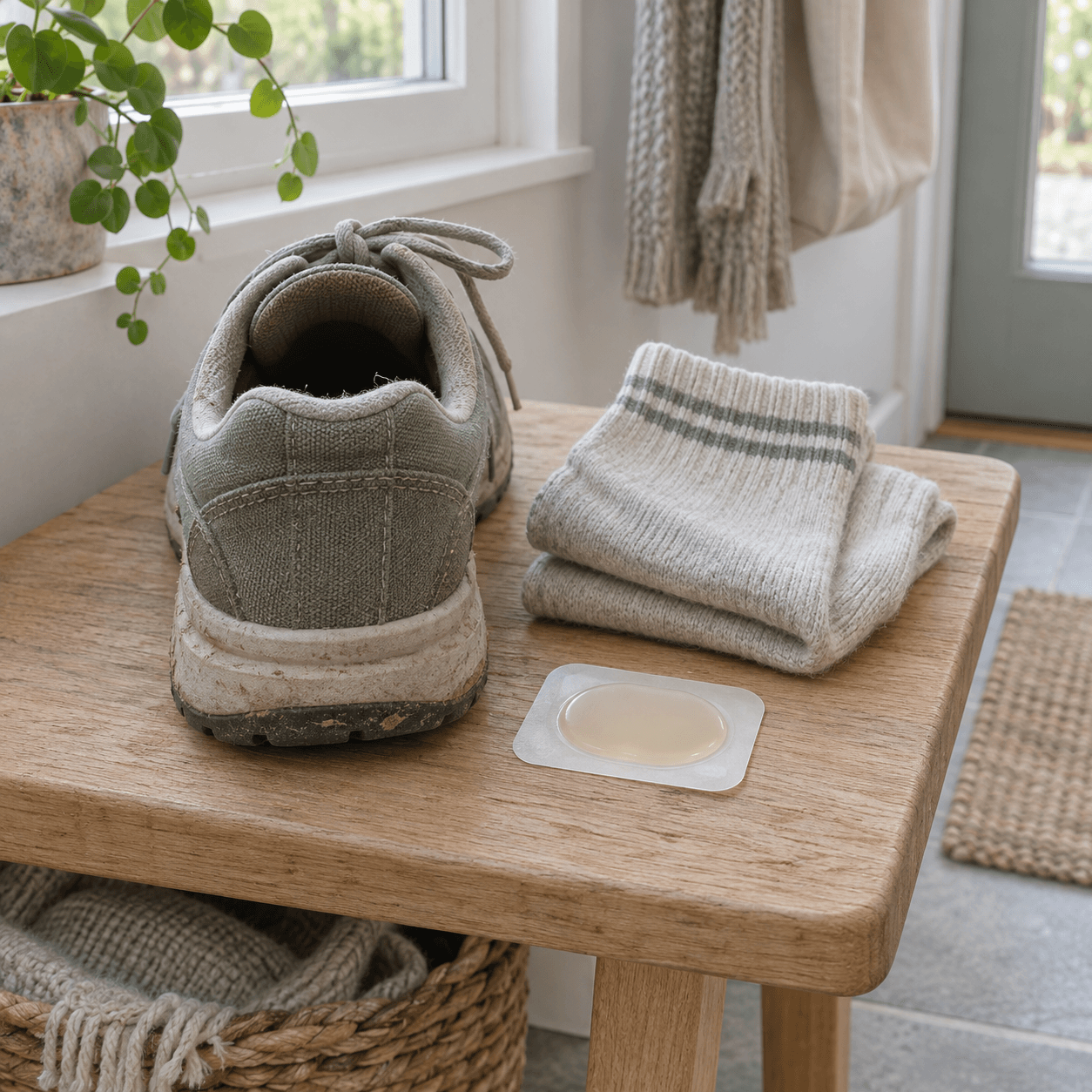
For a straightforward blister, a pharmacist can also help you choose a hydrocolloid plaster. It cushions the area and may ease pain.[1] Follow the instructions for that dressing. Less pain under a plaster does not mean the skin has healed enough for the shoes that caused it.
What to do if it bursts in your sock
Ease the sock off without tugging the loose skin. Wash your hands before touching the blister, let the fluid run out on its own, then gently wash with soap and water. Pat dry and cover with a clean dressing. Leave the attached skin where it is, even if the blister now looks flat and wrinkled.[1][4]
There is no need to squeeze out the last drop or pull at the edge to see what lies beneath. If the dressing gets dirty or comes loose, replace it with a clean one. When changing it, look at the surrounding foot as well as the small open patch. Increasing tenderness or swelling matters even if the opening itself looks no larger.
When a foot blister needs medical care
Get urgent medical advice if the area grows hot or swollen, the pain worsens, redness spreads or there is yellow or green pus. Redness may be harder to see on brown or black skin; changes in warmth, swelling and pain are useful clues. A very painful blister, one that keeps coming back, or several blisters with no obvious cause also deserve prompt assessment.[1][4]
An ordinary shoe blister often improves over the next few days and may heal within a week, though some take a week or two.[1][4] If it is getting worse, do not wait for that time to pass. And if you have diabetes, do not use pain as your guide: changes in the nerves can make a new foot injury difficult to feel.[2]
How to stop the same shoe rubbing again
Wait until the skin heals before trying the shoes again. Start with the socks you actually plan to wear. A shoe can feel comfortable with thin socks in a shop and leave little space for the thicker pair you wear on a hike. If the heel slides up and down or the toes are pressed against each other, look at the fit before adding more padding.
For a long day on your feet, choose socks that draw moisture away from your skin and pack a dry pair if yours tend to get soaked. Wear new shoes for a short outing first. A walk around the block gives you a chance to turn back when a spot starts to sting; an all-day shift gives you fewer choices.[1][4]
Does paper tape prevent foot blisters?
Two trials in ultramarathon runners asked slightly different questions. In the first, researchers put paper tape on common trouble spots on one foot and compared it with the other foot. Of the 136 runners who enrolled, 90 provided complete data. The study found no clear protective effect.[5]
In a later trial, researchers enrolled 128 runners in multiday desert races and usually taped spots where that individual had blistered before. They found fewer blisters at the taped sites than elsewhere on the same foot. More skin was uncovered than covered, which limits that comparison.[6]
Both studies tested prevention before an endurance race. Neither shows that taping a burst blister makes it heal faster. If you know exactly where a shoe tends to rub intact skin, a little protective padding may be useful. If the adhesive itself leaves an itchy outline, see the guide to a rash after an adhesive bandage. And if a shoe rubs in the same place on every short walk, change the shoe before you buy another roll of tape.
People also ask
Should I pop a blister on my heel?
Leave it closed. The skin over the fluid protects the tender surface below. Cover it and avoid the shoes that caused it. If it is large and very painful, get medical advice about treatment.
What should I do if a foot blister has already burst?
Wash your hands, let fluid drain on its own and gently wash the area. Leave the remaining skin in place, pat dry and cover the blister with a clean dressing.
Can I put a blister plaster on it?
A soft plaster or padded dressing can shield it from rubbing. A hydrocolloid blister plaster is one option for an uncomplicated blister. Seek medical advice if the skin feels hot or swollen or you see pus.
When can I wear the shoes that gave me a blister again?
Wait until the blister has healed, then check where the shoe rubs before wearing it again. Try a short outing first. If the same spot begins to sting, stop and change shoes.
What if I have diabetes and my foot blister doesn't hurt?
Call your foot care team or doctor straight away and arrange assessment within 24 hours. Reduced feeling can hide an injury. Use an urgent out-of-hours service if your usual team is unavailable.
Keep reading
Citations
- NHS. Blisters. Reviewed November 22, 2023. Accessed November 12, 2026.NHS
- Diabetes UK. Serious foot problems and diabetes. Reviewed December 24, 2024. Accessed November 12, 2026.Diabetes UK
- Oakley A. Friction blister. DermNet. 2013. Accessed November 12, 2026.DermNet
- American Academy of Dermatology. How to prevent and treat blisters. Updated July 6, 2026. Accessed November 12, 2026.American Academy of Dermatology
- Lipman GS, Ellis MA, Lewis EJ, Waite BL, Lissoway J, Chan GK, Krabak BJ. A prospective randomized blister prevention trial assessing paper tape in endurance distances (Pre-TAPED). Wilderness Environ Med. 2014;25(4):457-461. doi:10.1016/j.wem.2014.06.013.PMID 25443754
- Lipman GS, Sharp LJ, Christensen M, et al. Paper Tape Prevents Foot Blisters: A Randomized Prevention Trial Assessing Paper Tape in Endurance Distances II (Pre-TAPED II). Clin J Sport Med. 2016;26(5):362-368. doi:10.1097/JSM.0000000000000319.PMID 27070112